

Stanford - East
This section covers the 62 properties in the Stanford area to the east of the Aldershot Road, ie Upper Stanford Road, Bridgemead, Stanford Farm, The Royal Oak, Stanford Cottages and the houses nearby on the east side of the road. The properties to the west of the Aldershot Road (eg Stream Farm, Barnhurst, Dingley Dell) are covered in the Stanford - West section
The Stanford area lies a little way away from the nucleus of Pirbright, and therefore it is not surprising that there was quite a lot of intermarriage between Stanford-based families, especially in the late 1800s and early-mid 1900s. This can make the history a little hard to follow at times, for which we apologise (although we must respectfully point out that it’s not our fault). 2 families dominated the Stanford area (both East and West sides) during that period: The Frys and the Avenells. The reader will find plenty of references to both families in the text.
We will work our way from east to west. We have shown an extract from the current OS Map (with thanks) and a table showing when each property was built.


The Early days to 1841
But first we will look at the early history of Stanford, covering both east and west sides of the Aldershot Road from the earliest days up to 1841.
The Stanford part of the Rocque map of 1763 is quite difficult to match to today’s environment, but we will try. Here is the Stanford area as drawn by Mr Rocque:

A few points of interest:
-
The junction of the Henley Park Road with the Ash Road from Bakersgate are today in quite a different position to that shown. The position of today’s junction would be near the “n” of “Green”. Likewise, today’s road to Normandy is now north of the 3 properties shown. On the map, the right-hand fork after the stream goes west to Aldershot and the left-hand one, still partly visible on the satellite image as a track, leads directly to the lodge and carriage drive of Henley Park.
-
The 3 buildings near the centre of the map represent (left to right) what are today Stanford Cottage, The Royal Oak, and Stanford Farm. They are not quite in the correct locations, although the Stanford Brook is correctly shown as flowing between The Royal Oak and Stanford Farm, as it does today.
-
A 4th building is clearly marked on the left side of the map. A casual observer would assume that this was today’s Stream Farm, but this is not the case. It was in fact a farm called Lussells, which no longer exists. On the ground today we can find no trace of it whatsoever.
-
At the time, each of these 4 dwellings would have been a small farm or smallholding. We have written more about their early history under the sections on each property below.
-
Bakersgate and Pullens Farms are shown on the right side, also out of position, but these are outside the scope of this section.
-
Stanford has a quaint spelling. Maybe Mr Rocque was hard of hearing, or perhaps he couldn’t understand the thick Pirbright accent of the times.
The 1807 map (shown below) is much more helpful. For a start, the tracks (shaded grey) match up pretty well to today’s roads and paths.
The same 4 buildings are shown (ringed in red). All were fairly small:
-
Linnards Farm (12 acres, owned copyhold by George Linnard, furthest right)). We have written about Linnards Farm in detail later in this section.
-
An unnamed farm, (7 acres, owned freehold by Richard Turner, second from right). The farmhouse was sited where the Royal Oak is today.
-
An unnamed 4-acre leasehold held by George Watts (second from left). The farmhouse was sited where Stanford Cottage is today. We have written about Stanford Cottage in detail later in this section.
-
Lussells. By this time, the farm had ceased to be used as a dwelling. Only a barn existed. We have written about the history of Lussells in the Stanford West section.


We have colour-coded this map by owner/tenant right. (For simplicity, we have only shown the map of the Stanford – East properties. For the Stanford – West properties such as Stream House, please see the Stanford Road – West section.
It is a real patchwork of fields, with no discernible patterns. In 1807 there were 11 different owner/tenants involved in the area. We have, however, tried to make a bit of sense of it with some comments below the map.
Some observations on all this:
-
The patchwork nature of the fields looks extremely inefficient to our modern eyes. But we should bear in mind that in 1807, much farm labour was manual in nature, meaning that people worked the fields with hoes, scythes, ploughs, etc. However, the reader will not be surprised to learn that many of the small fields have since been consolidated into fewer but larger fields.
-
The area to the east of Stanford was dominated by 2 larger farms: Bakersgate and Pullens, which we have written about elsewhere. Upper Stanford Road was built on land previously part of Bakersgate, and Bridgemead was built on land previously part of Pullens Farm.
-
The Stanford Brook runs off the Ash Ranges in a north-west to south-east direction through the middle of the area. Unsurprisingly, both farms were sited close to the brook.
-
The whole area abuts commonland to the south. This is still the case today.
-
The triangular area adjoining the Aldershot Road to the north, called Stanford Common still exists, although it is now known (on the western side of the road) as Newbridge Common. The only house ever built on this land is Gorselands.
The 3 farms which still existed in the area in 1807 are colour coded as follows:
-
Linnards Farm (12 acres). Coloured red.
-
Richard Turner’s farm, (7 acres). Coloured brown.
-
George Watts’s farm (4-acres). Coloured turquoise.
The remaining 80 acres formed parts of other farms in different areas of Pirbright and were held by 7 different people. We have written about these people below (in decreasing order of acreage):
-
Henry Halsey 2 (dark green). These 22 acres of land, on the northern fringes of Stanford on the west side, abutted Court Farm (which was owned by Henry Halsey 2). We have written more about this in the Court Farm section.
-
Samuel Greenfield III (bright green). These 21 acres formed part of Bakersgate Farm, owned (copyhold) by Mr Greenfield, whose story we have told in the Bakersgate section. During the 1950s, 7 of these 21 acres became the estate where Upper Stanford Road now stands.
-
George Tate (dark purple). These 14 acres (freehold) were part of the Fords Farm estate which George acquired through his marriage to Bridget Moore (nee Ford) in 1775. We have told George’s story in The Fords Farm section.
-
John Collins (orange). These 14 acres (part copyhold and part freehold) were part of the Collins family estate, which centred around Newmans and Burners Farm. We have written about John Collins and his long family background in the Newmans section and in the Collins family section.
-
Mary Giles (or Gyles) (delicate pink). Mary was the widow of Philip Gyles (1724-1803). These 5 acres (as well as what is today Gibbs Acre) were owned copyhold. They were situated where Stream Farm is today. This is covered in the Stanford West section.
-
George Boylett (grey). George was the owner of the small (2-acre) copyhold called Merristwood Mead, a few hundred yards east. We have written about George in the Hockford Cottage section.
-
John Hall (yellow). John was the owner of Pullens Farm (which he held freehold, except for this small outpost of a field at the western end of the farm (which was held leasehold for some unknown reason). This 1-acre field now forms the estate where Bridgemead now stands.
-
Richard Honer (shocking pink). Richard was one of the sons of James Honer I, who had lived at Cawsey House. One of his sons, James Honer II, was the miller at Heath Mill for many years. This 1-acre piece of land (freehold) seems a bit of an outpost for Richard, and we can’t work out how or why he would have acquired it.

The 1841 Tithe map (left) shows that the field pattern was very similar to how it was in 1807. The same 4 dwellings existed. See their individual sections for details of tenants. There were, however, 4 new buildings as follows:
-
No 283. We think that this cottage was originally used as Dog Kennels (and thus referred to as “Dog Kennels”). It was later used to house staff who worked in The Laundry (see bullet below). The 1841 Tithe records show that it was occupied by Charles Colyer, but strangely he does not appear there in the census of that year.
-
No 284. This building was built by Henry Halsey 2, to become The Laundry for Henley Park (where Henry lived). It seems a rather strange place for a laundry, being a mile away from the house, but at least it was near running water. We don’t know what the people living downstream would have thought about it though. Today the site is occupied by Stream House.
We should also mention Nos 235 and 236. These were the remains of the old Lussells property, written about in the Stanford West section. They are coloured black on the map, which means that they were agricultural buildings, rather than dwellings. They disappear from the maps c1900, and no trace of it remains today.
1841 - Present
We will now look at each property in the Stanford – East section in turn from 1841 onwards.
Bridgemead Nos 1-10
For over 100 years, the land on which Bridgemead stands was part of Pullens Farm. It was the field numbered 437, coloured yellow on the multi-coloured map of 1807 shown above.
But in 1912 Pullens was sold to the Board of Agriculture, and from that point onwards, its land was owned by one government department or another. At the same time, the Board of Agriculture also bought 100 acres of Bakersgate farmland (including the fields on which Upper Stanford Road now stands). However, the Board of Agriculture is now long gone, and today, both the entire plots of Bridgemead and Upper Stanford Road are owned by an organisation called UK Research and Innovation, known as UKRI.
Trying to understand what UKRI really does is quite time-consuming and requires skill in cutting through corporate-style waffle and the myriad of the different councils which make up the organisation. In pub language, it is a quango which dishes out £10 billion of taxpayers’ money each year to fund research into important areas like health and net-zero technologies. One of its goals is to help grow the UK economy (in other words the £10 billion is seen as an investment, rather than a cost). It’s worth saying that the UK has had a positive reputation for its research over the years, and most of it is funded by UKRI. The cost of running the Pirbright Institute is one such investment by UKRI.
So it seems that both Bridgemead and Upper Stanford Road, built in the early 1950s, were designed to house staff at the Pirbright Institute. Some staff accommodation had already been built in Bullswater Common Road from 1947, but this seems to have been earmarked for senior staff. (In contrast, more recently, Bridgemead has tended to have been occupied by short-term occupants, including students).
Turning now to Bridgemead, We don’t know for sure when the houses in Bridgemead were built. The first mention of the houses we have found is from October 1951, when an Annette Ponder was baptised in St Michael’s Church. Annette was the daughter of Iris Ponder, who gave her address as No 1, Ash Road, which we think later became No 1, Bridgemead. Iris was a single mother, born in 1929, who had arrived in Pirbright from Hackney, where her daughter had been born a year earlier. She soon moved to Epsom.
This was soon followed by an entry in the school admission records in March 1952 for Barry Jackson, son of Royston and Doris Jackson, who lived at No 6, Ash Road. Royston had been born in 1904 in Warrington, the son of a boot dealer. Doris (nee Gammon) was born in Gillingham in 1902, the daughter of a tobacconist. Roy worked as a railway porter, and then served in the Royal Navy from 1930 until 1940, when he was invalided out. In 1933 he had married Doris in Warrington. They only stayed at No 6 for a short time, and by the following year they were living at Pullens Farm (which was then part of the Pirbright Institute).
Entries in the Electoral Registers during the early 1950s are scarce, suggesting that the occupants tended to be short-stayers. However, by 1955 families were staying a little longer, but few would stay as long as 5 years, and that still seems to hold true today. We have mentioned a few of the longer-serving residents below:
-
John and Doreen Kirkham. John was born in 1926 in Rotherham, the son of a colliery foreman. Doreen (nee Drake) was born at Hemsworth (near Rotherham) in 1930. They married in Hemsworth in 1953, and the couple moved south to Pirbright the following year, settling in No 1, Bridgemead. John became a Scientific Research Officer at Pirbright Institute, and in the 1960s the couple had 3 children. They moved to Blatchford Cottage in Chapel Lane in the mid-1960s. They stayed at Blatchford Cottage until the mid-1980s, by which time John was a University lecturer. They returned to Yorkshire and John died there in 1989.
-
Richard and Joan King. Richard was born at Gurnard on the Isle of Wight in 1921, the son of a market gardener. Joan (nee Perry) was born in 1923 in London, the daughter of a catering supervisor. They married in Worcester Park in 1944 and moved into No 2, Bridgemead c1955. They moved out of Bridgemead in the mid-1960s. They retired to Huntingdon, where Richard died in 1997 and Joan in 2019 (aged 96). We have shown photos of Richard and Joan, right.


Michael and Marian Maskell. They married in April 1965 and immediately moved into No 4, Bridgemead. They moved out sometime in the 1980s. We have shown a press cutting about them from May 1965, left.
-
Bryan and Joy Underwood. Bryan and Joy lived at No 6, Bridgemead c1970. In the late 1980s they moved to No 16, Bullswater Common Road, opposite the Pirbright Institute. By 1991 they had moved elsewhere in Pirbright.
-
Terence (Terry) and Janet Burrows. Terry and Janet moved into No 10, Bridgemead in 1955 and were married at St Michael’s Church later the same year (refer press cutting, right). Terry was a skilled glassworker in the Pirbright Institute. Janet was the daughter of a hairdresser in Connaught Road, Brookwood and after their marriage worked at the Berry Lane Carnation Nursery. They had 2 daughters and stayed at No 10 until c1981. Janet died at Phyllis Tuckwell Hospice in 2000 and Terry returned to his native Wales.

Upper Stanford Road Nos 1-36
Upper Stanford Road was built on land previously part of Bakersgate. It comprised the plots numbered 452, 453, 455 and 457, coloured bright green on the multi-coloured map of 1807 shown above. Plot 457 was, in 1807, a small house for use by Bakersgate employees, but it had disappeared by the time of the 1938 OS map. As we described in the Bridgemead section above, the land on which Upper Stanford Road stands was bought by the Board of Agriculture in 1912. Today it forms a (small) part of the Pirbright Institute plot.
Development proceeded as follows:
-
The first 2 houses (Nos 3-4) were built in 1947.
-
The following year (1948) another 2 houses (Nos 5-6) were built. At this time they were known as the “Virus Research Station Cottages”.
-
In 1954 Nos 1-2 were built and the road was deemed important enough to be given its current name of Upper Stanford Road.
-
A further 20 houses (Nos 7-26) were built the following year (1955).
-
4 more houses (Nos 27-30) were built in the 1960s, and
-
The final 6 houses (Nos 31-36) were built in the 1970s.
As with Bridgemead, they were used to house employees of the Pirbright Institute. And as with Bridgemead, many of the tenants were relatively short-stay, so we have written about a few of the longer-term tenants below (in house number order).
-
Frederick and Hilda Marshall. The Marshall family had, since 1946, been living at No 2, White Cottages (at the Institute), where we have told their story. They had 4 children and then became the first occupants of No 2 from 1955. Perhaps they had asked the powers that be at the Institute for a larger house to accommodate their 4 children (the eldest of whom was in her twenties). If so, it seems to have worked. However, Hilda died in 1959, aged 55. Frederick remained at No 2 and died in 1973, aged 67.
-
Dominic and Violet Hastings. The Hastings family were the second occupants of No 3 from 1955. Dominic was born in Dublin in 1914. We can’t find any definite trace of him in UK records until his marriage to Violet Corscadden in Wandsworth in 1952, and we think that he only arrived in the UK after WW2. And we can’t trace with any certainty his wife, Violet, which is surprising given her unusual surname. The Hastings stayed at No 3 until 1976, when they moved to Knaphill. Dominic remarried to Joyce Waterman the following year. Dominic died at Knaphill in 2008.

-
Edmund and Beatrice Scoates. Edmund and Beatrice were the first occupants of No 5 from 1948. Edmund was born in Hampstead in 1911, the son of a soldier, but his father was killed in Flanders in 1916. By 1939 Edmund was a Lab assistant, living at Hendon. Beatrice (nee Mutler) was born in 1914, the daughter of a chemist’s porter. In 1939 she was living in the St Pancras area. They married in 1940 in London, had one son, and moved to Pirbright in 1948. Their son, Robert had an unfortunate brush with the law in 1962 (refer cutting left). Edmund served on the committees of the Pirbright British Legion branch and the Pirbright Social Club. Beatrice served on the committee of the Pirbright Youth Club. c1980, after 32 years in No 5, they moved to Mt Hermon Road in Woking. Beatrice died in 2001, aged 87 and Edmund in 2003, aged 92. We have shown a picture of Edmund, right

-
Terence (Terry) and Joan Kinsella. By 1958 the Kinsella family had moved into No 10. Terry was born in 1932 at Steyning. He arrived in Pirbright c1953, living at No 2, The Cot, Furze Hill. Joan (nee Tinkler) was born in 1933, the daughter of John and Gwendoline Tinkler. We have told their story at 15, Rapley’s Field, where they lived from 1950. Terry and Joan were married in 1954 in St Michael’s Church. Terry was a labourer at the time. They had 3 children, and Terry became a cattleman at The Pirbright Institute.
Terry also became captain of Pirbright Cricket Club (1969), as well as being an opening batsman and opening bowler.And for good measure he played for the village football club, earning the name of “hooker” for his tackling technique.Below is a photo of the team (undated). We think Terry is the man holding the ball. Next to it is a photo of the gathering at the funeral of Bob Laker in 2011. We have written about Bob in the section on Hideaway at The Green. Terry is the gent in the middle with white hair and glasses, next to the lady with the wreath. The Kinsellas left Pirbright in the 1980s, moving to Camberley. They returned to Pirbright in the early 2000s, living at No 9, Mill Lane. We think that Terry died in 2021.


-
Harry and Edith Williams. Harry and Edith Williams were the first tenants of No 12 in 1955. Harry was born in Abingdon in 1920, the son of a carpenter. Edith (nee Bray) was born in London in 1924, the daughter of a blacksmith’s striker. They married in Surrey in 1951. When they arrived in Pirbright, Harry worked as an animal technician. They had 2 children here. By 1976, Harry had become a Security officer (presumably still at the Institute). They moved to Abingdon in the late 1970s. Harry died in 1979, and Edith in 2008. Left is a great picture of Edith on holiday (location unknown), while right is a picture of the couple.

-
Ronald and Enid Crouch. Ronald and Edith moved into No 13 during the 1960s. Ronald was born in 1934, the son of Alfred and Gertrude Crouch, who had lived at No 3, Model Cottages, West Heath. Enid (nee Sayers) was born in 1935 at Knaphill, one of twins. Ronald and Enid married in 1957 and initially lived at No 3, The Terrace. They had 2 children and Ronald worked as a cattleman at the Institute. They stayed at No 13 until the 1990s, when they moved to Wood St Village. We think that Ronald died in 2009.
-
Ivor and Eileen Hughes. Ivor and Eileen were the first tenants of No 19 in 1955. We are very grateful to the Surrey Advertiser who printed an account and photo of their wedding in December 1954, which we have reproduced here with thanks. Ivor was an Experimental Worker at the Institute. They moved out of Pirbright in the late 1990s.


-
Reginald and Sophie Smith. Reginald was born in 1914. He may have married a Sophie Carter in Bethnal Green in 1939, although this is not certain. The couple lived at Chilworth with their daughter, then Westcott. Between 1950 and 1955 they lived at No 7, Cooks Green in Pirbright, where Reginald was a farm worker. c1956 they moved to No 20. An unusual story appeared in the newspapers about Reginald in 1958. We have shown the relevant cutting below, but make no further comment. By 1970 Reginald was a Guard attendant (presumably at Pirbright Institute). Reginald died locally in 1984.


-
Ernest and Peggy Gaze. Ernest was born in Windsor in 1919, the son of a coachman. Ernest’s mother was born Frances Mary Tubb in 1886, but we can’t find any recent connection to the other Tubb families in Pirbright. Peggy (nee Payne) was born in Hampshire in 1928, the daughter of a Works engineer. In 1939 Ernest was working as a greengrocer’s assistant in Reading. In WW2 he served in Africa as a Sapper in the Royal Engineers. He and Peggy were married in The New Forest in 1947, when Peggy was just 19 years old. They moved into No 26 c1957, but an unfortunate incident involving Peggy occurred in February 1958 (see press cutting, left). Despite this setback, the Gazes stayed at No 26 for over 20 years until the 1980s, when Ernest was working as a laundryman.
Peggy died in Gloucester in 1996, and Ernest died in Carmarthen in 2004.
-
Michael (Mike) and Gillian Denyer. Mike was born near Guildford in 1956. We don’t know whether he was related to the Denyer family who had lived at West Heath for many years, but there were a few Denyer households in Knaphill and Brookwood at the time. Gillian was born Gillian Farmer. They married locally in 1980 and immediately (in 1981) moved into No 31. They stayed at No 31 until c2006, when they moved to Guildford.
Stanford Farm (prev Linnards Farm, then Leonards Farm)
The first mention of Stanford Farm we can trace is a Court record of 1578, stating that:
“Thomas Symondes has license to lease for 20 years to John Symonds his brother certain lands called Stanford Inhomes containing 4 acres parcel of a tenement called Barnardes.”
The word “Inhomes” (or Inholmes) is a curious one. It was used for an area of land that had been enclosed or carved out from common land that had usually been open and shared, typically for farming. The wording of the text tells us that the Symonds family owned the land (almost certainly copyhold) at that time, and that 4 acres were leased to the owner of Burners Farm.
The Farmhouse itself is a fine building. It was built in the early 1600s and retains much of its original fabric. It was extended and refurbished in the early 1900s. It is a Grade II Listed Building. We have shown the listing particulars below:
House, formerly farmhouse and later two cottages. Early C17, refronted in early C18, and restored in the early C20, with a south west extension of the 1920s and a 1930s north west kitchen wing. The original part is timberframed with the framing visible in the north west gable and two gables to the south east, but these were infilled in brown brick in the early C18 when the remainder of the building was refronted in brick in Flemish bond with a stringcourse and plinth with moulded edge. The lower part of the north east, west and south fronts also has some sandstone with galleting. Plain-tiled roof gabled to north and hipped to south with original external chimneystack to north and C20 chimneystack to south west. Windows are mainly early C20 wooden casements in original openings which include gauged brick heads. The early C20 additions are of brick with tiled roofs.
PLAN: Originally a two bay end chimneystack house, possibly with original staircase in north east gable, adapted into two cottages in the C18 and converted back into one residence in the C20 with additions.
EXTERIOR: The north west side has an early C17 external brick chimneystack, crow-stepped near the top of the eastern side and with some sandstone rubble with galleting to the base, together with small fixed casement windows with wooden surround and leaded lights. The west side, originally the entrance front has two wooden casements to the first floor and four to the ground floor, the two outer windows replacing doorcases in the early C20 with the thresholds remaining. The south west front is now the entrance front with a C20 oak arched and ribbed door and cambered casement to the ground floor. The south east and west sides also have Flemish bond brickwork matching the rest of the house but the roof is higher and there is some timberframing to the top of the western gable. Adjoining is a narrower C17 gable which is timberframed with exposed collar beams, purlins and diagonal braces with brick infill. The ground floor has a bricked-in doorcase in stretcher bond brickwork. The north east C20 kitchen range is in matching materials.
INTERIOR: The hall has C18 brick paving with a reused ceiling beam, an early C20 oak cupboard of planks with metal butterfly hinges and an early C20 oak winder staircase with a similar oak cupboard beneath. The north western room has a wide open fireplace with wooden bressumer with brackets, brick end piers and wooden gunrack above. The brick firehood is early C20. There is a chamfered axial beam with lambstongue stop and square floor joists, the partition wall to the south is pegged-in and has a midrail and the eastern wall has some original elements. The north east room has a C17 chamfered spine beam which is not pegged-in and a north wall with some framing below a reused midrail. The brick fireplace is of Inter-War date. The upper floor has heightened ceilings although some of the framing appears C18 with diagonal windbraces and the roof structure has purlins, curved windbraces and some original rafters. Sections of the roof have been cut out for later additions.
SUMMARY OF IMPORTANCE: An early C17 timberframed two bay end chimneystack house with fine quality external chimneystack with crow-stepped top and some exposed framing visible to the exterior, mainly refronted in the early C18 in good quality brickwork with a stringcourse and plinth when it was converted into two cottages. Internally an open fireplace, some ceiling beams and wall frame survive. It was extended in well matched materials and refurbished in the early C20, some of the joinery of good quality for its date. The building retains a significant proportion of its C17 and C18 fabric and the plan form is still readable from the exterior and to some extent from the interior.
In 1651, we can identify the property in the Court Rolls, as “Stanford and Furze Inholmes”. Here is a summary of the Court Rolls for the property from 1651 to 1826:
-
1651: Thomas Symonds surrendered the copyhold property to George and Agnes Woodyer. The property was described as “a tenement and certain lands”, thus conforming that a dwelling existed on the property at that time.
-
1666: George Woodyer died and the property passed to John Watts, a potter from Ash.
-
1701: John Watts and John Scotcher surrendered the property for £190 (equivalent to £36,000 today) to Thomas Burchatt. We don’t understand who John Scotcher was, or why he was involved in this transaction.
-
1701: The same year, Thomas Burchatt surrendered the property to William Lennard 2. The property was described as “a customary message and tenement (ie dwelling) with the barns, stables, gardens and orchards with the rest of the appurtenances (ie equipment) and certain lands and meadow called Stanford Inholmes and Furze Inholmes.”
-
1731: The property is now described as being about 10 acres in size. William’s surname is now “Linnard”.
-
1746: William Linnard 2 died, and the property passed to his eldest son, William Linnard 3.
-
1767: William Linnard 3 died, and the property passed to his eldest son, William Linnard 4.
-
1789: William Linnard 4 died.
-
1791: George Linnard, the brother of William Linnard 4, inherited the property.
-
1809: Not mentioned in the Court Rolls, but George Linnard died, and the property passed to his son John Linnard.
-
1825: John Linnard surrendered the property to the Lord of Pirbright Manor, Henry Halsey 2.
We have written a few words on the Linnard dynasty below.
William Lennard 2 (1665-1746) was the son of William Lennard 1 (????-1710), a shoemaker. William 1 had bought the land at Gander Hill, Pirbright, where The Fox Pub stands today in 1688, and this land, like Stanford Farm, was passed through the next few Linnard generations. William 2 was described both as a yeoman (ie farmer) and a shoemaker. He also owned some property somewhere (we don’t know exactly where) in Horsell. c1722 he purchased the copyhold of Stanford Farm from Thomas Burchatt. When William 2 died in 1746, he left his Horsell property to his wife, Jane. But he left his Stanford property to his son, William 3. We have shown a copy of his entry in the Burial register of 1746 below.

William Linnard 3 (c1700-1767) was probably born in Pirbright, the son of William Linnard 2 (we can’t trace his baptism in the parish registers, although we can see entries for William 3’s siblings. In 1730 William 3 married Mercy Collins. Mercy (1704-1779) was the eldest daughter of John Collins 1 and Elizabeth (nee Woods). We have written about the Collins family in the Collins Family section.
William and Mercy had 7 children, the eldest of whom was William Linnard 4 (1733-1789). He inherited Stanford Farm on the death of his father in 1767, and, flush with his inheritance, he probably built Linnards on The Green. In 1762 he had married Sarah Stevens, but they had no children. As was the case with his forebears, he was a cordwainer (shoemaker). On William 4’s death in 1789, he bequeathed his freehold property to his wife and his copyhold property (Stanford Farm) to his younger brother George Linnard, with instruction that, on George’s death, it should pass to George’s eldest son, John Linnard. We have shown the relevant extract from William’s will (which is surprisingly legible) below.

George Linnard (1739-1809) probably helped his elder brother work Stanford Farm. In 1789 he inherited it in accordance with William’s will, above. In 1767 he had married Elizabeth Collins, granddaughter of John Collins 1, and they had 2 sons.
By 1807 the size of the farm was 12 acres, coloured red on the map near the front of this section. As well as the 8 acres of land to the south of the house, it included the 4 acres running east-west between Moyana and Stream Farm. Today this is a single large field.
When George died in 1809, Stanford passed to George’s eldest son, John, as dictated by William 4’s will.
John Linnard (1772-1846) married Ann Waddington (born 1796) in Woking in 1819. Ann’s father, Samuel Ferrand Waddington (1759-1829), was a bit of a character. In the 1790s, he vociferously supported the French Revolutionaries. In 1800 he was found guilty of buying several Kentish hop-grounds with the intent to control the price of hops (and thus make a profit). He was fined £500 (equivalent to £36,000 today) and sentenced to 1 month’s imprisonment. He wrote several pamphlets (for example, “Three Letters to that Greatest of Political Apostates George Tierney”). Some were published under pseudonyms like “Esculapius” and “Algernon Sydney”.
John helped his father work Stanford Farm, and then inherited the copyhold when George died in 1809. They sold the copyhold back to Henry Halsey 2 in 1825 and moved to Gander Hill, which is the site of today’s The Fox Pub. John and Anne had 1 daughter, Rebecca Linnard, who married James Cranstone. James was an agricultural labourer who worked at various farms around Pirbright.
When Henry Halsey 2 purchased the copyhold from John Linnard in 1825, it seems that he set about consolidating some of the small farms in the Stanford area. Stanford Farm became the central focus of some of these farms.
By 1841, all of John Linnard’s 12 acres plus several other fields had been subsumed into a 58-acre farm run by a Henry Collier, who may have been living at today’s Bourne House. About half of this land was in the Law Meadow area. We have shown below an extract from the Tithe Map, with the other 27 acres of fields in the Stanford area shaded red.

Henry Collier lived elsewhere in Pirbright in 1841 (we’re not sure exactly where). It is possible that Stanford Farm was occupied by farm labourers.
The 1851 census is unfortunately not specific as to who lived where in the Stanford area. Our best guess is that William and Rebecca Clear were tenants of the farm. William described himself as a retired farmer. He had been born in 1790 near Chichester. Rebecca (nee Evershed) was born in 1789 in Billingshurst. They married in 1814 in Billingshurst and had 1 daughter.
William was a farmer In Billingshurst until at least 1841. William then retired from farming and the Clears moved to Pirbright. It seems a rather strange move, and there must have been a reason for it, but we can’t work out what it was. In 1861 they were living in Pitfield House, Puttenham. William died in 1862. Rebecca moved to Guildford to live with her daughter and family, and died in 1873.
By 1855, George Saunders was the tenant at the farm, now named Linnard’s Farm (reflecting George Linnard’s earlier ownership). The 1861 census records George as being a farmer of 50 acres, employing 2 men, so the farm was a little (c8 acres) smaller than it had been in 1841.
George had been born in Wonersh in 1805. In 1841 he was a manservant for William Stirling, apparently single, and living at Pirbright Lodge.
In 1868 George married Sarah Turner (nee Cranstone). Both were widowed, although we cannot trace any record of George’s first marriage. The marriage took place in St Nicholas, Guildford, and both parties stated that they lived in that parish (ahem). Sarah had been born in Billingshurst in 1812, one of the 10 children of Joseph Cranstone (1775-1851), who had been the farmer at Lawford’s Farm, off the Bagshot Road. Sarah had actually been married twice before, to Isaac Collyer and Henry Turner, but they had both predeceased her.
George died in 1874 and was buried in St Michael’s Churchyard. After George’s death, a change of tenant farmer was required and so an inventory (and valuation) was taken of the farm in 1876. It shows that the farm was then only 12 acres in size. Most of this land had been used for growing crops, in particular mangel-wurzels, Swedes and wheat. The valuation of the tenancy was calculated at the very precise figure of £196 12s 6d, equivalent to £19,000 today. The incoming tenant (George Fry) was required to pay this amount to Sarah, which he duly did (see receipt below).

Sarah moved to Tonbridge and died there in 1889. Meanwhile, George and Charlotte Fry had become the new tenants of Linnards Farm c1877. George was born in Farnham in 1847, the 6th of 12 children of William and Harriett Fry. William was an agricultural labourer, who became a farmer of 2 acres. In 1874 William married Charlotte Faggetter, born in Pirbright in 1849, the daughter of Henry and Mary Ann Faggetter, who lived at West Heath and then Walnut Tree House.
They married in Pirbright in 1874. George gave his occupation as Beerhouse Keeper, and so it is likely that he was employed at The Royal Oak at the time. Within 3 years the Frys had started a family, and purchased the tenancy of Linnards Farm. A few years later, they had produced 7 children (the first 2 of whom unfortunately died young). A painting of the farm by Mary Cawthorn in 1887 is shown below.

During the course of their ownership, the name of the farm changed from Linnards Farm to Leonards Farm, for reasons unknown. George died in 1906. Charlotte died in Brookwood Asylum in 1910. They are both buried in Pirbright Churchyard. The lease on the farm passed to their middle child, Alfred Fry (born in 1881). Alfred had grown up on Leonards Farm, and so was a natural choice to take over from his father.
We have shown below a wonderful postcard from around this time. We think the view is towards the south-west, the road to Henley Park winding its way into the distance. The Royal Oak is just out of picture on the left. Maybe the vehicle in the picture carried the photographer’s clobber - there seems to be a great deal of it. Or perhaps it had broken down. We’ll never know. The flints around the signpost in the foreground were used for pothole repairs, hence the use of solid (not pneumatic) tyres in those days!

As Alfred was a farmer, he was not called up to serve in WW1. In 1916 Alfred married Eva (“Carrie”) Tucker (nee Etherington). Carrie had been living at nearby No 2, Stanford Cottages (refer section below), where we have described her earlier years. The Frys changed the name of the farm to its current Stanford Farm. By 1918 Alfred and Carrie had decided to rent (from Henry Halsey 4) a cottage and land at Vines Cottage (near what is today Vines Farm), although they continued to live at Stanford Farm. Then, in 1919, as part of his efforts to raise money to support his flamboyant lifestyle, Henry Halsey 4 auctioned Vines Cottage. Alfred and Carrie decided to buy it, and we have continued their story in the Vines Farm section.
But Henry Halsey 4 soon needed even more cash, and he auctioned Stanford Farm (as well as several other properties) in 1922. We have shown an extract from the sale catalogue and accompanying map below. Stanford Farm is coloured pink, marked as Lot no 15.


A few interesting points to note from these documents:
-
The farm, at 56 acres, was more or less the same size as it had been in 1841.
-
The 2 big neighbouring farms, both also owned by Henry Halsey 4, were Rails Farm (coloured blue) and Manor Farm (coloured light brown).
-
Lot 12 was the 2 Duchies Cottages.
-
Lot 13 was Fillmoor Cottage (today Track End and The Nursery), let to Andrew and Ann Cranstone.
-
Lot 14 was the 5-acre Fellmoor, let to Charles and Ethel Avenell.
-
Lot 16 was Stanford Cottage, let to John Chandler – refer section below.
-
The catalogue noted that there was scope for development, which indeed has come to pass.
We have also shown below photos of the front (left) and rear (right) of Stanford Farm from 1922.
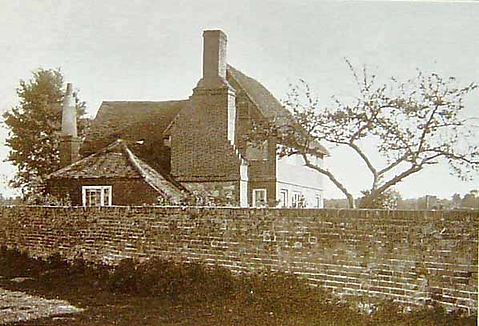

Lot 15 was bought by Mr HB Baverstock for £1,200 (equivalent to £58,000 today). Mr Baverstock was a Godalming-based estate agent, who decided to split the 56-acre farm into 2 sections:
-
Stanford Farm and 10 acres nearby (thus returning it almost to its 1807 size), and
-
46 acres of the outlying fields, which were incorporated into Rails Farm and Stream House Farm. We have written further about it in a separate section in the Stanford West section.
-
Alfred and Carrie decided to leave Stanford Farm virtually immediately and move to Vines Cottage, which they had bought 3 years earlier. This may have been Alfred and Carrie’s plan all along, in which case it worked out well for them. We have shown photos of Carrie and Alfred, right.


The new purchasers of Stanford Farm (but not the additional pieces of land, which were carefully kept by Alfred) were Commander Basil and Mary Guy. Basil’s full title was Commander Basil John Douglas Guy VC, DSO, and he ranks as one of the most eminent residents of Pirbright. He is one of only two recipients of the Victoria Cross to have lived in Pirbright (the other was Ross Mangles, of Pirbright Lodge.
Basil was born in May 1882, the son of a vicar in a town near Harrogate. He was educated at Aysgarth School, Yorkshire and then Llandaff Cathedral School in South Wales. He joined the Royal Navy in Dartmouth as a trainee and then served as a midshipman on a battleship in the Far East.

This included an involvement in the Boxer Rebellion in China in 1900, when Basil was just 18. The Boxer Rebellion was an uprising against foreign and Christian influence in China, and an international force was assembled at Tientsin (now Tianjin, a port to the south-east of Beijing) to deal with it.
During one attack on Tientsin, Basil’s brigade came under heavy fire, and it was during this encounter that Basil earned his Victoria Cross. We have shown (left) the citation for Basil’s VC, as recorded in the London Gazette (with thanks).
He formed part of the Guard of Honour at Westminster Abbey at the Coronation of King Edward VII in 1902.
He served in WW1, being appointed commander of the Q-ship HMS Wonganella (pictured below). A Q-ship was a decoy vessel – heavily armed, but disguised as a merchant vessel to lure enemy vessels into a surface attack.
In one notable action with a U-boat in March 1917, the Wonganella came under severe attack and its lifeboats were put out of action. In a chaotic situation, Basil gave the order to fire on the submarine. It retreated, but not without firing a torpedo, which the Wonganella just managed to avoid. Basil was awarded the DSO for his command, and was promoted to Commander in 1918. We have shown a press photo of Basil on the way to collect his DSO, and an invite to Basil’s sister to attend the ceremony.


One of Basil’s brothers, Major Oswald Vernon Guy, who served in the West Yorkshire Regiment and the Tank Corps in WW1, was awarded the MC and bar, DSO and the Legion of Honour. The article below appeared in the Christian Herald in February 1918, celebrating the Guy family’s involvement in WW1. Basil’s picture is at the bottom right. We have also shown a photo of Basil’s medals, which are displayed at The Imperial War Museum.


In 1917, 5 months after the Wonganella episode told above, Basil managed to find the time to marry Elizabeth Mary Arnold (known as Mary). She was born in 1885 and was the daughter of a civil engineer in Harrogate.
We have shown a wedding photo (right). On the left are Vera and Bernard Gordon Guy (siblings of Basil). On the right is Harold Arnold (Mary’s uncle – her father had died in 1915 of cancer).

Basil retired from the Royal Navy soon after WW1, and moved to Paignton, where he worked for the coastguard. The Guys then purchased Stanford Farm to be their retirement base and had some extensions built. They had 2 daughters, Marjorie and Elizabeth. Basil decided to occupy himself by farming chickens. There were 3,000 White Leghorn hens, housed in 3 large asbestos-roofed (oh dear) sheds, more or less free-range. Basil had a private egg round in Worplesdon.
One of his daughters remember him as being “rather strict” and not having much to do with his children, although he encouraged them to play tennis on the grass and swim in the swimming pool at the farm.
Below is a photo c1925 of the 2 Guy daughters with a cousin in the garden of Stanford Farm. We have also shown a plan of the property drawn for the Rate revaluation in 1929. It shows the border of the property (edged in lilac) and the 3 chicken sheds coloured a vivid red.


Basil’s father, Douglas Guy (who had been the Rural Dean of Knaresborough) and mother came to live at a house in Warwick’s Bench, Guildford when he retired in 1927. They died in 1934 and 1930 respectively.
Basil became a Churchwarden at St Michael’s. In the 1930s, however, the egg business lost money (possibly as a result of some shady business by one of the managers), and the chickens went. The battery room became a table tennis room, then a gardener’s cottage, then a home for Aunt Lilian (one of Basil’s sisters, whose husband was killed in WW1, just 8 months after their marriage).
c1936, Basil travelled to Madeira to work on behalf of the International Non-Intervention Committee (set up to prevent the Spanish Civil War from escalating throughout Europe). We think that Basil’s role was probably to help administer control processes on the island, to help prevent the flow of armaments and munitions into Spain. Basil spent 2 years staying in a villa in the grounds of the old Savoy Hotel, playing tennis and bridge, swimming, and not doing a lot of work apparently. The family had 2 wonderful summer holidays there. Basil was later posted to Marseilles in a similar role.
He returned to Stanford Farm unexpectedly one day, having walked from Brookwood Station. When the family asked about collecting his luggage, he replied that it was at the bottom of the sea, as the liner he was travelling in had been torpedoed.
We have shown below Basil’s entry in Who’s Who in 1938. During WW2 he was recalled for service. The official story is that he was involved in controlling shipping movement in connection with anti-submarine warfare. According to his daughter though, he spent WW2 in London at The admiralty as a reservist “looking after the WRENS along The Thames”. We have also shown a 1948 cutting from the Evening News.


We have shown 3 photos of Basil below, one of which shows him escorting his daughter Elizabeth along the path to St Michael’s Church on her wedding day in 1944. She married Halsey Edward Giffard Booth, the son of Leonard and Helen Ricardo, who lived at Avila in Malthouse Lane between 1918 and 1931. (In case you were wondering, yes, Halsey Booth was indeed a scion of the Halseys who were Lords of the Manor of Pirbright. Henry Halsey 2 was his great-great grandfather).
We have also shown a photo of Mary below.


Their other daughter, Marjorie Guy, married John Giffard Booth in 1950 at St Michael’s Church. John was the elder brother of her sister’s husband, Halsey Booth, who we referred to in the paragraph above.
In 1945 the Guys converted one of the farm barns to a 3-bedroomed bungalow, which was named Stanford Farm Cottage. We have written about this cottage in the section below.
Basil died in St Thomas’s Hospital, London in December 1956, aged 74 and was buried in St Michael’s Churchyard. In his will he left £100 to St Michael’s Church. 4 years later (!), the Parish Council decided to spend the money on a new set of main doors. We have shown below an excerpt from the Parish Council minutes 1960, and a photo of the doors. Some 60 years later, a fine brass plate was added, to commemorate Basil.


Mary stayed at Stanford Farm until 1964, when she moved to Dorset. She died there in 1975, aged 90. She was buried in the family grave in St Michael’s Churchyard.
In 1964 the house and its 10 acres were advertised for sale, including Stanford Farm Cottage (built 1945). The tennis lawn and swimming pool were still there, together with an air-raid shelter, used as an apple store. Offers around £30,000 (equivalent to £520,000 today) were requested. We have shown (left) a picture of the house at this time.

The purchasers of the farm were Bruce and Anne Jenkinson. Bruce was born in 1918 in Lyons, France, the son of an insurance broker. We think that Anne was born Athalie Anne Fowler in Romford in 1923. Bruce served in WW2, reaching the rank of Lieutenant. He and Anne married in Westminster in 1942 and lived in the Heathside area of Woking before moving to Horsell. Like his father, Bruce worked in insurance, being a Lloyd’s underwriter, which involved a few trips to the US over the years. They had 2 daughters and moved to Shamley Green c 1985. Bruce died in 2000.
From c1985 John and Claire Smith lived at Stanford Farm. John was born in 1943. He and Claire (nee Taylor) were married near Sevenoaks in 1978. They had 2 children while they lived in Pirbright. John was a Vice-President at Chemical Bank. They moved to Godalming, and we think that John may have died in 2006.
The house has been sold twice since the early 1990s. The farm was advertised for sale in 2010 with a guide price of £1.95 million. We have shown an agent’s photo of the house (with thanks) left. The oldest section can clearly be seen at the centre of the house. It’s interesting to compare it with the 1922 photo several pages earlier.
Stanford Farm Cottage
Stanford Farm Cottage was built by Basil and Mary Guy in 1945 as a conversion of one of the barns on Stanford Farm. We have shown an extract from the building plan showing its location (the hatched building marked “Building referred to”).
The first tenants were Charles and Florence Robinson. Charles was born in Seale in 1907, the son of a gardener. Florence (nee Bromley) was born in Gosport in 1902, the daughter of a Chartered Accountant. They were married in Seale in 1928 and had 1 daughter. Charles followed his father in becoming a gardener, and it was probably a job vacancy (with the promise of a bungalow to live in) that brought the family from Seale to Pirbright. The Robinsons probably left the bungalow when Mary Guy sold Stanford Farm (including the bungalow) in 1964. We think that they returned to the Seale area. Charles died in 1972 and Florence in 1994.
Michael and Phyllis Shurmer were living in the cottage in 1970. They had married in 1962 and lived in Warlingham and Chislehurst prior to moving to Pirbright. In 1981 the cottage was empty, but by 1992, the current owners had moved in.
The Royal Oak
We saw in the “Early Days” section above that in 1807 a cottage standing where The Royal Oak is today was occupied by a Richard Turner, along with 7 acres of land.
We are not sure of the original date of the building, but from the brick dentil (i.e. in & out decoration) course under the eaves, the cottage appears to have been built in the 18th century, like a number of Pirbright buildings with this feature (The Cricketers), Linnards and Stanford Farm (refer section above), for example).
The Land Tax records tell us that in 1781 the property was owned by William Collins (1731-1813) of Worplesdon, who we shall refer to as W C (Worplesdon). This is NOT the William Collins (son of John Collins) who owned Newmans around the same time. But he was a close relation. W C (Worplesdon) was a grandson of John Collins 1 (1670-1713), who owned Newmans and Burners, so the 2 William Collinses were second cousins.
W C (Worplesdon) was born in 1731 in Worplesdon, the son of William (1708-1764) and Elizabeth Collins. William Collins (the father) was the son of John Collins 1 (1670-1713). We’d not be at all surprised if the reader is having some difficulty working out the precise details of the Collins family. More information (perhaps a little clearer, but perhaps not) is provided in the Collins Family section.
In 1805, W C (Worplesdon) mortgaged the property (probably best described as a smallholding) to Richard Turner for £300 at the usual 5% pa interest. Richard thus became the tenant farmer from 1805 onwards. We can see from the 1807 survey map (a few pages up from here) that the property (7½ acres) comprised the cottage where the Royal Oak stands, a field immediately to the south of the cottage along with 3 other fields near today’s Stream Farm.
W C (Worplesdon) died in 1813 without ever marrying. He left all his freehold and copyhold property to a nephew, Henry Collins (1767-1826). But Henry Collins wasn’t interested in holding this mortgage, and it took until 1821-22 for W C (Worplesdon)’s executors to transfer the mortgage on the property to someone else. This was Richard Huntingford (1761-1837). Richard had been given what is today called Hockford Farm by his father. But this father was far from pleased with his son’s activities, and he made this plain in his will (which makes interesting reading - see the Hockford Farm section. It seems that Richard Huntingford sold Hockford Farm in 1821-22 and used the money to take on the mortgage from Richard Turner.
In 1837, Richard Huntingford died and the mortgage passed to one of his daughters, Harriett Huntingford. When Harriett died in 1839 aged only 32, the mortgage passed to another of Richard’s daughters, Hannah Honer (wife of Richard Honer).
Turning now to the tenant farmer, Richard Turner was born in Woking in 1766, the son of Richard and Mary Turner. His parents moved to Pirbright around 1800, and Richard then married Sarah Jennings (born 1767) in 1794 (in Ash). They had 2 children (both of whom we will meet again further in this section):
-
Ann Turner (born in Worplesdon in 1795), who married Thomas Sherwood at St Michael’s in 1820.
-
John Turner, (born in Pirbright in 1809), who, in 1850, married Emma Madwick at St Michael’s. He farmed the 7 acres until 1854 but also worked as a carpenter (which is how he described his occupation in the 1841 census).
Richard Turner died in 1839, leaving the property to Sarah for her life, then to his son John. John then maintained the smallholding until he married Emma in 1850. They soon (4 months later) had a daughter Ann (who went on to marry a man called George Quelch – Billy Bunter fans will be pleased). Within a couple of years they had 2 sons.
In the 1851 census John described himself as a carpenter/undertaker. The family lived in the cottage with one of Emma’s uncles (Thomas Jennings), a lodger and a servant. In 1854, John Turner placed the ad (right) announcing that he was selling up the farming stock.

Sarah died in November 1856 at the (then) amazing age of 89, and we think that this was the cue for John to make some big changes. We’re not sure about the exact sequence of events, but it looks as though John:
-
In 1857 or 1858, converted the cottage into a beerhouse.
-
In October 1858, sold the property (which already included a beerhouse) to George Holt, a Guildford cabinet-maker/upholsterer, whose shop had been on North Street, Guildford. George’s father (also George Holt) had a previous Pirbright connection. In 1854, he had been one of the executors of Samuel Greenfield (of Bakersgate)’s will, and Samuel had referred to him in his will as a friend. In 1858, after selling the property, the Turners moved next door into Stanford Cottage (refer section below).
-
George (probably straightaway) leased the beerhouse to one of 2 Farnham breweries, either The Lion brewery or The Red Lion brewery – we don’t know which. He also owned 4 houses at West Heath.
-
In 1884, on retiring from the upholstery business, George Holt passed the property (and a few other properties) to his son, William Holt. George, who had been a trustee of the Pirbright United Friendly Benefit Society, died in 1885.
-
In 1889, a new company, “Farnham United Breweries” was formed, comprising the 2 Farnham breweries named above. The new company had an estate of 164 hotels and pubs, most of which were held freehold. The press announcement conveniently listed these 164 premises, and we have shown a copy of the “Leasehold beerhouses” section, which included The Royal Oak, below.

Thus, we can be fairly certain that in 1889 The Royal Oak was owned by William Holt, and leased by Farnham United Breweries. William Holt had 9 children, and so we suspect that he might at some stage have been tempted to sell the freehold to the brewery. In fact, that’s exactly what he did – in 1899.
Let’s now return to the occupants of the new beerhouse. The 1861 census shows James and Louisa Sherwood and their family living in “Stanford House”, with James as a beerkeeper. The cottage had not had a commonly-used name before, and so we think that the name “Stanford House” was probably used as a convenience by the beerhouse in the 1861 census, not to be confused with the house we know today as Stanford House.
The Pirbright Sherwoods are quite difficult to sort out, but we think that James was born in 1828, the son of Thomas Sherwood, who had married Ann Turner, daughter of Richard Turner (refer above). In 1855 James had married Louisa Collyer in St Michael’s Church. Louisa (born in Pirbright in 1834) was the daughter of Edward Collyer, who had lived at Sandpit Cottages.
By 1871 the property had acquired the name The Royal Oak, and was tenanted by John and Jane Collyer and their 5 children. John was born in Pirbright in 1838, the son of Henry and Ann Collyer (nee Faggetter). Henry was the farmer of 71-acre Whites Farm, and we have told his story there. Was John related to the wife (Louisa nee Collyer) of the previous innkeeper, Thomas Sherwood? Yes, they were 2nd cousins once removed.
In 1861 John married Jane Faggetter in Guildford. Jane was born in 1839 in Horsell, the daughter of John and Anne Faggetter. John Faggetter was the landlord of the White Hart, so we can guess where John (Collyer) got his expertise from. The reader may have spotted that both John’s mother and wife were Faggetters. Were they related? Yes they were, but the connection goes back 3 generations.
One day early in 1873, Mr Collyer, informed the local policeman of a Frenchman in the beerhouse who matched the description of a man wanted for a vicious murder in London (the Great Coram Street Murder). It took quite a while for the police to establish that it was not the right man, and accordingly they released him. One of the main reasons for releasing him was that the wanted man had spoken with a German (not French) accent – a Basil Fawlty-esque mistake. The murderer was never identified.
By 1874 it looks as though George Fry had taken over the job of publican of the Royal Oak. He was married that year, and gave his occupation as “Beerhouse keeper”. He also appears on the 1880 Electoral Register as living there (“The Oak”). However, from 1877 he was also the tenant of Stanford Farm, so he must have been a busy fellow. We have written more about him in the Stanford Farm section (refer above).
We have shown below one of our favourite old photos of Pirbright. It dates from around 1880, and shows a lunchtime group of labourers, some with their scythes, in front of the pub. The grand-looking gentleman in front of the horse is probably Henry Greenfield, from Bakersgate, so these were probably his workers. The pub sign is partly legible and the dentillation below the roof line can be clearly seen.

The records for the next 5 years are a little confusing. The 1881-85 Rate books show a John Croucher as the tenant of The Royal Oak. But the 1881-85 Electoral Registers show that a Charles Collins was living there. The 1881 census shows Charles at The Royal Oak, and John farming 9 acres at Vine Cottage in Worplesdon. So what was going on? The situation may have been that John Croucher was the tenant landlord of the pub from 1881 onwards, but decided to install Charles as the acting landlord as a temporary measure, while he could wind down his farming activities. So we’ll assume this and look at each of these 2 people in turn.
Firstly, Charles and Emma Collins. Charles was born in 1 January 1843 in Rickford, Worplesdon, the son of Henry (a farmer on West Heath, and later a labourer at Bridley) and Mary Ann Collins. In 1871 Charles was a farm servant at Burners Farm.
In 1879 he married Emma Parlett. Emma (nee Fry) had married, had 2 children in 1871 and 1873, but was widowed soon afterwards. She moved her young family to Pirbright, where her brother, George Fry, was farming Leonards Farm (today Stanford Farm - refer section above). In 1879, Emma married Charles, who presumably was already the beerhouse-keeper next door at The Royal Oak. Charles and Emma had 4 more children and c1886 moved a few doors away to Stanford House, where we continue their story.
Next, John and Emma Croucher. John was born near Faversham in 1836, the son of a farmer. Emma (nee Coleman) was born in 1846 near Canterbury, the daughter of a farm labourer. They married at Faversham in 1865. John was a labourer, and initially they lived in Emma’s village near Faversham. They had 4 children.
For whatever reason, they moved from Kent to Worplesdon during the 1870s, and started farming at Vine Cottage in Worplesdon. By 1886, the Crouchers were installed at The Royal Oak. In 1899 the brewery gained approval to extend the building considerably, as shown by the building plan (right). The red part is the proposed extension, and is pretty obvious if one looks at the pub today.


John died in 1899 just 9 months after these plans were approved, aged 63, but Emma remained at The Royal Oak as the proprietress. Stables were built in 1905 at the rear of the pub, and the plans show that there were piggeries there as well. Emma remained there until 1915, as the cutting left (from April 1915) states. Emma moved to a house in Connaught Road, and died there in 1920. We have shown a picture of their headstone in St Michael’s Churchyard right.

As the cutting suggests, the next tenants at The Royal Oak were Albert and Flora Hawksford. Albert was born in Kensington in 1876, the son of a furniture dealer. In 1911 he was still living with his parents, who by then were living in Paddington, and was a painter by trade.
In June 1905 he married Flora Fry, daughter of George Fry, who farmed Stanford Farm (refer section above for George’s story), at the time called Leonards Farm. Flora had been born in 1879 in Pirbright, and the marriage was held at St Michael’s Church. But very soon afterwards, Albert and Flora sailed to Canada. Exactly 9 months after their wedding (ie in March 1906), their first child (also called Flora) was born in Peel, now part of Toronto (near the airport). Albert now described himself as a furniture finisher. 2 more daughters followed, and Albert’s profession changed back to painter on the registration documents.
With all due respect to the accuracy of the press cutting above, we think that Albert, Flora and their family returned to England in 1913. Albert’s name appears in Kelly’s Directory of that year, with an occupation of Beer retailer. So it looks as though he worked for Emma Croucher in The Royal Oak during 1913-15, and then took over the full tenancy when she retired in 1915.
Below is another fine photo of The Royal Oak, this time c1905, we think. The name of the brewery is proudly displayed (twice for some reason). Emma’s name is displayed as the landlady of the pub just above. She is a licensed retailer of beer and dealer in tobacco. She would have been 59 when the photo was taken, so we are guessing that she is the lady underneath the word “FINE”. The other people are members of the Fry family. Flora Hawksford (nee Fry) is second from the left. On the extreme left is her sister, Ethel Fry. We think that the man with the beard in front of the entrance was George Fry from Stanford Farm (see section above). The man with the slouch hat next to Emma may have been Henry Beacham, who lived at No 6, Pirbright Cottages.

Albert appears to have renamed the inn “The Oak”, a name that lasted about 20 years before reverting to its original name, The Royal Oak. That is a history lesson the owners of The White Hart could have learnt from before their unsuccessful attempt to rename the pub “The Moorhen” a few years ago. We will continue to refer to the pub as The Royal Oak.
But Albert and Emma’s stay in England was not for long. For whatever reasons, they returned to Canada in 1921, living at Owen Sound near the shores of Lake Huron. In 1931 Albert had returned to his original skills - he was a machine varnisher - and both Albert and Flora were well-liked in the community. Albert was secretary of the Owen Sound City Softball League and one of its founders. He was also active in Trade Union work, and died in 1940 while in the act of opening a meeting of the Furniture Workers’ Union. Flora died in 1947. We have shown below a nice obituary of Flora from The Owen Sound Daily Sun Times (with thanks). Shame about the spelling of our beloved village though.

The next tenants from 1921 were Thomas and Maria Selfe. Thomas was born in a small village near Salisbury c1858, the son of a shepherd. He worked as a groom, then a coachman, and in 1882 married Maria Hargreaves. She had been born in 1860 in a village called Tarrant Gunville (we’d never heard of it, but it’s near Blandford Forum). Maria’s father was a sawyer, and she was working as a school mistress at the time of her marriage.
They soon moved to Compton (south of Guildford), presumably to take up work opportunities. By 1891 they had 3 young children, and 3 more were to follow over the next 14 years (the age difference between the youngest and eldest children was 22 years). Thomas was still working as a coachman in 1901 in Compton, but in 1905 the family were living in Suffolk, and by 1911 Thomas was working as the beerhouse keeper of The Punch Bowl at Hindhead. This was only a brief stay and over the next 10 years the family lived in Guildford and then Farnham. We assume that Thomas was working in short spells doing various jobs in the area. By the time they arrived in Pirbright Thomas was aged 62 and Maria 60. At this stage Thomas’s occupation was officially declared as “Motor-car proprietor”, and the Selfes were living in Artillery Road, Guildford.
We have shown in the Stanford Farm section above a plan of the area drawn in 1929 as part of the Rate revaluation of that year. It shows the plot of the Royal Oak (bordered in red) with the name of the tenant and owner handwritten.
The Selfes stayed at The Royal Oak until c1930, when they moved to The Green Man in Guildford. They stayed there until c1938 (when Thomas would have been aged 80 – fairly old to work in a pub today, let alone in 1938, we would have thought). Maria died in 1939 after a long illness, and Thomas moved to The Nutcombe Hotel, Guildford, on the Portsmouth Road (which would have been somewhere near St Catherine’s, but doesn’t exist today). Thomas died in 1946, aged 88. His life had comprised many changes of job and therefore family moves, which must have been tough for the whole family.
In 1927, Farnham United Breweries was purchased by Courage & Co Ltd, and so the pub became a Courage pub. For some reason over the next 20-odd years there was a series of short-term tenants. We don’t know if this was a result of the Courage acquisition, though...
The tenants from 1930 to 1932 were Thomas and Florence (“Florrie”) Worsfold. Thomas was born at Pyrford in 1890, the son of a farm stockman. Florrie (nee Williams) was born in 1889 at Lyndhurst, the daughter of a labourer. They married in 1914 at Pyrford and had one son. In 1921 they were workers at the Pyrford farm where Thomas grew up. Thomas was a carter and Florrie a “Field worker”. We have shown right a photo of the front of the pub from around this time.

Their move to Pirbright in 1930 to run a pub must have been quite a new experience for them. We don’t know how well they took to it, but Florrie died in 1933 aged only 38, and Thomas left the area soon after this. In 1939 he was a lorry driver, living at Bagshot. He later moved to Godalming and died in 1968.
After the Worsfolds, Geoffrey and Ruby Gale ran the pub from 1933. Geoffrey was born in Wandsworth in 1906, the son of a bricklayer. Ruby (nee Chuter) was born in Woking in 1906, the daughter of Henry and Ruth Chuter. Henry had been born in the centre of Guildford, and was an “Oil traveller for the Cooperative Society”, whatever that was. There had been Chuters living in Pirbright for several years until the late 1800s and Ruby was indeed related to them, albeit 3 generations previously, via a William Chuter (1772-1839).
They married in 1928, lived in Eagle Road, Guildford (just off the Stoke Road) and had 4 children – all daughters. They only worked at The Royal Oak for a couple of years before moving to Coniston Road, Old Woking. In 1937, George was inducted into The Royal Antediluvian Order of Buffaloes, which is apparently a charitable organisation. 2 years later Geoffrey was living in Blandford Forum, where he was a Foreman carpenter, but Ruby stayed in Woking, later moving to Hale, near Farnham, under her maiden name.
The next tenants from 1935 were Percy and Emmeline Prince. Percy was born in Brentford in 1894, the son of a Rate collector. As a 16 year-old he worked as an audit clerk for the Great Western Railway Company and served as a gunner in WW1 in the Royal Garrison Artillery. Emmeline (nee Puddicombe) was born in Swansea in 1892, the daughter of a dairy farmer. They were married in Mumbles in 1923 and had one daughter. They lived for a while in Brentford and then from 1928 in Orchard Road, Burpham. Maybe Percy worked in the nearby Green Man pub (which dated back to the 1600s, but was demolished in 2008 to make way for an Aldi supermarket).

Percy served in the ARP during WW2. We have shown, right, an extract from an ARP group photo, left. Percy is the chap with glasses on the end of one of the rows. We think that the lady just behind him is his daughter.
They moved to The Royal Oak in 1935. In 1936, Percy applied for the soon-to-be-vacant position of Clerk to the Parish Council. He was one of 7 applicants, and his application letter did make a powerful case. He cited his preparation for Bankers Institute and Chartered Institute of Secretaries exams (without saying whether he actually passed them) and 20 years working in The City. But unfortunately he didn’t make it to the list of the final 3 candidates. We have shown the rather fancy letterhead of the inn from that time left.

But the Princes left Pirbright sometime during or at the end of WW2. They lived for a short while in Orchard Road, Burpham (with Percy working at The Green Man again?), but then moved to Worplesdon to start up The Worplesdon Place Hotel. Previously it had been a rather grand private residence in a 56-acre estate. The Princes had purchased the hotel and 15 acres of land (presumably with the help of a hefty mortgage) and proceeded to renovate it (with the help of a large War Damage grant to repair damage during WW2).
The hotel seems to have been a success (although it was later described as “run down and under-capitalised”). However, in 1961, a long newspaper article (too long to show here) records a Lands Tribunal, in which local residents opposed the Prince’s plans to build no less than 19 houses on the Worplesdon Place estate. Development would have necessitated the lifting of previous restrictive covenants.
We don’t think that the development went ahead. Percy died the following year and Emmeline died just 6 months later. An obituary of Percy is shown right.


A fatal road accident occurred on Christmas Eve 1945 outside the inn. A 57 year-old cyclist who lived in Connaught Road, Brookwood was crossing the road towards The Royal Oak, when an oncoming jeep (coming from Pirbright) hit him. The coroner concluded that the cyclist had not seen the car and recorded a verdict of accidental death. Almost exactly 2 years later, another bad accident occurred nearby, as explained in the press cutting (left). Some might wince at the headline describing the location as “at Woking”.
The pattern of short tenancies continued after WW2. Reginald and Mabel Morris held the fort during 1945-46. Unlikely as it sounds, we think that the Morrises (born in the 1890s) may have hailed from Thrapston in Northamptonshire, where Reginald was a dairy farmer in 1939.
The next tenants 1948-50 were Robert and Lily Smith. They were soon followed by Cyril W and Agnes (“Jeannie”) Weldon during 1951-52. Cyril was born in 1909 in Southampton, the son of a railway clerk. Jeannie (nee Beale) was born in Kings County, Ireland in 1909, the daughter of a government surveyor. They were married at Southampton in 1931 and were living there in 1939. Jeannie already had a son (Gordon), born in 1926 from a previous relationship.
By 1948, Cyril was the landlord of The Royal Standard pub in Aldershot, before the family moved to Pirbright in 1951. Then in September 1952, Jeannie’s son Gordon and his young wife sailed to Melbourne aboard the SS Chitral, almost certainly two of the many “£10 Poms” of that generation who emigrated to Australia. The following month, Jean sailed (alone) to Melbourne, presumably to live with them. Rather oddly, we can find no record of Cyril sailing to Australia, but he did sail from Brisbane back to London (alone) in 1953. It looks as though things stayed that way. Cyril died in Essex in 1979, while Jeannie died in a coastal town in New South Wales in 1993. Gordon died in the same town in 2020, aged 94.
The rapid turnover of landlords came to a juddering halt in 1953 when Thomas (Tom) and Doris Hatton came to The Royal Oak. Tom was born in 1905 in Kensington, the son of an undertaker’s coachman. He started his working life working with cars. Doris (nee Thatcher) was born in 1906 in Camberwell, the daughter of a “Lunatic attendant”, who worked at one of the Epsom asylums. They married in Hammersmith in 1926, moved to Acton and soon had 2 children. In 1939 the family still lived in Acton. Tom was working as a Motor engineer’s inspector.
The Hattons moved to The Royal Oak c 1953 and stayed there until 1976. We don’t know much at all about them during their tenure at The Royal Oak, so any information, stories, photos, etc would be very welcome. The Hattons moved to Wokingham in 1976, and Tom died there in 1990. Doris died there in 2003, aged 97. In 1953, Courage had merged with a brewery called Barclay, Perkins & Co Ltd, who operated at The Anchor brewery in London. The new entity was called Courage and Barclay Ltd. [Barclay Perkins & Co was the largest brewery in the world in the early 1800s apparently. One Edmund Halsey MP ran the brewery between 1693 and 1729. Now there’s a coincidence.]. We have shown, below 2 photos from this time, both of which show the importance of the pub to the local fox-hunting set. The second photo also shows a wonderful display of late-1950s cars.


In 1960, Courage and Barclay Ltd acquired the Reading based H & G Simonds Ltd, and the company name was changed to Courage, Barclay, Simonds & Co. Ltd. Now the Simonds brewery had owned The Fox at Fox Corner for the previous 100-odd years, and so the 2 Pirbright pubs which had, for those 100 years, fought each other tooth and nail for customers suddenly became cousins and friends within the Courage family. Below are 2 photos of the pub in the 1960s. The left-hand one is the earlier of the two, and perhaps shows an unseasonably late frost. The right-hand photo (extracted from the local WI scrapbook of the time, with thanks) shows the old Courage & Barclay logo, and a questionable spelling of the word “licensed”. We have also shown a photo of the road, taken from the pub garden. It’s a nostalgic reminder of the 1960s.


The pub was sold by the brewery c1976. The new owners were Geoffrey and Eileen Walkling. Geoffrey was born in Edmonton in 1929. He and Eileen (nee Larter) were married at Edmonton in 1954.

A 1983 local newspaper article about the high price of beer in some local pubs (“PROBE INTO BEER PRICES RIP-OFF”) singled out The Royal Oak as being high on the price scale at 95p per pint (£3.33 today – if only...). Other pubs were cited where the price of a pint was 75p-85p. Geoffrey was quoted as saying “We have a lovely atmosphere and a very nice clientele, who do not mind paying a little extra. It is more like a club. We are not just selling a pint of beer – we are selling an atmosphere which you can’t get elsewhere”. A fine early example of marketing-speak, we think.
Geoffrey was notorious for refusing any ignorant customers foolhardy enough to ask for a soft drink, and we have heard of some local residents who preferred to take their custom to The Fox at Fox Corner.
Maybe the reality was that Courage wanted to avoid competition between the 2 pubs, so they positioned The Royal Oak as a high-price “posh” pub, with The Fox serving a more “down-to-earth” market. In 1985 the Walklings were given approval to extend the bar area and build an entrance porch. On the left is a photo of the pub in 1987, taken by Stan Dabbs.
The Walkings left the area soon afterwards and moved to Hindhead. Geoffrey died in Gwynedd in 2007. We think that Eileen died in Ramsgate in 2014.
By 1980, the pub had been bought by Whitbread. We have shown below with thanks a wonderful sketch of the pub from 1991. Around this time some renovation took place. It included replacement of the old beams. The new beams came from the barns belonging to The Bungalow on The Green, which had recently been demolished (the barns that is, not the bungalow!). And fine, solid beams they are too.
In 1992 an Anthony and Annette Woodbine were the tenants. By 2008, it had been bought by Greene King, the current owners, but we are not sure who the various landlords have been since the early 1990s. A 2007 photo is also shown below.


Stanford Cottages 1-6
The 6 Stanford Cottages are arranged as 3 pairs of semi-detached cottages, all facing the Aldershot Road. When originally built, there were 8 Stanford Cottages, and this remained the case until c1970. The passer-by today would be puzzled as to where the other 2 cottages were. They were in fact tucked behind today’s 6 cottages, ie where Jordans and Round Meadow (see below) are today. We will cover the early history of all 8 cottages until 1900 below.
If we look carefully at the 1841 Tithe map (pictured right) and correlate it to today’s map, we can see that the land where Stanford Cottages stand today was part of the plot where the Royal Oak is today. It is coloured brown on the map, roughly where the number 216 is. The black-coloured building was an outbuilding (ie not a dwelling). On the western side of the brown plot is a cart track, which was used for access to the meadows behind. Today it is the access road to Jordans and Round Meadow.

In 1841, this land belonged to Richard and Sarah Turner. We have told their story, as well as the earlier history of the plot, in the Royal Oak section above and so will not repeat it here. As part of the Royal Oak property, it was sold to George Holt in 1858 (again, please refer above for information about George).
The land remained as part of the Royal Oak’s property until 1899, but George did build a cottage on the land, probably in the early 1870s. The cottage never appears to have had a formal name, but we can see in the 1881 census that the occupants were John and Ann Stonard, with James Sherwood as a lodger.
John Stonard was born in 1815, the son of Stephen and Hannah Stonard, who had farmed at Fords Farm, where we tell their story, from 1825. For further details of the Stonard family, please refer to the Stonard family history page. Ann (nee Sherwood in 1821) was also born in Pirbright, the daughter of Thomas Sherwood, who farmed Fords Farm after Stephen Stonard.
John Stonard was an agricultural labourer. The couple had 11 children, a fairly normal number for Pirbright Stonards in those days, it seems. They had previously lived at Webb’s Cottage (today, Rails Cottage) until the 1870’s when they moved to the new cottage at Stanford. John died there in 1892 and Ann in 1896.
The lodger, James Sherwood, was Ann Stonard’s younger brother, and had been the publican of The Royal Oak (refer above) back in 1861, in its very earliest days as a beerhouse. By 1881 he had become a butcher. By 1901 he was a pauper at the Guildford Union Workhouse. He never married and died there in 1902.
In 1884, George Holt passed the cottage to his son, William Holt, but he let the Stonards remain there until Ann’s death in 1896. For the next year or so, the cottage was rented by William Stonard, who we assume was the 3rd child (of 11) of John and Ann, and who would later rent one of the newly-built Stanford Cottages (No 3), where we tell his story.
In 1898, Lord Pirbright bought all of William Holt’s land at Stanford. This included the cottage, surrounding land, and a large field to the south. A plan of the property sold is shown right.


We have told Lord Pirbright’s story in the Pirbright Cottages section. He commissioned several housing developments in Pirbright, many of which are marked with a panel containing a “P” or a “W” (for Worms). Today, these would be called “Affordable housing”. The vast majority of these houses are still going strong today, 120-odd years later. Whether or not they are still affordable, we leave others to decide.
From 1898 to 1900 the cottage was occupied by James Avenell. James and his family had previously been living at Fellmore Farm (today’s Stream Farm. They returned to Fellmore Farm in 1900, and we don’t know why they felt the need to rent this cottage for the 2-year period.
Lord Pirbright soon decided to demolish the cottage and build 8 Stanford Cottages on the site. They were built 1900-01. We have shown an extract from the 1900 building plans left. Each cottage was semi-detached. But Nos 7 and 8 were at the rear of the others, on larger plots. The “Cart Road to Meadows” on the right hand side of the plan (which in reality heads in a south-easterly direction) still exists today as an access track for Nos 7 and 8 (since rebuilt and renamed – refer below).
When Lord Pirbright died in 1903, ownership of the cottages passed to his wife, Lady Pirbright. After her death in 1914, the 8 cottages were offered for sale by her executors. The sale plan of the cottages is shown right.
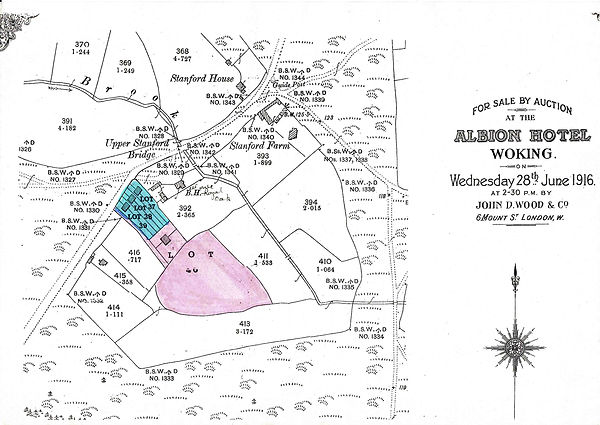
The 8 cottages were first offered as 1 lot. If unsold (which, as it happened, they were), they were to be offered as 4 separate lots. Lots 37-39 were the pairs of cottages 1-2, 3-4 and 5-6. Lot 46 comprised cottages 7-8, and the large meadow behind them, 2½ acres in total. The large meadow (originally called Further Round Meadow) had been owned by George Tate (who owned Fords Farm in 1805, and then passed to one of his wife’s descendants (one Edward Fitz-Moore). They had sold it in 1869 to George Holt for £120 (equivalent to £12,000 today). No doubt George thought it would be a useful addition to the grounds of The Royal Oak, to provide grazing ground for his animal stock. But it was now included in with Nos 7 and 8, Stanford Cottages.
We do not know who bought Nos 3, 4, 5 or 6, but we do know that:
-
Nos 1 and 2 were bought by Alfred Fry, who was living at Stanford Farm (refer section above), just around the corner.
-
Nos 7 and 8 (including the large meadow) were bought by Annie Rice. Annie was the wife of Edward Andrew Rice, a coal merchant who lived in Knaphill. In 1920 Annie sold the property to Archibald Rice , Edward Rice’s elder brother, who was a blacksmith in Pirbright and ran the village shop on The Green for many years. Esdor Faggetter was a witness to the sale deed.
-
In 1941 one or more of the cottages, belonging to the late John Faggetter (who had been living at Elm House, Gibbs Acre) were auctioned.
-
In 1945, Nos 3 and 4 were auctioned by the Faggetter family and purchased by Alfred Fry (who thus then owned Nos 1-4).
-
At some stage prior to 1973, Nos 5 and 6 were purchased by the Fry family, this completing the set of all 6 of the Aldershot Road-facing cottages.
-
In 1965, Nos 1 and 2 were gifted by Eva Fry (wife of Alfred Fry) to her granddaughter, Jean Cole (refer Section on No 1 below).
-
In 1965, Nos 3 and 4 were gifted by Eva Fry (wife of Alfred Fry) to her son, Alfred George Fry.
We have shown below an extract from the 1945 sale document, describing the accommodation of each cottage. Some of the features may not be to our modern tastes, but a Beetonette (sic) range (also pictured) looks very smart.

Let’s now look at the main inhabitants of each house, starting at No 1.
No 1, Stanford Cottages
The first tenants of No 1 were Isaac and Eva Forster in 1901 for just 1 year. Isaac (whose middle name was Ivy) was a cowman, born in Egham in 1877. Eva (nee Tedder) was born in 1879 in Chobham, the daughter of a carman. They married in Battersea in 1899, just 2 months before the birth of their first child, a daughter, whose middle name was Transvaal. The Forsters clearly liked unusual middle names. They moved to Woking in 1902.
The Forsters were followed by Richard and Ada Jones for 2 years until 1903. Richard was an engine driver, and they had previously lived at the Lock House at Deepcut.

They were followed in 1903 by William and Sarah Ratcliffe. William was born in 1870 in Farnham, the son of a Dairyman and Corn chandler. Sarah (nee Snuggs) was born in Hartley Wintney in 1871, the daughter of Caleb and Lydia Snuggs. Caleb was a farmer. They were married in Farnborough in 1894, when William was a butcher. They moved to Ash for a few years, before moving to Pirbright. They lived at No 1 until 1910, when they moved to Smallbourne (today’s Bourne House). William was working as a domestic gardener, and they had 7 children. They later moved to Connaught Road, Brookwood. Sarah died in 1918, aged only 48. William remarried and died in 1955, aged 85. We have shown a photo of William, left.
By 1911 Albert and Eliza Brooking were living at No 1. Albert was born in Edmonton in 1871, the son of a beer shop keeper. By 1881 his family had moved to Dapdune Road, Guildford. Eliza (nee Flowers) was born in London in 1870, and by 1891 her family moved to the Farnham Road, Guildford.
They married in 1897 in Brighton and had 8 children. At the time of his marriage, Albert was a commercial traveller but by 1911 he was a domestic gardener, staying in a Sussex Care Home. They stayed at No 1 until 1914, but then moved to Egham. By 1921 Albert seems to have reverted to his roots and become a Furniture salesman. The Brookings stayed in Egham, Eliza dying in 1945 and Albert in 1955.
In 1915 John and Minnie Collins were the new tenants. John was born near Petersfield in 1876, the son of a gamekeeper. He wasn’t a near relative of the other Pirbright Collins. Minnie (nee Wilson) was born at Kemishford, near Mayford, in 1884, the daughter of a nurseryman. They married at St John’s in 1905 and had 4 children. In 1911, they were living on Whitmoor Common, Worplesdon.
In 1915 John signed up to the 1st Cambridgeshire Regiment. He was a nurseryman gardener, but later became a stonemason’s labourer in Brookwood Cemetery. The following year, Minnie appeared in court, accused of receiving a sack of Army coke from a soldier. The incident was described in the local newspaper of the time (see cutting, right – that sort of headline today would mean something entirely different, we think).
In 1925, the Collins’s eldest son, William, was involved in a dangerous prank with 2 other local youths. The details are described in the press cutting, left.


In 1922 John stopped paying rent to his landlord (Alfred Fry). After a Court Ejectment Order in 1926, the Collins family were evicted from the cottage, owing £65 2s (equivalent to £3,400 today). The court noted that there were no less than 12 people living in the cottage: John, Minnie and their 4 children, as well as Frank and Kate Stevens (see below) with their 4 children. The Chairman of the Court publicly stated that he hoped Guildford Rural District Council would expedite the building of houses in Pirbright.
The Collins family moved to No 11, Council Cottages, West Heath. This left Frank and Catherine (Kate) Stevens as the occupants of No 1. Frank was born in 1890 in Pirbright, the son of Alan and Annie Stevens. Alan was a Railway platelayer, and the family lived on The Green, and then Model Cottages on West Heath. Catherine (nee Leo) was born in Limerick in 1889. They married in Limerick in 1918, but settled back in Pirbright.
In 1918 they were living with Frank’s parents at West Heath, but by 1921 they were living at No 1 (with the Collins family), and by 1926, as we wrote above, there were 12 people living in the cottage, including the 4 very young Stevens children. It would have been crowded... However, life would have been more comfortable after 1926, when the Collins family moved out.
Frank was a cowman at Stanford Farm. c1951, they moved to No 16, Rapley’s Field. Frank died there in 1953. c1957, Catherine moved to No 20, Rapley’s Field), and then to Woking, where she died in 1974.
The next occupants from c1957 were Ronald and Cecelia Stagg. Ronald was born near Hersham in 1934, the son of a Railway Station foreman. Cecilia (nee Chapman) and Ronald married at St Peter’s Church in Ash, in 1952 and initially lived in Ash Vale. Their lease was terminated in 1965, as the owner (Eva Fry) wanted to gift the house to her newly-married granddaughter, Jean (see paragraph below).

From 1965, Geoffrey and Jean Cole lived at No 1. Geoffrey was born in 1944 and lived in Horsell. Jean (nee Foulkes), also born in 1944, was the daughter of Stan and Mabel Foulkes (nee Fry, the daughter of Alfred and Eva Fry). We have told their story in the section relating to No 21, Rapley’s Field.
Geoffrey and Jean married in 1965 at St Michael’s Church. The same year, Jean’s grandmother, Eva Fry, gifted No 1 to Jean to mark her 21st birthday. Geoffrey and Jean lived at No 1 for 4 years and had 2 daughters there, until Geoffrey was posted overseas (see cutting left).
From 1969 to c1972 Derek and Carol Martingell lived in the cottage. Derek was brought up in West Byfleet and Carol (nee Guest) from Horsell. They were married in 1967. They left the cottage c1972 and moved to the Goldsworth Park area.
From c1973, Raymond and Jacqueline Foulkes lived in the cottage. Ray was the brother of Jean Cole (refer a couple of paragraphs above), thus continuing the Fry/Foulkes connection with the cottage.
We think that whichever member of the Fry dynasty who owned the cottage around 1985 decided to sell it at that time. The current owners bought the house c1985.
A recent agent’s photo of Nos 1-3 is shown right (with thanks).

No 2, Stanford Cottages
The first tenants of No 2 were Alfred and Phoebe Hill. Alfred was born in Plaistow in 1877, the son of a house decorator. Phoebe (nee Green) was born in Oxford in 1876, the daughter of a cordwainer. They married in Farnborough in 1899 and had 5 children.
They only lived at No 2 for a year, and by 1911 they were living in Ash Vale, where Alfred was working in a Balloon Factory. It would be nice to imagine that Alfred spent his time making balloons for children’s parties.
But he was more likely employed at the Army Balloon Factory in Farnborough (today part of Farnborough Airport), making dirigibles (ie airships). Right is a wonderful photo of the Farnborough site from about this time (with grateful thanks to Wikipedia).
The next tenants from 1902 to 1908 were Robert and John Brown, who we assume were brothers. From 1908, the tenants were Arthur Cann and Gertrude Littlejohns, who hailed from the Isle of Wight. Arthur was born in Bideford in 1879, the son of Caleb Littlejohns, a Carriage proprietor. Gertrude (nee Draper) was born in Cowes in 1879, the daughter of a joiner. Gertrude’s family moved to Mayford in the 1890s. They married in Woking in 1901 and had 8 children. After leaving Pirbright in 1913, the family moved to Mayford in 1913. Arthur ran a shop at Kingfield and then worked at the munitions factory at Martinsyde Ltd. We have told the interesting history of Martinsyde in the Fox Corner section. However, Arthur died of pneumonia in 1916, aged only 38. Gertrude remarried and died in Chertsey in 1963, aged 84.
In 1913 Isaac and Elizabeth Chowney moved into No 2 from No 1 Manor Farm Cottages, having previously lived at No 9, Pirbright Cottages. We have told their story in those sections. However, we should mention again that in 1892, Isaac spent 3 months in Brookwood Asylum. In 1916 his unusual death was reported in the local newspaper (shown left).

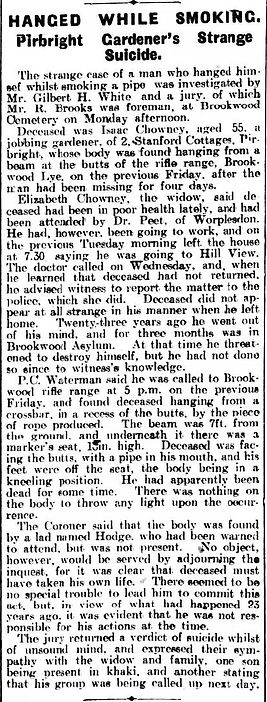
By 1916 Frederick and Marion Goddard were renting No 2. Frederick was born in Compton in 1876, the son of a farm labourer. Marion (nee Luff) was born in Elstead in 1884, the daughter of a labourer who died when Marion was just 1 year old. Frederick and Marion married in Guildford in 1911. It was Frederick’s 3rd marriage, and Marion’s 2nd. They had 3 children. Frederick was a carter, and they lived in Stoughton, then Guildford, then Pirbright (1916-18), then Ash, before finally settling at Farnham.
From 1920, George and Annie Callingham lived at No 2. They had previously lived at Henley Park Farm Cottages, in Normandy. In 1925 the Callinghams moved to Pullens Farm Cottage, where we tell their story.
Between 1925 and 1929, Alfred and Alice Smith lived at No 2. Alfred was born in 1901, the son of a Guildford builder. Alice (nee Harding) was born in Brookwood in 1900, the daughter of a Railway platelayer. They married in Guildford in 1921. They only stayed 4 years in Pirbright, before moving to Gravetts Lane, Worplesdon, and then Willey Green, where in 1939 Alfred was a coal merchant.
Also living at No 2 from c1927 to 1930 were William and Caroline Horton. They had previously been living at No 2, White Cottage, at the Pirbright Institute, where we have told their story. They moved to Wood Street in 1930.
From 1931, Albert and Ivy Carter lived at No 2. Albert was born in Godalming in 1886, but his parents moved to Pirbright in the 1890s, living at No 11, Pirbright Cottages, where we tell their story. Albert served in The King’s Regiment in WW1. Ivy (nee Collyer) was born in Woking in 1891, the youngest of 10 children of a nurseryman. Albert and Ivy married in 1920 in Horsell, both having been already widowed. Albert at that time was a groom, and Ivy was 3 months pregnant. They went on to have 7 children. They only stayed in Pirbright for a year before moving to Sunbury.
The Carters were followed in 1932 by Arthur John (Jack) and Olive Coram. The Coram family originally came from Somerset, but Jack was born in 1901 in Sussex. c1921 his parents, David and Mabel, moved to Blanket Mill, Worplesdon, where Jack was a carter for Humphrey Smallpeice. Olive Annie Lucretia Case was born in 1909 at Whiteparish, Wiltshire, daughter of Henville, a shepherd, who moved to Frensham during WW1. She married Jack at Guildford in 1931 and set up home at No.2, where their only child Lawrence (Larry) Henville Coram was born the next year. In 2011, 80-year-old Larry wrote his childhood memories. Here are some excerpts:
-
Regular errands by bicycle were to Rickford Mill at Fox Corner to purchase bran used to make up chicken food for the hens kept at the bottom of the garden at No.2 in a chicken run and house constructed by my father.
-
Apart from Army vehicles and Fry’s milkman with his pony and cart selling milk by the pint from a churn, there was very little traffic on the Stanford stretch of the Aldershot Road.
-
We boys used to roam all over the common opposite Stanford Cottages, even up to Admiral’s Walk to collect wood from the long avenue of pine trees that used to stand there. This wood was used the heat the front room of No.2.
-
It was on a pair of skates….screwed to the bottom of some old football boots that I ice-skated from Stanford to Pirbright in the winter of 1947.
-
Other reasons for using my bicycle could be to visit Nind’s store in Pirbright or Moor’s store at Fox Corner, passing the F & M research laboratories (today the Pirbright Institute) on the way, which always smelt of disinfectant and incinerated animals. Both these stores were quite upmarket in their day. These shops were only used for the basics, as we were all largely fed by the efforts of my father from his vegetable garden behind no.2 and from an allotment he had behind Mick Avenell’s wooden bungalow just up the Aldershot Road, said to be a salvaged WW1 Army hut put there by her father, who built an earth bank and ditch all around it.
-
In later days the Aldershot Road became quite busy and there were a number of accidents on it, cased by speeding vehicles on the straight from the crossroads down to Stanford, which did not manage to negotiate the bridge over the stream. Because of this, my mother did some serious lobbying to have the pedestrian pavement built from Guys (Stanford Farm) to Swallow Pond. I’ve often thought that it should be called Olive’s Path.
Joan Foster remembers that Olive and Dorothy Stephens of Dingley Dell were great friends and often walked together. Although Olive was quite short, she strode at great pace along the Aldershot Road towards the village.
In 1945 Olive was a witness (she happened to be looking out of her window) to a fatal accident on the Aldershot Road in which a cyclist was knocked down by a car. We have written a little more about this in the Royal Oak section above. And in 1973 Olive featured in a local newspaper article (shown left) about the drainage system at the cottages. The article is well worth a read, as it describes pretty unpleasant conditions that existed only 50-odd years ago. In case you were wondering, “55, Standford Cottages” refers to No 5, Stanford Cottages! We have shown 2 photos of Jack and Olive below. One was taken in front of Lord Pirbright’s Hall. It’s fairly obvious where the other was taken.

In 1945 Olive was a witness (she happened to be looking out of her window) to a fatal accident on the Aldershot Road in which a cyclist was knocked down by a car. We have written a little more about this in the Royal Oak section above.
And in 1973 Olive featured in a local newspaper article (shown left) about the drainage system at the cottages. The article is well worth a read, as it describes pretty unpleasant conditions that existed only 50-odd years ago. In case you were wondering, “55, Standford Cottages” refers to No 5, Stanford Cottages! We have shown 2 photos of Jack and Olive below. One was taken in front of Lord Pirbright’s Hall. It’s fairly obvious where the other was taken.


c1968 the owner (Eva Fry) gifted the cottage to her grandson, Ray Foulkes. 3 years previously, she had gifted No 1 to Ray’s sister, Jean, as explained above. The family joke is that Jean (who was married that year) received the house where it was easiest to remove the sitting tenants... And the agreed yearly rental was one peppercorn.
Jack died in 1981 and Olive moved to No 7, Mill Lane c1985. She then moved to Abbeyfield in School Lane, where this photo of her (left) and Larry was taken in 2004, aged 96. Olive died in Farnham Abbeyfield in 2007, aged 98.
We suspect that the house was probably sold (at the same time as No 1 above) c1985. The cottage was sold again in 1992, 1999, 2019 and 2024 (to the current owners).
A recent agent’s photo of Nos 1-3 is shown (with thanks) in the section relating to No 1 (refer above).
No 3, Stanford Cottages
The first tenants of No 3 in 1901 were Reginald and Frances Peacock. Reginald was born in Bedfordshire in 1866, and was the son of a Cemetery Keeper in Lincolnshire. Frances (nee Gazy) was born in Leicestershire in 1874, the daughter of an agricultural labourer. They married in 1896 in Leicestershire. Reginald was a carpenter, but we don’t know what brought them to Pirbright. They only stayed a year and then moved back to Lincolnshire.
James and Louisa Avenell lived in the cottage in 1902. We have referred to James in the introduction to this section. He later lived at Fillmoor (today, Stream Farm), and we have written more about him there. James died in 1902, but Louisa stayed there for a long while after James’s death. A William Peckham rented the cottage for a short while in 1903.
The next tenants were Edith Willis and her 5 children. Edith (nee Jenner) was born in Maldon, Essex c1854, the daughter of a baker/confectioner. In 1878 she married Alfred Willis (born 1848 in Kew, the son of a labourer in a biscuit factory, who morphed into an accountant. Alfred worked as a Government messenger, and then became a church curate.
However, Alfred died in 1895, aged 47, and Edith was left with 5 children, aged between 3 and 19, to look after. She moved to Pirbright in 1903 for reasons unknown. The Rates Book has her listed as John Willis, but we can’t trace any close relative of hers with that name. Edith was able to live off her private means (perhaps partly due to her husband’s church pension?). She moved out of No 3 in 1907, and by 1911 was living at The Cot in Chapel Lane.
After Edith left No 3 William Stonard rented the property. William was born in Pirbright in 1846, the son of an agricultural labourer. He moved around the local area, living in Bisley, Westfield and one of the cottages which had previously been The Laundry, but has now been rebuilt as Stream House. In 1887 he married (in St Michael’s Church) Emma (or Emily) Barratt, a 38 year-old, about whom we know little. Emma died in Pirbright in 1900, and the burial register notes that she had been born in the Union Workhouse in Guildford. William and Emma had no children. William stayed at No 3 until c1913. He died in 1923, and was buried in St Michael’s Churchyard.
Also living at No 3 with William were William and Elizabeth Lamport. William Lamport was born in 1867 in Hale, near Farnham. The baptism register records that his mother (Elizabeth Lamport) was a single woman. No father’s name was provided, and in his early years, William was looked after by an aunt. He became a carman (ie a delivery driver using a horse and cart). In 1901 he married Elizabeth Farthing in Farnham. Elizabeth had been born in 1878 in Richmond, the daughter of a coachman. We are not sure when the Lamports moved into No 3, but they had moved out by 1912.
The next tenants of No 3 from 1912 were Walter and Lily Slyfield. Walter was born at Hook Heath in 1879, the son of a nursery labourer.
Now the reader will surely be wondering if Walter’s family had, many generations earlier, given their name to the Slyfield area of Guildford. Or whether the place name came first, and the family derived their name from a place called Slyfield. We think the latter. The Slyfield in Guildford exists in documents from the 13th century, as does a Slyfield near Bookham. The word itself means “slippery place in the open countryside”, which we think could have described the Guildford Slyfield very well in days gone by, given its proximity to the River Wey. We suspect that some people of old took the name Slyfield because they actually lived in a “slippery place in the open countryside”.
Lily (nee Stroud) was born in 1883 in Thornton Heath. Her father died the following year, and in 1891 she was being cared for by her uncle and aunt in Brixton. In 1901 Lily gave birth to a daughter, Hilda May, in Shepperton. The baptism records that she was a single woman, and no father was named.
Walter and Lily married in 1906 in West Ham. By 1908 they were living in Westfield, where Walter was a gardener. In 1911 they were in Old Woking. Walter was then a farm labourer. During WW1 he served in The Labour Corps. They had 4 children.
But the marriage did not last. By 1921 they had separated. Lily had moved to Farnham with her children. In 1921 she had 2 lodgers in her house, one of whom was Thomas Gutteridge (the other was Thomas’s father, who was recorded as her stepfather). In 1929 Lily and Thomas married in Farnham. She died in 1949. In 1931 Walter was living at Knaphill. He died there in 1963, having also remarried.
By 1918 Patrick and Mary O’Flynn were living at No 3. As the reader may have guessed, they were an Irish couple, who had arrived in England in 1915 with their 3 children. They lived in Farnborough and then Kingston before moving to Pirbright. Patrick was born in Dundalk c1874 and was an engineer, while Mary was born in Drogheda c1884. They had 3 more children in England (the last 2 in Pirbright). In 1921 Patrick was unemployed, having last worked at Albert Docks in London. The O’Flynns moved from Pirbright c1930. Patrick died at Hove in 1943.
The school registers tell us that a Patrick Moore lived at No 3 (briefly) until September 1932. The next tenants of No 3 from 1933 were James and Elsie Daniels. James was born in 1907 in Battersea, the son of the manager of a butcher’s shop there. c1920 the Daniels family moved to Frimley. In 1921 they moved to No3, Pirbright Cottages (briefly) before moving to Fellmoors (today Stream Farm).
In 1933 James married Elsie Walker, who was born in 1909 in Merrow, the daughter of a carpenter. They already had had a son (born in Kingston in 1928, when Elsie was aged 18). After their wedding, James and Elsie immediately moved into No 3. c1937 James and Elsie moved to Farnham, where James worked as a Butcher’s assistant.
The next tenants of No 3 from 1938 were William and Catherine (Kitty) Fooks. William was born in Normandy in 1909, the son of a blacksmith. We think he lived his early life in Henley Park Cottages, which are on the Pirbright-Aldershot Road about a mile south-west of Pirbright. Kitty (nee Halton) was born in Tynemouth in 1913, the son of a gardener. The Halton family moved south to Normandy c1930.
William and Kitty married in Normandy in 1938, and immediately rented No 3. They had one child and remained at No 3 until c1958, when they moved back to Normandy, living on The Guildford Road. William died in 1974 in Normandy. Kitty lived to 100, dying in 2014 at Frimley. We have shown photos of William and Kitty, right.


From c1958 Eric and June Blanchard rented at No 3. We think that Eric was born c1934 near Hull and that June (nee Harvey) may have been born in Shropshire the same year. They married in Surrey in 1956. At some time during the 1960s they moved to Woking.
The next occupants (we are not sure whether they were owners or tenants) from the mid-1960s were Peter and Elsie Thompson. Peter was born in 1933 at Mayford, the son of Sidney Thompson (who was in Domestic service). Peter’s mother was Phyllis (nee Tubb), who had been brought up at No 6, Pirbright Cottages where we have told the Tubb family’s story. Elsie was born probably in Worplesdon in 1941, the daughter of a farm worker.
They were married at St Michael’s in 1960. At the time of his marriage Peter was living at No 6, Pirbright Cottages, where his mother, Phyllis was living, having remarried. He worked as a motor mechanic, probably at Clarke’s Garage. They soon moved into No 3 and had 2 daughters. They remained at No 3 until sometime in the 1980s. At that point they moved back to No 6, Pirbright Cottages, where Peter’s mother, Phyllis, was still living. Peter died in 1993 and Elsie in 1994, both aged in their early 60s.
As written in the introductory piece to this section, No 3 remained owned by the Fry family until at least 1965. We are not sure when the Fry family sold the house, but it is now owner-occupied. The house was sold in 2022 and sold again to the current owners in 2024. A recent agent’s photo of Nos 1-3 is shown (with thanks) in the section relating to No 1 (refer above).
No 4, Stanford Cottages
The first tenants of No 4 in 1901 were Frank and Lucy Hill. Frank was born near Southampton in 1868, the son of a farmer who farmed 45 acres. Lucy (nee Edwards) was born in 1865 in Monmouthshire, the daughter of a labourer. They married in London in 1897, and had 2 children. For some reason they decided to move to Pirbright in 1901, where Frank worked as a cowman.
The Hills’ stay in Pirbright was very brief. They moved out of No 4 within a year, and by 1911 had moved to Monmouthshire where Frank worked as a greengrocer.
The following year, in 1902, Henrietta Crook was renting No 4, along with one of her children (Lizzie Crook), who was fostering 3 children. She was born Henrietta Sherlock in Brixton in 1833, the daughter of a gardener. She was brought up in Brixton, and in 1858 married Richard Crook, a grocer’s assistant in Brixton. They had 7 children, all born in Brixton. However, Richard died in 1888, aged 57.
Henrietta moved to Pirbright in the late 1890s with Lizzie, who had been born in 1873. Henrietta had become a foster-mother, and perhaps this was part of the reason why she moved from Brixton to Pirbright. Maybe Lord Pirbright had a hand in bringing the Crooks to Pirbright. Perhaps it was a ploy to ensure that the foster-children were well out of the reach of their biological parents.
In 1901 the household comprised Henrietta, Lizzie and 5 children aged between 1 and 7, who had been born in different places in the South East. In 1911 Henrietta and Lizzie were looking after 3 different foster-children, aged between 7 and 10.
Henrietta died in 1916, aged 82. For some reason, she was buried at Wyke, not Pirbright. Lizzie continued the foster-mother role at No 4, and in 1921 she was looking after 3 children aged between 10 and 21. The 21 year-old had been part of the Crook household in 1911 (when he was 11). In 1921 he was described as a Lieutenant in the Royal Engineers, retired (disabled). He moved away from Pirbright c1928, became a civil servant, married and the couple lived in Weybridge until his death in 1959 (aged 58).
Lizzie remained at No 4 for the rest of her life, never marrying. In 1939 she was a Domestic help. She died in 1942, having lived at No 4 for a little over 40 years. One of her sisters was named as her executor.
The next occupants of No 4 were Hans Seraphin and Alice Gerber. Hans was born in 1894 near St Pancras, the son of a Swiss national who had come to England sometime in the late 19th century and worked as a “Hotel servant”.
Alice (nee Durrant) was born near Billingshurst, the daughter of a farm labourer. She was born in 1903, although on some later records Alice gave her year of birth as 1900. They married in 1921 (when Alice was aged 17). In the 1921 census they were living with Alice’s parents. Hans was a farm labourer at a nearby fruit farm.
The Gerbers moved to Pirbright c1926. They lived at No 4 until the 1960s, when they moved into No 19, Rapley’s Field. We have told their story there, and shown a photo of Hans in his Home Guard uniform, left.
After the Gerbers, there seem to have been several short-term occupants (we assume tenants) of No 4. These included:
-
Robert and Sheila Cook (c1970)
-
Alan and Julia Brown (c1971-74, the subject of a rather unusual occurrence – see cutting, right)
-
John and Christine Starr (1976-78)
-
Vincent and Gillian Goff (c1979-81)
No 4 was sold to the current owners in 2008.
No 5, Stanford Cottages
Between 1901 and 1910 the Rates Book shows that there were no less than 8 different tenants of No 5. The 1901 census gives us a different name to the 8 in the Rates Book. This rapid turnover of families in No 9 suggests that many were just passing through Pirbright on the lookout for work. Based on a little bit of digging on our part, this does usually seem to be the case.
However in 1911, Robert Inkpen moved into No 5 and managed to stay more than a couple of years. Robert was born in Mile End in 1858, the son of a carpenter. In 1882 he joined The Royal Navy, working on 11 different ships until he retired in 1902. He served again during WW1. In 1914 Robert decided that Pirbright was not for him, and he moved to Normandy. He never married and stayed in Normandy until he died in 1939, aged 80.
Frank and Ellen Monger were the next tenants in No 5, from 1914. Frank was born in a town just east of Reading in 1885, the son of a farm carter. Ellen (nee Thurkettle or Thirkettle) was born in a small town near the Suffolk coast in 1885, the daughter of a shepherd. The name of the road where she grew up was puzzlingly called “Dumb Boy Lane”.


Frank and Ellen married in Woodbridge, Suffolk in 1908. Initially they lived in Suffolk, and were clearly in a hurry to have children (they had 3 in 4 years, the first being born 4 months after their marriage). They had 4 further children (all daughters), and in between all this, found the time and energy to move to Pirbright, where they stayed for 5 years. They moved to Albury in 1919, and then a small village near Wallingford. Frank, meanwhile had become a blacksmith. In 1939 they were living in Wokingham, where Frank was a “Concrete Box builder” and Ellen worked in a laundry as a hand ironer.
In 1921, Mary Robinson and her son, Frederick Robinson were the tenants of No 5. Mary Ann, a widow, was born in Longborough, Gloucestershire in 1857. She married, and her son, Frederick, was born in 1879 in Wandsworth. By 1921 Mary was widowed. Frederick was a Railway platelayer.
The next tenants stayed at No 5 much longer than their predecessors. They were John and Eleanor Chandler, who moved in around 1923. John was born in Pirbright in 1864, the son of Charles and Mary Ann Chandler, who lived at The Green and then West Heath. Charles’s father, William, had come to Pirbright from Ash in the early 1800s and established the Chandler dynasty in the village.
Eleanor (nee Simms) is a bit of a mystery. She was born in Effingham in 1860, the daughter of William Simms, a brickmaker. However, we couldn’t find her name in the censuses for her early years. But intriguingly an Eleanor Rose (born at Effingham at the same time) was living in 1871 with Arthur and Emma Rose at Bridley. And in 1901 (6 years after Eleanor had married John Chandler), Arthur Rose was described in the census of that year as John Chandler’s father-in-law. It rather looks as though Eleanor grew up with the Rose family (possibly as an adopted child?), but used her original surname of Simms on her marriage certificate.

By the time of her marriage to John in 1895, Eleanor was living in Worplesdon. They married at St Michael’s Church, and in 1899 they moved into nearby Stanford Cottage (refer section below). John worked as a gardener at Brookwood Cemetery, which at that time was a sizeable employer. They were still at Stanford Cottage in 1921, but John was working as a Roadman for Guildford Rural District Council. By that time they had produced 4 children.
Their move to No 5 c1923 was to be their last one. Eleanor died at No 5 in 1927. In 1939, John was living there with one of his daughters, Alice. Another of his children, Charles, was living nearby at “The Bungalow”, which we have written about in the section dealing with Brookmead (refer below) with his wife, Kathleen (nee Jelly). John died at No 5 in 1947.
After John’s death, daughter Alice Chandler remained at No 5. Alice had been born in Pirbright in 1898 and lived with her parents for most of her life. During the 1960s, Alice moved from No 5 to Ivy Cottage in Perry Hill. She never married, and made donations to several charities. On the left is a cutting from 1978 about Alice (on the right of the picture) and her work. The other lady in the picture, Ivy Crann, lived with Alice in Ivy Cottage. Alice later moved to a care home at East Horsley, and died there in 1992, aged 94. Her ashes were buried in the family plot in St Michael’s Churchyard.
After John Chandler’s death, Alice’s brother, Charles Chandler (born in Pirbright in 1901) moved into No 5 with Alice, leaving his wife, Kathleen at Heather Bungalow, which seems a rather odd arrangement. Charles died in 1964, naming Alice as his executor. It may have been Charles’s death which then caused Alice to move from Pirbright to Worplesdon.
After Alice left No 5 in the mid-1960s, a succession of different people lived at No 5 (possibly as tenants), for example:
-
Kenneth and Julia Brown (1970s)
-
Leonard (Len) and Janet Keyworth (Late 1970s-1980s)
-
Kieron Harwood and Sarena Gardner (2005-2010)
We have shown a photo of Len Keyworth in a winning tug-of-war team on Pirbright Green from the 1950s (below). No 5 was sold in 2010, 2019 and again in 2020, when the current owners bought the house. A recent agent’s photo of Nos 5-6 is shown right (with thanks).


No 6, Stanford Cottages
No 6 was the only one of the 8 cottages in which the original tenants stayed longer than a couple of years. They were Sidney and Caroline Simpson. Sidney was born in Odiham in 1856, the son of an agricultural labourer, turned gamekeeper. Caroline, nee Boylett, was born in Horsell in 1855, the daughter of a Nursery labourer. Despite Boylett being a common name in Pirbright, Caroline was not a scion of the Pirbright Boyletts (although she may have been a distant relative).
They married in Horsell in 1881, and they initially lived in Horsell (in the Littlewick area). They proceeded to have 10 children over the ensuing 20 years. Of these 10 children, only the youngest (Albert, born 1901) had the privilege of being born in Pirbright. At the time, Sidney was a bricklayer’s labourer.
In 1905, disaster struck when Caroline died at Brookwood Hospital of pneumonia. At the time, Sidney was working as a labourer at the hospital. In 1909 Sidney remarried to Martha Brown, and the family moved out of No 6 into No 4, Connaught Villas on Connaught Road. They had 2 children and later moved to Knaphill. Sidney continued to work as a labourer at the Brookwood Hospital (or Asylum as it was then called), and died there in 1938.
From 1908 until 1917 there was a succession of short-term tenants:
-
Frederick Collins (1908-09). There was more than 1 person in Pirbright with this name at the time. We cannot identify for certain who this Frederick Collins was. But he had been living at No 7 (refer section below) just before moving into No 6.
-
Alfred and Mary Page (1909-10). The Pages only lived for a short while in No 6, before, in 1910, moving to No 8 (refer section below, where we have told their story).
-
William and Caroline Horton (1910-11). The Hortons also had a brief stay at No 6, which was probably their first home in Pirbright after arriving from Bramley. They soon moved to No 1, Bullswater Cottages (today called Bullswater Farmhouse), where have told their story. After that they moved to No 2, White Cottage, at the Pirbright Institute, and then to No 2 Stanford Cottages (refer section above).
-
John and Wilhelmina Ryder (1912-15). John was born in Salcombe in 1885, the son of an agricultural labourer. Wilhelmina (nee Sherriff) was born in 1878, also in Salcombe, the daughter of a merchant seaman. They married in Salcombe in 1906. Their first child only survived for 10 days. They had one other child the following year. John was a gardener. We don’t know what brought them to Pirbright in 1912, but they stayed around 3 years before moving to Send.
-
Eva Caroline Tucker (1916). Eva (nee Etherington) was born in Slyfield Green in 1891, the daughter of a Timber labourer. She married George Tucker in 1911. George was the son of John and Eliza Tucker, who we have written about in the Rails Farm section. George and Eva had two daughters, Winifred Ivy, in 1912 and Bessie in 1914. Alas, George was killed at the First Battle of Ypres, when WW1 was only 6 weeks old. We have written a lot more about George, Eva and their families in the War Memorial section. Eva married Alfred Fry (who was farming Stanford Farm – refer section above) in July the same year. We have continued her story in the Stanford Farm section above.
Then, in 1917, John and Elizabeth Denman became the tenants of No 6. John was born in Streatham in 1883, the son of a carman (equivalent to a white van delivery driver today, but with a horse and cart instead of a white van) and lived in Streatham until at least 1901. Elizabeth (nee Etherington in 1889) was the elder sister of Eva Tucker, who had been the previous tenant (see above).
We don’t know how the couple met, but they married in 1908 at St John’s Church in Guildford. They moved to Pirbright c1915, living first at Rails Cottage with the parents of Eva Tucker’s first husband (George Tucker). However by 1916 they had 3 children and it was very soon afterwards that they moved into No 6. In December 1921, a sorry tale was told in the newspapers about John’s part in a fraud case at Aldershot Camp. We have shown a copy of said article, together with a rarity - John’s bail notice from January 1921. Alfred Fry of Stanford Farm (refer above) was one of the guarantors.


John and Elizabeth stayed at No 6. In 1939 John was a labourer with a Public works contractor. We have shown a photo of John and Elizabeth below, left. Elizabeth died in 1948, and a copy of her death notice in the local newspaper is shown, below right.


John remained at No 6 until c1957. We suspect that he may have lived with his youngest son, Edward and his family, though we cannot trace any record of this. John died while living at School House in School Lane (where Edward and his family then lived) in 1975, aged 91.
The next occupants of No 6 from c1957 were Robert and Cherry Gammell. We think that Cherry (nee Barnes) was born in Brentford in 1939. She and Robert were married in Middlesex in 1958. They only stayed a few years in Pirbright before moving to Basingstoke, but it seems that Cherry may have died in Dorset in 1970, aged only 31.
As was the case at No 5, the 1970s to the 1990s saw a fairly rapid turnover of (presumed) tenants:
-
Dianne Clayton (1970)
-
Gareth and Kim Roberts (1981)
-
Lee Humpherson and Derren Ready (1993)
No 6 was sold fairly frequently thereafter (in 2003, 2004, 2006, 2011 and 2018, when the current owners moved in).
A recent agent’s photo of Nos 5-6 is shown (with thanks) in the section relating to No 5 (refer above).
No 7, Stanford Cottages
The first occupants of No 7 were Edward and Annie Clarke. Edward was born in 1862 in a small village in Hertfordshire just off the A10, the son of an agricultural labourer. Annie (nee Hursey) was born in 1869 in Ash, the daughter of a labourer. Before they met, Annie had given birth to a daughter, Mary Jane, 2 months after her 17th birthday in 1886. We can’t trace any record of the girl’s baptism.
Annie and Edward married in Farnborough in 1890 and had a daughter, Nellie Annie Rose, in 1899. In 1901 the family was living in Frimley and Edward was a labourer. The same year they moved to Pirbright and lived at the newly-built No 7. They only stayed a couple of years before moving to Hodds Cottage.
Annie’s first daughter, Mary Jane, gave birth to a son called Edward in 1903 while at Hodds Cottage. The baptism register describes her as a single woman, and the child was “privately baptised”. Mary Jane soon left the area and in 1904 married a gunner in the Royal Fleet Auxiliary named John Barton. In 1921 the Bartons were back in Pirbright, living at 10, Model Cottages at West Heath, where we have continued their story.
In 1903 Edward and Annie Clarke moved to No 4, Model Cottages at West Heath where we continue their story.
The next tenants of No 7 were John and Emma Stevens. John was born in Pirbright in 1850, the son of John and Matilda Stevens, who lived at East End (at the southern end of Chapel Lane). Emma nee Holdforth was born in 1859, probably at either Crastock or nearby Bridley, where her father was working at the time. c1908 they moved to Millstream Cottage and then to No 2, Malthouse Lane), where we have continued their stories.
There followed a succession of short-term tenants as follows:
-
Frederick Collins (1908). This gentleman lived in No 7 for only a short while. He then moved into No 6 (refer section above). There was more than 1 person in Pirbright with this name at the time. We cannot identify for certain who this Frederick Collins was.
-
Mark and Sarah Lawe(s) (1909). They had moved from next-door No 8 (refer section below), and only lived a short time at No 7 before moving to Burners Cottage (today Heath Oaks), where we tell their story.
-
Alfred and Mary Page (1910-11). The Pages had been living in No 6 (refer above) for a year or so before moving into No 7. Alfred was born near Gravesend in 1868, the son of an agricultural labourer. Mary (nee Cockle) was born in Lee in 1867. Her father, James Cockle, ran an oil warehouse. This was before the era of petroleum, and so the oil would probably have been kerosene (derived from coal and shale). James Cockle had had 14 children by his first wife, who died in 1861. He remarried a lady called Sarah Snook (not the actress) and had 2 further children, one of whom was Mary. He was 69 when Mary was born and 76 when his last child was born. We are impressed. However he died the following year, which would have left his 2nd wife in quite a pickle. In 1911, Alfred and Mary moved next door to No 8 (refer section below), where we continue their story.
-
John and Janet Storry (1911-12). John was born in a small village near Scarborough in 1833, the son of a farmer. Janet (nee Petrie) was born in London, near Regent’s Park, in 1839, the daughter of a lapidary (ie a stone polisher). They married in London in 1872 and had 5 children. The family lived in Yorkshire for a short while, and then moved to Sunninghill, where John was an agricultural labourer and cowman. We can’t work out why the Storrys would have moved to Pirbright in 1911, but their stay was brief. John died in Scarborough in 1919. Janet moved to Nuneaton to live with one of her sons and his wife and died there in 1928.

There seems to be a gap in occupancy of No 7 until 1921, when Henry Tolcher and Kate Turner became the tenants. Henry was born in Warfield, Berkshire in 1871, the son of a plasterer. His middle name of Tolcher was an old family name from the Plymouth area. Kate (nee Smithers) was born in Bagshot in 1872, the daughter of a plumber. They married in Guildford in 1896 and moved to Church Road in St John’s. They had 2 sons (one of whom later became a plasterer) and by 1906 had moved to Maybury.
An unsavoury incident occurred at The Royal Oak in 1929, as reported in the local newspaper (left). We didn’t realise how dangerous a game darts could be. The Turners lived at No 7 for 18 years. Kate died in December 1939 and Henry 3 months later. They were both buried in St Michael’s Churchyard.
The next tenants at No 7 in 1940 were Fred and Edith Archer. Fred was born in Consett, Durham in 1904, the son of a coal miner. Edith (nee Dunn) was born about 5 miles away near Chester-Le-Street in 1905. Her father was also a coal miner. They married somewhere in Surrey (not Pirbright) in 1936 and moved into Barneslea in Chapel Lane. They then spent a couple of years in No 8, Stanford Cottages (refer section below), while Fred was working at The Pirbright Institute. They then moved into No 7 in 1940.
They had 3 children during their time in Pirbright. Fred joined the army during WW2, although we do not know what role he had. After WW2, the Archers moved out of the area. Fred died in Dartford in 1971 and Edith died in 1995 in Gravesend (aged 91). We have shown photos of Fred and Edith right.
From c 1949, George and Alice Crouch moved into No 7. George was born in Pirbright in 1906, the son of William and Mary Ann Crouch, who lived at East End, at the southerly end of Chapel Lane, where we have told their story. George was the 7th of 8 children. When he was 15, George was living with his parents at No 3, The Terrace. Alice (nee Ryall) was born in 1908, although we don’t know where.
They married in Chertsey in 1931 and had one daughter. In 1939, they were living at The Garage Cottage in Brookwood Cemetery. George was a chauffeur in a Funeral services company. In 1948 they were at No 3, The Terrace. They moved into No 7 c1949 and stayed there until c1970. We have shown a rather amusing (to some) cutting from 1968 about George, left. George died in 1982, and Alice in 1992, both living locally.


Nos 7 and 8 were demolished c1971 and two new detached houses (Jordans and Round Meadow), built at opposite ends of the plot. The local newspaper announcement of this is shown, right (you need to skim over the second line completely!)
Neither of the new houses stood on the exact site of the old Nos 7 and 8. Accordingly, we have written about the history of Jordans and Round Meadow in their own sections which follow the section on No 8 (below).
No 8, Stanford Cottages
As with most of the other Stanford Cottages, at the start of their existence from 1901, there was a fairly high turnover of tenants as follows:
-
Edward John and Margaret Webb (1901). Edward was born in Harlington, Middlesex in 1865, the son of a blacksmith. Margaret (nee Bull) was born in 1870, in North Hyde, Middlesex, the daughter of an agricultural labourer. They married in 1888 and lived in North Hyde for 7 years, where Edward was a boatman. Edward became a lock-keeper, and in 1895 the family moved to The Lock House. They had 10 children, and in 1901, moved to No 8 for a brief spell before moving back to The Lock House – maybe The Lock House was being repaired at that time. In 1935, when Edward was aged 70 and presumably retiring, they moved to Connaught Road, Brookwood, and stayed there until they died in 1941 (Margaret) and 1947 (Edward).
-
Frederick and Edith Tingay (1902-04). Frederick Tingay was born in Harrow in 1872, the son of a nurseryman from Norfolk originally. Edith (nee Smith) was born in 1869 in Dursley, Gloucestershire, the daughter of a labourer. They married in Kilburn in 1898, and in 1901 were living in Epsom, where Frederick was a platelayer. They soon moved to Pirbright, where No 8 was their first home. Within a couple of years they had moved to Blatchford Cottages in Chapel Lane, where we continue their story.

-
Cornelius (“Neal”)and Harriett Boylett (1905). Neal was born in 1868, the son of Henry and Sarah Boylett, who lived at Duchies Cottage, and then Burners Cottage (today Heath Oaks). Neal (pictured right) was the 9th of 10 Boylett children, and was a plasterer’s labourer. Harriett (nee Mileham) was born in Pirbright in 1871, the daughter of Henry and Esther Mileham, who lived at Dawney Cottages. Neal and Harriett married in 1898 and initially lived at East End, which was a small group of houses at the southern end of Chapel Lane. They had 3 children but only stayed 1 year at No 8 before moving to Sandpit Cottages. Neal died there in 1907, aged only 39. Harriett remarried in 1915 to Herbert Mason (who was the son of Edward and Maria Mason of Fords Farm). Herbert was a labourer, and from 1925 they lived at Pirbright Camp. Harriett died at 5, Rapley’s Field in 1949.
-
William Bailey (1906). William appears to have lived only for a year or so in Pirbright before moving to pastures new.
-
Mark and Sarah Lawes (1907-08). The Lawes’s stay at No 8 was brief. They moved to next-door No 7 (refer section above), and then to Burners Cottage (today Heath Oaks), where we tell their story.
-
Alfred and Mary Page (1909-15). Alfred and Mary had lived at both No 6 and No 7 (refer sections above), before settling into No 8 In 1909. Alfred was a baker, and the couple had 5 children. By 1917 the family had moved to Horsell. Mary died in 1920, and in 1921 Alfred was still at Horsell with his children. At that time he was a Commissionaire at The Palace Theatre (which was actually a cinema) in Duke St in the centre of Woking. In 1939 he was living at Bagshot, still working, but as a journeyman baker. He died in 1958.

By 1918 William and Agnes Barrett were living at No 8. William was born in Devon in 1869, the son of an agricultural labourer. In 1894 he married Alice Hall at Newton Abbot, but Alice died just 9 months later, aged 32. William moved to Eton and in 1897 married Agnes Walpole. Agnes was born in a small village in the middle of Norfolk, the daughter of a farmer of 30 acres of flat Norfolk land. In 1891 she had been working as a housemaid at Montacute House in Somerset (which is, by the way, well worth a visit nowadays). They lived in Shinfield and proceeded to have 6 children. They moved to Lightwater and then Knaphill, before settling in Pirbright in 1918.
William was a gardener at Pirbright Camp at this time, and later became a landscape gardener. They stayed at No 8 until 1936, when they moved to Send. William died there in 1940, and Agnes died in Byfleet in 1953. Below are 3 photos of members of the Barrett family. The family group and the picture of Agnes in front of No 8 were taken c1918. The group of workmen we think was taken in Brookwood Cemetery in the mid-1920s, during clearing of Non-conformist Plot 103. William is the gent in the suit. The fellow with the pickaxe is Clayment (“Clem”) Walpole Barrett, one of the Barrett children, born in 1904.


The next occupants of No 8 from 1937-1940 were Fred and Edith Archer. They moved next door to No 7 (refer section above) in 1940, and we have written about them there.
During or after WW2, John (Jack) and Grace Douthwaite moved into No 8, from Rails Cottage. Jack was born in 1900 in Malton, Yorkshire, one of twelve children of a postman. All 12 children survived to adulthood, so it would have been a crowded household.
Grace (nee Denman) was born in 1910 in Walworth, the daughter of John and Elizabeth Denman. The Denman family moved to Pirbright c1915, living first at Rails Cottage. However by 1916 they had 3 children, and soon moved into No 6 (refer section above). Elizabeth Denman died in 1948, and John remained at No 6 until c1957 – roughly 40 years after moving in.
Jack and Grace Douthwaite married in Guildford in 1929. Initially they lived in Council cottages at Clasford, but they soon (1931) moved to “Kiln Cottage”. Just to confuse us, this was not the cottage in Pirbright next door to Rails Cottage. It was another house called Kiln Cottage on the north side of Berry Lane, a little past Bridley Manor going eastwards, and this in Woking. But by 1935 the Douthwaites were back at Rails Cottage. They had 3 children. Jack was a cowman in 1939.
They left No 8 c1969 and moved to No 9, Mill Lane and we continue their stories there. Below we have shown photos of Grace and Jack in their youth and during WW2 (Jack is in his Home Guard uniform). We have also shown a picture of the 3 Douthwaite children from the 1950s in front of No 8.


Nos 7 and 8 were demolished c1971 and two new detached houses (Jordans and Round Meadow), were built at opposite ends of the plot. The local newspaper announcement of this is shown, right (you need to skim over the second line completely!)
Neither of the new houses stood on the exact site of the old Nos 7 and 8. Accordingly, we have written about the history of Jordans and Round Meadow in their own sections, below.
Jordans (prev No 7, Stanford Cottages)
For the early history of Jordans up to 1971, see Nos 7 & 8, Stanford Cottages above.
The first owners of the new Jordans from c1972 were Frank and Vera Rice. Frank was the younger brother of Jim Rice, who ran a shop on The Green, and was well known in Pirbright for running a plumbing business. Frank and Vera had previously been living at Wayback on The Green, where we have told their story in more detail. The name Jordans is intriguing. It crops up in the Court Rolls from the 1650s and was in use up to the early 1800s to describe a property south of The White Hart. Mary Cawthorn (Pirbright’s first historian) thought that the name derived from Parson Jordanus in 1214. Did Frank and Vera know this? Or did they select the name for another reason?
Frank died in 1993, while living at Jordans. Vera moved out c2001 and died while at Cunningham House in 2007, aged 90. Members of the family have lived in Jordans since then.
Round Meadow (prev No 8, Stanford Cottages)
For the early history of Round Meadow up to 1971, see Nos 7 & 8, Stanford Cottages above. The house sits in a decent-sized square plot of around 2 acres.
The first owners of the newly-built Round Meadow from c1972 were Michael and Margaret Schofield. Michael was a carpenter/joiner who lived in Knaphill. Margaret was the daughter of Frank and Vera Rice (who had just moved into Jordans next door – refer above). Michael and Margaret were married at St Michael’s Church in 1971 and had 2 children while living in Pirbright.
The house remained within the family, until it was sold in 2024 to the current owners.
Heather Bungalow
Heather Bungalow was built c1928. We have shown right an extract from the building plan, which has a few points of interest:
-
The owner of the plot was Mr FJ Avenell. This was Fred Avenell (see below), a son of James Avenell of Fellmoors (now Stream Farm).
-
The owner of the next-door plot (which was to become Suncroft – refer section below) was Mr Albert Avenell, another son of James Avenell.
-
The owner of the plot on the left-hand side of the plan (Stanford Cottage – refer section below) is shown as Mr G Avenell. Now James Avenell had 9 children, but none of their first names began with a G. We think that this was an error, and that it was owned by Charles Avenell (another of James’s sons).
-
But a much more glaring error is the presence between the new bungalow and The Royal Oak of only 2 buildings. These were Stanford Cottages, but there were in fact 3 buildings, not 2! The plan also excluded Stanford Cottages 7 and 8, which lay back a little from the road. These omissions are even more surprising, given that the plan goes to the trouble of including the shed belonging to The Royal Oak and the barn belonging to Stanford Cottage. Perhaps we should not be surprised that the person who drew the plan declined to add their own name.

The first owners were Fred and Emily Louise (sometimes known as Louise) Avenell and Fred Collins. Fred Avenell was born in 1885 in Pirbright, the son of James and Louisa Avenell, who lived at Fellmoor (today Stream Farm). We have told James and Louisa’s stories in the Stream Farm section, so here we will focus on Fred’s life once he had married Emily Louise (nee Collins) in 1920.
Louise had been born in Pirbright in 1886, the daughter of Charles and Emma Collins, who lived at the Royal Oak and then Stanford House, and we have written about her family in the Royal Oak section (refer section above). They married in Guildford in 1920, and in 1921 were living at nearby Stanford House with Louise’s parents. Fred, like his father-in-law was working as a labourer at Brookwood Cemetery (working for the wonderfully-named London Necropolis Company).
By 1928 they were living at the newly-built Heather Bungalow in Pirbright. It seems that initially Fred took to doing some vegetable-growing, as he placed an ad in the local newspaper, offering 2,500 spring cabbages for sale. From a gardening perspective, growing that quantity (and managing to keep the slugs at bay) sounds quite an impressive feat. 2 years later, he offered 1,000 cabbages for sale.
In 1938, they extended the house to provide an extra bedroom for Louise’s brother, Frederick Collins, who had been living at Stanford Cottage (refer below) with Albert Avenell (Louise’s brother). The various links between the Avenell and Collins families in this period are a bit hard to follow! At the time of the 1939 register, Fred Avenell seems to have given up his cabbage-growing, as both Freds were labourers at Brookwood Cemetery.
Fred and Louise never had any children. Louise died in 1959, and Fred in 1977, aged 91, living at next-door Suncroft with one of his nephews, John Avenell (see section below). Fred Collins had died in 1965, aged 80.
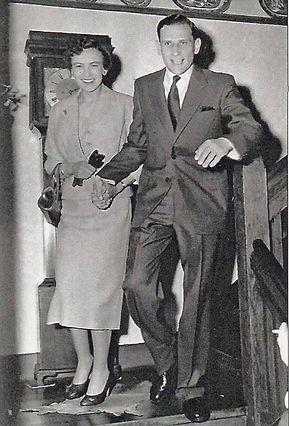
The bungalow was sold in 1981 to John and Sheila Grose, who had married in 1955 (see photo, left) and had previously lived at Horsell and then Mayford. John was born at Bromley in 1923 and Sheila (nee Sheila Ann Kynaston Guyer) in Shropshire in 1929. Both were children of bank managers who had come to work in Woking.
The name of the house seems to have changed at some stage to Heather Cottage (not to be confused with the Heather Cottage at Fox Corner), although the original name still appears on the current OS map. The family lived in the house until 2004, when John died. Sheila, formerly a churchwarden, lived on there until she died in 2017, aged 87, when ownership passed to another family member. Below is a picture of a typically cheerful Sheila in old age.

Suncroft
We think that Suncroft was built c1958. The first owners were John (Jack) and Winifred (Win) Avenell. They had previously lived at Heathfield in Chapel Lane, where we have told their story. John was the son of John (1869-1953) and Ellen (1871-1962) Avenell, and hence the grandson of James (1845-1902) and Louisa Avenell (1844-1928). The latter lived at what is today Stream Farm, and their descendants remained in the Stanford area for many years. We have shown below a press cutting from 1961 of the marriage of John and Winifred’s daughter, Sheila. Several well-known names of Pirbrighters at the time are mentioned. We have also shown photos of Jack and Win later in life.


The Avenells sold Suncroft in the 1980s to John and Jennifer Butcher. The Butchers remained at Suncroft until 2014, when they sold the house to the current owners.
Stanford Cottage (prev, for a short while, Oak Cottage)
The earliest records we have of Stanford Cottage are the 1781 land tax records, which show that it was owned and occupied by a Jacob Watts. We think that Jacob was born in Pirbright in 1709, the son of another Jacob Watts. He married Sarah Frost in Horsell in 1738. Some of the original features, including beams and the fireplace, can still be seen.
Jacob died in 1782 and the property passed to their son, George Watts. George had been born in 1741 in Cobham (and baptised on Christmas Day). He married Elizabeth Stovell (born 1852 in Worplesdon) in Pirbright in 1774. In the marriage register, both gave their occupation as servants. In 1781, George was the Village Constable.
In the 1805 survey, the cottage was recorded as being owned by Henry Halsey 1 and leased by George Watts. This contradicts the Land Tax records (which continued to record that George paid the tax, suggesting he was the owner). However, sometimes in those days leaseholders would pay the tax and reclaim it from the owner, so it is probable that, in fact, the cottage was owned by Henry Halsey 1 (as Lord of the Manor) and leased to George Watts.
Elizabeth died in 1818, and George died in 1820. They were both buried in Pirbright, although George’s abode in the Pirbright burial register was Greenwich, which is odd.
James Watts (George’s son) paid the Land Tax up to 1825, suggesting that the lease was still held by the Watts family, and the property sub-let. However, from 1826 to 1831 Henry Faggetter paid the tax as the occupier, and so we think that, by then, the lease had been re-assigned to him. The Faggetters had been in Pirbright from at least the 1500s, so there were plenty of them in the village, mostly in the building trade in the 1800s. Henry may have been a bricklayer, but there were three Henry Faggetters living in the village at this time, and difficult to tell which was which.
At some stage in the 1820s, Henry Halsey 2 amalgamated the 4 acres of land with the land of Stanford Farm (refer above). In 1841 it was farmed by Henry Collier. The size of the new farm was c27 acres. Henry Collier also farmed another 31 acres which lay just south of Pirbright Green.
Unfortunately both the 1841 census and the Tithe details are vague as to where people lived (except for Sarah Turner, who lived where the Royal Oak is today), and so we cannot be at all certain who lived in Stanford Cottage. We can be sure that the following families lived in the Stanford area, one of whom presumably lived at Stanford Cottage. It’s just that we can’t be sure which family it was.
-
Richard and Elizabeth Rose. Richard was a 65 year-old farmer.
-
Elizabeth Newey, a 61 year-old widow who was living on her own means.
-
James and Ann Rose and family. James was a 39 year-old agricultural labourer.
-
Steven and Hannah Stonard. Steven was a 58 year-old farmer and we would guess that he lived at Stanford Farm (refer section above).
-
Anne Callaway, a 67 year-old lady who was living on her own means.
However, there is a later connection between Stanford Cottage and members of the Rose family (see a few paragraphs below), and so our hunch is that the occupants in 1841 were James and Ann Rose. That is what we will assume below. Trigger warning – the next few paragraphs get a bit complicated....
James Rose was born in 1802, the son of Arthur (who we’ll call Arthur 1 from now on) and Mary Rose. Arthur 1 (an agricultural labourer) and Mary (nee Rose) had married in Pirbright in 1802. In fact they were cousins, and Arthur 1 was only aged 16 at the time of his marriage. James (their first child) was born just 3 weeks after their marriage. He was born in Windlesham (presumably to avoid too much embarrassment, but we suspect there was probably quite a bit of tittle tattle about it in Pirbright).
Ann was born in Pirbright in 1808, daughter of John and Mary Stevens. James and Ann were married at St Michael’s in 1826. Ann was only 17 at the time of her marriage. They proceeded to have 6 children, one of whom, Eliza, later had 2 illegitimate children.
In 1851, again, the census is unclear as to who lived where in the Stanford area. We will continue our hunch, and suggest that Arthur and Mary Rose were living in Stanford Cottage. They appear as one of the 2 families in the 1851 census living at “Lower Sanford”.
These are NOT James’s parents who we mentioned in the previous paragraph. No, this Arthur (Arthur 2) was James’s younger brother, born in 1805, again in Windlesham. In 1829 Arthur married Mary Trodd (born in Guildford in 1811) and they had 6 children. Arthur was a labourer.
In 1861, the story is the same – it’s not clear who lived in Stanford Cottage. Our best guess is that John and Ann Turner and their family had moved in from the cottage next door (which by 1861 had been converted into a beerhouse). For more information on the Turners, please refer to the Royal Oak section above.
We think that James and Louisa Avenell were living at Stanford Cottage in 1871 (although again it is not clear from the records). The Avenells were soon to move to Fillmoor (today’s Stream Farm) and we have told their story there.
We are on surer ground by 1881, as the Pirbright Rate Books have miraculously survived from 1881 to 1912 (albeit with a 5-year gap in the middle). The rate books show the occupier of ‘Stamford Cottage’ was Edward Collyer, and the owner as being Henry Halsey. The census of that year confirms Edward and Elizabeth Collyer as living a couple of doors down from The Royal Oak.
Edward was born in 1842 in Pirbright, the son of Edward and Sarah Collyer, who had lived at West Heath and then Pirbright Green. Edward was a labourer. Elizabeth was born Elizabeth Woolford in Odiham in 1848, the daughter of a railway labourer. By the time she was 13 she had moved to Pirbright and was working as a servant in the house of John and Mary Ann Glover at Gibbs Cottage. In 1871 she married James Ironmonger, an engineer living in Kennington and they had 2 children. Within 5 years, the family had moved to Pirbright (although we don’t know where they lived). But James died in 1876, aged only 29. Elizabeth remarried (to Edward Collyer) in 1878 and they had 4 children.
By 1883 the Collyers had moved to Vapery Lane, and later to No 5, Longhouses, where we have told their story.
The next tenants from 1883 were Arthur and Emma Rose. Arthur (we’ll call him Arthur 3) was the son of Arthur 2 and Mary (nee Trodd), who had lived in the cottage in 1851 and 1871. Arthur 3 was born in 1840 in Pirbright.
Emma (nee Hartfree) was born in Worplesdon in 1827, the daughter of an agricultural labourer. One of her 7 siblings was William Hartfree, who gave his name to the plantation of trees formerly on the 11th and 12th fairways of Worplesdon Golf Club. In 1849 Emma married William Simms, a brickmaker. They lived in Effingham and had 2 children, Edward and Eleanor, but William died in 1864, aged 39.
Arthur and Emma married in 1867 in Woking and had a child of their own, Emily. In 1871 the family were living at Bridley, where Arthur worked as an agricultural labourer. By 1881 they were living in Normandy, but in 1883 they moved to Pirbright, which is where they would stay. Emma died in 1896, but she lived long enough to see her daughter, Eleanor Simms, marry John Chandler here in June 1895.
Confusingly, by 1901 the property had changed its name to Oak Cottage, occupied (since 1899) by John and Eleanor Chandler and their children plus the widowed Arthur Rose 3. John Chandler was born in 1864. His grandfather, William, had come to Pirbright from Ash in the early 1800s and established a dynasty in the village, including John’s father, Charles. They all worked the land, in John’s case as a gardener at Brookwood Cemetery, at this time a sizeable employer.
Eleanor Chandler was none other than Eleanor Simms, who we mentioned 3 paragraphs earlier. She had a rather mysterious background, which we have told in the section dealing with No 5, Stanford Cottages above.

Ten years later, by 1911, the cottage name had resumed as Stanford Cottage, John still tending the gardens at the Cemetery. Arthur Rose 3 was still living there, employed as an agricultural laboured, aged 70. Most impressive!
Two years after this census, in 1913, with the Great War looming, John Edward, the Chandlers’ elder son, left school and became a gardener, probably at the Cemetery like his father. As he was born in January 1899, once he was 18 he had no choice but to be conscripted in 1917 into the 2nd Battalion, Northamptonshire Regiment. Here is a photo of him, looking so young, just four years out of school.
He had only been in France for a month before he was captured on May 27th on the Aisne after a surprise German attack which almost wiped out the battalion. The report below appeared in the Surrey Advertiser for August 30th 1918. Sadly, a request to Berlin via the Red Cross reported that he died on September 8th, just a few days later than this report, ‘nothing further known’. Not until May 1919 were his belongings returned to his grieving parents. Luckily their younger son, Charles James, was not born until 1901, so just escaped the horrors of the Great War and went on to marry. In fact, jumping ahead to 1939, he was living at the bungalow next door to Stanford Cottage (today, Brookmead - refer section below).
Arthur died in 1917. He and Emma are both buried in St Michael’s Churchyard. Meanwhile John and Eleanor Chandler remained at Stanford Cottage. By 1921 John had become a roadman, working for Guildford Rural District Council, and they soon moved to No 5, Stanford Cottages (refer section above), where we tell their story in more detail.
Left is a photo taken in 1920. From the brick dentil (i.e. in & out) course under the eaves, the cottage appears to have been built in the 18th century, like a number of Pirbright buildings with this feature (The Cricketers and Linnards, for example). The brick and wood building in front was almost certainly used for storing hay, straw and turves cut from the nearby Peat Moor for heating.


1922 saw the ownership of Stanford Cottage change hands. By the end of WW1, Henry Halsey 4’s finances were in a parlous state, as explained in the Halsey family section. He had been financing his rackety lifestyle at the gaming tables of Monte Carlo by vastly exceeding his income and in 1919 was forced to sell a number of farms and other properties. In June 1922, together with some other properties, Stanford Cottage was sold to a ‘Mr. Avenell’ for £210. Now we have a problem. Who is ‘Mr Avenell’?
We have shown an extract from the sale catalogue below, showing that the property was about half an acre in size (there are 4 roods in an acre, and 40 perches in a rood). We have also shown (with apologies for the quality thereof) an extract from the sale map. Stanford Cottage is Lot 16 (shaded yellow). It is dwarfed by Stanford Farm (Lot 15, shaded pink). And for good measure, we have shown a newspaper cutting of the sale result. £210 in 1922 is equivalent to £10,000 today.
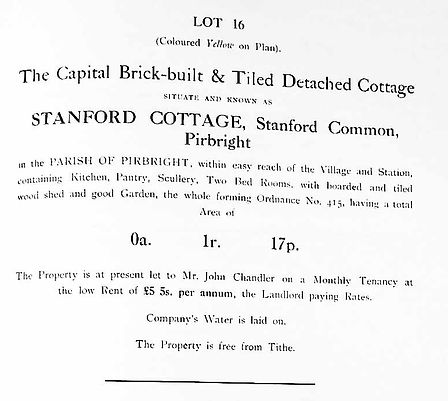


It is a pity that the newspaper report does not specify which Mr Avenell bought the property. There are a number of candidates, but we think that the purchasers were Charles and Ethel Avenell.
Born in 1877, Charles Avenell was the third son of James and Louisa Avenell, who lived at Fillmoor (today, Stream Farm). Back in 1911, Charles was still living with his widowed mother and two of his unmarried brothers at Fillmoor. He was a carman, working on ‘own account’, the equivalent of today’s White Van Man, collecting and delivering all sorts of goods by horse and cart.
Too old to be called up during WW1, in 1916 he married 39-year-old spinster Ethel Edith Smedley. We think they were probably schoolday sweethearts. Ethel was the daughter of an Irish soldier, John Smedley, who had married a Pirbright girl, Mary Saunders, at Aldershot in 1879. For less than a year, while their parents were living in the village, Ethel & her sister Phoebe went to Pirbright School in 1887, at the same time as Charles Avenell and his brothers. The next year, the Army posted the Smedleys away and John died in 1899, but in the 1911 census, when Ethel was a housemaid to a Yorkshire draper, her widowed mother and sister had come back to West Heath, Pirbright as a nurse and nurse attendant. Ethel might have come to visit them in Pirbright and may have met up with Charles again.

The couple initially lived with Charles’s widowed mother in Fillmoor (today’s Stream Farm, please refer to the Stanford West section), probably helping to care for her. They had no children. So who lived at Stanford Cottage? The answer is Albert Avenell, Charles’s younger brother. As he was five years younger than Charles, Albert was liable for call-up in the Great War and left is a photo of him in uniform. He probably joined the 13th Battalion (West Kensington), London Regiment.
Like Charles, Albert married late, at 47, to one of the Faggetter clan, Elizabeth Ann Faggetter, a spinster of the same age. They would have also have known each other at school. Right is a photo of the happy couple in June 1929, with best man Sydney Faggetter behind. After the marriage, Albert and Elizabeth moved out of Stanford Cottage to Church Cottage, where Elizabeth Ann was looking after her elderly father.

After Charles’s mother’s death in 1928, Charles and Ethel Ellen Avenell moved into Stanford Cottage (which they owned), and it became their home of for the rest of their lives. In the 1939 Register, Charles had changed his occupation to become a Jobbing Gardener. Charles died in 1947 and was buried in Pirbright Churchyard, with no headstone. Ethel Ellen was buried with him just under a year later, on May 29th 1948.
c1949 to 1954, Peter and Madge Nichols lived at the cottage. We don’t know for sure, but we assume that they bought the cottage from the Avenell executors. Peter was born in Teddington in 1920, the son of a master baker. In 1939 he was helping his father in his bakery business. He spent WW2 as a Petty Officer, serving in minesweepers. Madge (nee Madge Ellen Olive) was born in 1918, the daughter of a garage manager. Her family lived in Send, and in 1939, Madge was a hairdresser. Peter and Madge were married at Send Church in 1945. They had 2 children, but we think that the marriage may have foundered, as a Madge E Nichols was living in Guildford solo from 1954 and may have remarried in 1973. We’re not sure where Peter lived after leaving Pirbright.
In 1955, newly-weds Anthony Jack and Frances Trenchard arrived and started a family, with two sons. Anthony was born in the Guildford area in 1928, while Frances, nee Smardon, was born in Devon in 1929.
In December 1966, Frances had a little traffic accident when trying to navigate the sharp left-hand turn in Hook Heath Road on the way to Woking. She had not known of the existence of the bend (apparently), approached it too fast, skidded across the bend and hit a Rover car coming in the opposite direction. Also apparently, she had to get up out of her sick bed to take her children to school, as another mother (whose turn it was) couldn’t take them. The children were in the back of the car. Frances was fined £20 (equivalent to £300 today) and had her license endorsed. The cottage was later subject to a robbery (in 1967).
The Trenchards’ marriage must have broken up a few years later. Both remarried (in 1979 and 1980). By 1970, Richard and Jean Wall were living at Stanford Cottage. They had married in Aldershot in 1964, but this was after a difficult year, as explained in the press cutting (right) from 1963.
By 2002, Martin J & Janet M Cassidy had purchased Stanford Cottage. They had married in the Bracknell district in 1986, where their son Andreas was born in 1991. The cottage was sold to the current owners in 2021. A recent agent’s photo is shown, below.


Brookmead
In 1922, a bungalow was built on the land now comprising both Brookmead and Fernbank. We have shown part of the building plan right. It is difficult to read, but there is some useful information contained therein. It is also upside down (ie the top is south, and the bottom, north). Here are the points which interested us:
-
The person who owned the land (which was just over an acre in size) was Mrs E Jelly. This was Ethel Jelly, the wife of Septimus Jelly. We have written about them below.
-
The plan was approved, but on condition that Mrs Jelly would remove the bungalow if asked to do so.
-
The land to the west of the plot (ie the right hand side of the map) was War Dept land, which could have had something to do with the condition (in the point above) laid down by the council.
-
The strip adjoining the Aldershot Road was also War Dept land (for unknown reasons). However, the strip had a narrow “Cart right of way” across it. The strip can still be identified visually today.
-
The land to the south of the plot (ie at the top of the picture) is marked as Mr NC Hony’s land. This was Norman Charles Hony (1876-1955), who lived at Clewes Farm, Bisley. Born in Cornwall, he became a bank clerk, then a farmer, and finally, after leaving Surrey, a clerk in Holy Orders. Why he bought a field with no road frontage in Pirbright is anyone’s guess.
A “Sidney and Mary Jelly” lived in the bungalow from 1923 to 1928, according to the Electoral Register. Strangely enough, we can’t trace these people, despite the uncommon surname. Given that Septimus and Ethel Jelly (who had built the bungalow) don’t appear at all on the Electoral Register in Pirbright for those years, we suspect that it was some form of clerical error and that it was indeed the wonderfully-named Septimus and Ethel Jelly who had lived in the house since it was built in 1923. It was almost certainly originally an ex-WW1 hut. The Jelly’s receipt (see left) shows that it was a real bargain at £22 (equivalent to £900 today).


In 1921, Septimus and Ethel had been living at Vines Cottage. Septimus was a farm labourer, working for Alfred Fry at Stanford Farm (refer section above). And Ethel was in fact Alfred’s younger sister. Septimus had been born in 1872 at Wisley, the son of a “general labourer”. Ethel (nee Fry) was born in 1883 and grew up on Stanford Farm with her family (see separate page on the Fry family here).
They were married in 1906, when Septimus was a coachman at Stanford Farm and they had one daughter. In 1911 they were living on Heath House Lane, where Septimus worked as a coachman. The reader might wonder how the Jellys could have afforded to build a new bungalow, given that Septimus was on a labourer’s wage. We assume that it was done using Fry family money (which is why the bungalow was in Ethel’s name, not Septimus’s). Living at the bungalow would have certainly shortened Septimus’s daily journey to and from work.
They had one daughter, Kathleen Ivy Jelly, born in 1907. Ethel died in 1929, aged only 46. Septimus was a poultryman (presumably at Stanford Farm) at that time, but by 1939 was a night-watchman. Their daughter, Kathleen Jelly, was living in Knaphill when her mother died in 1929, but she immediately moved back into the bungalow with her widowed father. The photo, right, is of the bungalow in the late 1920s, with Ethel (left) and Kathleen (right). The body language seems to suggest a slightly frosty relationship.
In 1933 Kathleen married Charles Chandler at St Michael’s Church. Charles, born in Pirbright in 1901, was the son of John and Eleanor Chandler, who lived just along the road at No 5, Stanford Cottages (see section above). We have shown a picture of their wedding, left.
As far as we know, Charles and Kathleen had no children. They lived at The Bungalow with Septimus until the latter’s death in 1949. Although we are not certain, we have been told that the photo, below, is of Septimus in old age.


Charles was a plasterer. He died in 1964, but Kathleen, who was an auxiliary nurse, remained in The Bungalow until her death in 1994, aged 90. We have shown a notice of her death, left. Kathleen had lived in The Bungalow for nearly 70 years. Is this a record for Pirbright? We will reveal when we have finished this project….
It looks as though part of the Bungalow’s land was sold off in the late 1950s for the construction of Fernbank (refer section below). After Kathleen’s death, we think that the bungalow was demolished, and a new house, Brookmead, built in its place. The new house was sold in 1999, 2001 and again in 2002 to the current owners.
Fernbank
As stated in the Brookmead section above, we think that Fernbank was built in the late 1950s on land that had been carved out of the Brookmead plot. The first owners, c1957, were a Gilbert and Winifred Simpson. We don’t have any information on this couple, except that they moved out of Fernbank c1970. The next owner from c1972 was a Mr CJ Studd. He extended the house and moved out c1979. The house was sold to the current owners c1980.
