

Stanford - West
This section covers the 14 properties in the Stanford area to the west of the Aldershot Road, working from north to south, ending way down the track going south-west past Stream House. We have shown the area via 2 extracts from the current OS Map (with thanks, as always). The area can be a little confusing to those who don’t know it well, but the buildings on the map marked as Stream Farm and The Kennels are the links between each map. The long track in the left-hand map is a super walk (one of the author’s favourites). It goes past Stream House and joins the “road” coming up from the Aldershot Road, which ends at Henley Gate into the Ash Ranges. Henley Gate is shown at the very bottom left-hand corner of the map. Henley Lake and The Ranges themselves are not shown though.
We have also included a table showing when each property was built.


We have written in general terms about the earliest days of these properties in the Stanford – East section. We have also written more property-specific early history details in some of the sections below. In earlier days, the land was fairly open, divided into fields. The area was called Fellmoor or something similar, eg Fillmore, but these names fell out of use in the mid-1900s.
We will first look at the cluster of 9 properties that lie to the north of Stanford Brook, ie starting at Berrylands Livery Stables, and finishing at Moyana. We’ll then cross the Stanford Brook and look at the 5 more isolated properties (ie Stream Farm to Wood House).
Properties to the north of the Stanford Brook
Below, we have shown the 1807 survey map and the 1915 OS map. The current OS map of this area is also shown below.


There are some points of interest:
-
The area occupied by the 9 properties today maps fairly well to the 2 easternmost fields coloured blue on the 1807 map. These fields can also be identified easily on the 1915 map.
-
The blue fields were owned in 1807 by George Tate (who we have written about in the Fords Farm section).
-
The Stanford Brook in the southern part of each map seems to act as a bit if a barrier. The land on each side was always owned by different people.
-
The 1915 map shows only one building in the area – Stanford House.
On the 1841 Tithe map, the area comprising today’s 9 properties (4 acres in size) was owned by The Rev John Fitzmore Halsey, and farmed by Stephen Stonard. We have written about the Rev Halsey in the Hazel Acre section, and Stephen Stonard in the Fords Farm section.
We’ll now look in more detail at each of the 9 properties.
We will start on the north side of the brook, covering the 9 properties that are near the Aldershot Road, working north to south. We start at the far end of the lane which runs north-west off the Aldershot Road for about 200 yards.
Dingley Dell Farm
The large (20-odd acres) area at the far end of the lane off the Aldershot Road is a farm called Dingley Dell Farm. It is owned by a company called Optichrome. This is the family-owned printing company founded by Ken Stephens, who lived at the house Dingley Dell (now renamed Givat Chayim with its own section further down this web page).
The land comprises most of the land that Ken lovingly bought in the 1950s with his partner, Norman Nowell. He later bought out Norman Nowell’s share of the property, and converted it from scrubland into farmland in the 1960s. There are covenants preventing any residential building on the site. We have shown some photos of the farm (including some of the conversion process) in the Givat Chayim section below. And here’s a photo of Wilf Fry on his land (which backs onto Dingley Dell Farm in the distance) in the 1970s or 1980s judging by the existence of the smokery in the background.

As well as an active farm, the property is home to the Dingley Dell Dog Training and Agility Club.
Berrylands Farm (Prev Berrylands Cottage)
Berrylands was built c1930 for David William Bayliss, about whom we have written in the Cosy Nook section below. We have shown an extract from the building plans below. With just 3 rooms and an EC (earth closet) outside, the house would have been quite cosy. But as the plan states, the house had 2 acres of land attached. It was originally called Berrylands Cottage. The name Berrylands raises the question as to whether the house was named after the suburb near Kingston, which was being built at the same time (c1930). Unlikely, maybe, but we’ll probably never know for sure.

The first occupants were Frederick (Fred) and Kathleen Bayliss. They had married in Guildford in 1931. Fred was David’s younger brother, born in St John’s in 1905. Fred’s father was David Goliath Bayliss, about whom we have written quite a lot in the Stanford House section below. Kathleen (nee May) was the daughter of Ernest and Katherine May, who joined them in Berrylands during 1933-34, before moving to Barnhurst and then Dunromin (which were the two halves of the next-door building – see sections below).
Fred and Kathleen had a woodyard at the property, but also farmed pigs on their 2 acres. The name of the house was changed to its current name, Berrylands Farm, c1938, suggesting that the business was growing in size. They employed other Pirbrighters, for example John Coneley, who lived at Green View, Chapel Lane.
In 1936 Fred had been up before the bench for having an unlicensed shotgun and carrying it in his car. By today’s standards the fine of 5 shillings (£15 today) seems pretty lenient. In 1953 Fred was fined £1 (£25 today) for driving a motor-lorry with a defective tyre. A patch 10 inches by 3 inches had worn right through one of the back tyres, and as a result the vehicle was wobbling. His father, David, was fined £2 for allowing the vehicle to be driven in that condition. We have shown press cuttings of both incidents, below.


We have shown, right, a great photo of Fred Bayliss (on the right) walking 2 horses in the woodyard. A neighbour remembers playing as a young lad in the woodyard, but having to keep clear of the Bayliss’s Alsatian dogs (alas, not always successfully!).
Kathleen died in 1952, and in 1954, Fred remarried Bessie Eva Tucker (born 1914). Bessie was the daughter of George and Eva Tucker, who had lived at Rails Farm just before WW1. Tragically, Bessie’s father, George Tucker was killed in France in the early stages of WW1 when Bessie was only 9 months old. Bessie’s mother, Eva Tucker (nee Etherington) then remarried Alfred Fry in 1916 and so Bessie spent her early days with the Fry family, first at Stanford Farm, and then at Vines Cottage.
In the Stanford House section below we have shown a photo of Fred and Bessie’s wedding in 1954 and a separate photo of Bessie wheeling a wheelbarrow. Fred and Bessie stayed at Berrylands Farm until 1969. They moved to Hastings, where Fred died in 1981. Bessie died in 1995 in Surrey.
The next occupant of Berrylands was Vandella Spirgel-Sinclair. She purchased the property in 1969 for £9,000 (equivalent to £130,000 today). At that time the property consisted of the bungalow with stables, outbuildings, a mobile home and 10 acres of land, but we think that Vandella initially purchased only 2 of the 10 acres. She may have purchased more of the land over the next few years, as the property today seems to be around 7 acres in size.
Vandella’s father was one Henry Spirgel-Sinclair. Henry had been born Heinz Simon Spirgel in Berlin in 1920. We think that he and his family entered the UK between the 2 World Wars. The name Spirgel seems to derive from Latvia and Estonia. By 1939 Henry was a Wireless goods sales rep living with his parents and sister in Luton. Just to make sure he was recorded properly on the 1939 Register he appears on the Register twice under different addresses. By 1950 Henry had changed his name to the (questionably) more British-sounding Spirgel-Sinclair.
Vandella was born in Luton in 1944. Her mother’s maiden name was Renwick, but we cannot trace her. By 1965 Vandella was living in Rickmansworth at a property called Home Farm, and by 1969 she was living in Ash. She never married, but seems to have been a keen horse-rider.
For 20 years Adele Summers lived at Berrylands. She was born locally (not Pirbright) in 1948. We have shown (right) an amusing cutting from The Mirror of 1985 featuring Adele (Trigger warning - unacceptable language). Vandella is referred as “...her partner Vanella Williams”. The Mirror provided us with a suitable headline: “FIT OF PEKE”. In a separate article, the Daily Express confirmed that Vandella and Adele ran a kennels business together. We have no idea why Vandella used a false surname though.
Vandella moved to Farnham c2011 and died there in 2014.
The current owners bought the property c2011, demolished the old bungalow and built a new house. The property now hosts Berrylands Livery Stables. There are plenty of photos of the Stables available on the internet, so we have not shown any here.


Barnhurst
The building comprising Barnhurst and Dunromin was built in 1932 on land owned by David Bayliss, who lived in Stanford House (refer below). We have shown 2 extracts from the plan, right and below. The building has changed little externally since it was built. In particular, its distinctive curved roof (in the style of a large Nissen Hut) is clearly shown on the plan. At that time, Stanford House was the only other building on the lane, although the ghostly shape of Birches (see section below) can be seen between the 2 buildings, pencilled in by a council planner when an application was submitted to build it in 1945.


We should draw the reader’s attention to the small area to the north (which we have taken the liberty of colouring blue). This area appears as water on the 19th century maps, but is today a field (partly overgrown with brambles), its shape hardly changed from earlier days. We suspect that it gets quite damp in winter.
We assume that the name “Dunromin” was a product of David’s sense of humour regarding names (for far more extreme examples of his sense of humour, please refer to his choice of his childrens’ names in the Stanford House section below). “Dunromin” actually first appeared as a UK house name in 1926, and became popular over the ensuing years. Other examples of house-name humour at this time included “Bedside Manor” and “Wit’s End”. Fortunately neither of these names seems to have occurred to Pirbright homeowners.
It seems that David Bayliss’s plan was to let the 2 houses (Barnhurst and Dunromin) out. The first occupants of Barnhurst in 1933 were Cyril and Clarice Pink. Cyril was born on the Isle of Wight in 1913, the son of a labourer. Clarice (nee Barrett) was born in Knaphill in 1905, the daughter of a gardener. c1918 her family moved to No 8, Stanford Cottages. They married at St Michael’s in 1933, when Cyril was working as a butcher in Woking. Moving into a new-build like Barnhurst must have seemed like an ideal start to their married life. The first of their 2 children arrived a year after they married.
c1935 the Pinks moved to Send, where Cyril worked as a dairyman. In 1939 Cyril’s car was stolen in Knaphill . A policeman in Esher who knew about the theft (we wonder how?) spotted the car being driven up the A3 with 4 men in it. He stopped a passing car and gave chase. The men were caught at Thames Ditton. It seems that car thieves today have become a lot more savvy, and police a lot less effective at catching them, than in 1939.
The next tenants from 1935 were Eva Mary Grace and some co-tenants.
Firstly, Eva Grace. She was born in 1892 in Oxfordshire, the daughter of Henry and Susan Grace. Her family moved to Pirbright in 1899 and lived at No 2, Longhouses. Her elder brother, Leonard Arthur Hickey Grace, died at Thiepval in September 1916. We have told his story in our WW1 section. Eva never married. She left Barnhurst in 1950 (for a reason which will become apparent 4 paragraphs down) and died in 1966, living in Connaught Road, Brookwood.
Of the other tenants, we should mention Christopher Charles (“Chris”) Smith and Lilian Grace Madden, who lived there from 1935 to 1937. Chris was born in Wiltshire in 1890, the son of a carter. He worked as a nurseryman. Lilian’s previous abode had been Stanford House (refer section below) for a year, and before that she had lived at No 16, Pirbright Gardens, where we tell her early story. They married at St Michael’s Church in 1937 and moved to No 5, The Gardens. Chris died there in 1951 and Lilian remained there for a while. We think that she died in 1968.
We should also mention Ernest Edward May, who lived in the house for 13 years between c1937 and 1950. He was born in Redhill in 1876, the son of a coal merchant and married Katherine (who was born Katherine Dempster in Midhurst in 1879, the daughter of a hotel proprietor) at Woking in 1908. During WW1 Ernest served in the Labour Corps. They had 4 children and lived in a caravan in the Goldsworth Park area in the 1920s, with Ernest working in the coal and corn trades. Katherine may have died in 1933, which prompted the family to move to Pirbright. In 1933-34 Ernest lived just along the road with his daughter and her husband (Kathleen and Frederick Bayliss) at Berrylands Cottage (see section above). During 1934-35 they lived at Dunromin.
In 1937 his son (also called Ernest), who was a firewood merchant, was hauled up before the magistrate for cruelly overloading a horse. The horse could only pull the cart (full of firewood) 20 yards without stopping. The RSPCA inspector said it was the worst case he had ever known in his 30-odd years of experience. Young Ernest was sentenced to one month’s imprisonment. Old Ernest left Barnhurst in 1950 and died at Burpham Homes in 1965.
Then, in 1950, both Barnhurst and Dunromin were put up for sale (causing both tenants to leave). We have shown 2 pages of the sale documentation below.


The accommodation looks pretty sizeable, considering that both houses were bungalows. The Hartley Range was a cast-iron stove, made by Hartley and Sugden of Halifax and was clearly worth a mention. The Earth Closet sounds less appealing though.
But to a historian, the most interesting item by far is the names of the sellers, the executors of Miss ME Percival. No-one of this name had ever lived in Pirbright, or was related to the Bayliss family (who had built the houses 11 years earlier). Who was Miss ME Percival?
The answer is that she was Margaret Ellen Percival. Margaret was born near St Albans in 1858. Her father, Stanley Percival, was a wealthy farmer of 380 acres, who retired to the very grand Hermitage in Knaphill. Stanley died in 1902, leaving an estate of £41,000 (equivalent to £4.3 million today). We give our great thanks to the Woking historian Iain Wakeford at www.wokinghistory.org for the 2 pictures below (of The Hermitage and of Stanley). Maybe one of the ladies in the left-hand picture is Margaret? Stanley bequeathed 2 houses in Woking to Margaret, as well as a quarter of his remaining estate, so Margaret had become a wealthy lady.


Margaret never married, but continued living in the Hermitage until the 1920s. The Hermitage was knocked down in the 1930s to form the Hermitage estate, which probably provided Margaret with another pile of cash to invest. We assume that, during her 50-odd years in Knaphill, she came across David Bayliss, and he persuaded her to invest part of her cash in Barnhurst and Dunromin. In 1939 Margaret and her brother (a clerk in Holy Orders) were living in a house in the leafy Heathside Park Road in Woking. Margaret died in April 1950, aged 91 and her executors (one of whom was her brother) lost no time in obtaining probate and then putting Barnhurst and Dunromin up for sale. Margaret left an estate of £30,000 (equivalent to £900,000 today).
We are not sure who purchased Barnhurst in 1950. And rather strangely we can’t find any occupants in the Electoral Register over the next few years. However, we have found a reference to a Hugo and Anna Jasdrow living there in 1957, at which time Hugo was an animal technician, (doubtless working at the Pirbright Institute). Anna was born Anna Weiss, and they had married locally (but not in Pirbright) in 1955.
The surname Jasdrow is extremely rare. One website has found that only 7 people (ie probably just 2 families) in the world bear the name – one in England and the other in Germany. The name originates in Poland, possibly denoting Jewish origin. If Hugo had arrived in England during or post-WW2, then he would probably have not had sufficient residence years to be on the Electoral Register. Hence our earlier difficulty in finding out who lived at Barnhurst after 1950 – Hugo (and possibly Anna) may have been living there, but not qualified to be on the Electoral Register. They may have been the purchasers of Barnhurst in 1950, although, as we have explained in the Dunromin section below, we wonder if instead, it may have been Pirbright Institute (in which case the Jasdrows would have been tenants). Hugo and Anna moved to Church Close, Brookwood in 1968 and were still living there in the early 2000s. We think that Hugo may have died at Woking Hospice in 2020.
In 1968 the current owners bought the house, and have lived there for over 50 years.
Dunromin
The building comprising Barnhurst and Dunromin was built in 1932 on land owned by David Bayliss, who lived in Stanford House (refer below). We have shown 2 extracts from the plan and made some observations on it in the Barnhurst section (above).
We assume that the name “Dunromin” was a product of David’s sense of humour regarding names (for far more extreme examples of his sense of humour, please refer to his choice of his children’s’ names in the Stanford House section below). “Dunromin” actually first appeared as a UK house name in 1926, and became popular over the ensuing years. Other examples of house-name humour at this time included “Bedside Manor” and “Wit’s End”. Fortunately neither of these seems to have occurred to Pirbright homeowners.
It seems that David Bayliss’s plan was to let the houses out. The first tenants were Catherine Ibbs and her children William Ward and Evelyn May Ibbs. Catherine (nee Puffitt) was born in 1878 near St Albans, the daughter of a domestic gardener. Her family moved to Hampstead and she worked as a dressmaker.

In 1910 she married Ward William Ibbs in Farnham. Ward had been born in Shropshire in 1887, the son of a “Fancy draper”, which meant that he sold specialised and fashionable goods, as opposed to your ordinary draper. However Ward’s parents’ marriage didn’t last and he was brought up by his mother.
Catherine and Ward had 2 children while living in Hampstead. During WW1 Ward became a Sergeant in the Royal Army Service Corps. After WW1 the family moved to Knaphill, where Ward worked as an attendant in Brookwood Asylum. But Ward died in 1931, aged only 43, at which time the family were living in Hospital Cottages at Knaphill.
Catherine and her 2 children moved into Dunromin in 1933. During their stay at Dunromin, Evelyn married Walter Aiken (a sailor on HMS Iron Duke) at St Michael’s Church. In 1937 Catherine and her son William moved to Chitty’s Common (off Keen’s Lane on the Worplesdon Road into Guildford), living next door to Evelyn and her new Aiken in-laws. Catherine died locally in 1957.
Left is a wonderfully natural photo of Catherine and Ward, taken we would guess soon after their marriage.
The next occupants of Dunromin from 1937 were Francis Edward and Gertrude Ellen Tanner. Francis was born in 1911 in Paddington, the son of a milk carrier. By 1921 the family had moved to Amesbury, where Francis’s father was a farm bailiff. By 1925 the Tanner family had moved to Pullens Farm.
Gertrude (nee Buck) was born in 1905 in a village near Norwich called Hempnall (today near to a Tank Museum and a Steam Museum), the daughter of a carpenter. In 1921 she was working as a housemaid, one of 8 servants living in a large house in Diss. We don’t know how the couple met, but they married in Guildford in 1932. 6 months later their first child arrived, and another 3 quickly followed. They initially lived at Pullens Farm with Francis’s parents. But they managed to escape the in-laws in 1937 and moved into Dunromin, where Francis worked as a pig man. Francis was a member of the Pirbright Home Guard in the early stages of WW2, but was called up for service in 1942. He achieved the rank of Corporal in the Royal Corps of Signals, being mentioned in dispatches in 1945 for distinguished service.
In 1950, both Barnhurst and Dunromin were put up for sale (causing both tenants to leave). We have described this in some detail (including an explanation of why the houses were being sold) in the Barnhurst section above. We are not sure who the purchaser in 1950 was, but it is possible that it was the Pirbright Institute. We have 3 reasons for thinking this:
-
The Institute was certainly trying to find nearby accommodation for their staff at the time (refer sections on Upper Stanford Road, Bridgemead and Bullswater Common Road).
-
The occupants of both houses during the next 18 years worked in areas of relevance to the work of the Institute.
-
Both houses appear to have been sold again at the same time (c 1968).
But we don’t know for sure. Any information on this would be welcomed...
In any event, the purchaser allowed the Tanners to continue living in the house. In 1954, their eldest child, Frances, was very sadly killed in a road accident in St John’s. At the time, Frances was riding a motorcycle to her workplace (Skeet & Jeffes Ltd, an ironmonger in Church St, Woking).
In 1959 their younger daughter, Beryl, married Charles Wicks at St Michael’s Church, and the newly-weds stayed with Francis and Gertrude at Dunromin for a while. Francis and Gertrude moved to the Fairlands estate, we think in 1968. Gertrude died in 1990 and Francis in 1993. Their ashes were buried in St Michael’s Churchyard.
We have shown photos of Francis and Gertrude in their younger days below, together with a wonderful portrait of Francis in army uniform. We’re not sure what happened to the early photo of Francis – it has certainly seen better days.


The Birches (aka Birches)
The first plan for building The Birches was submitted in 1945 by John Denman, who lived at No 6, Stanford Cottages, where we tell his story. We have shown an extract from the building plan below.

The planning application may not have been accepted, and it is not until 1954 that we can find a record of occupants of The Birches. The Electoral Register shows that Herbert, Donald and Sadie Mason were living in “Bungalow, Stanford Common”. This suggests that The Birches was newly-built (as it didn’t have a name), and that the Masons moved in 1953 (as the Electoral Registers usually publish information collected in the previous year). The Mason family (probably Herbert Mason) was in fact the owner of the bungalow.
Herbert Mason was born in 1883 in Woking, the daughter of Edward and Maria Mason junior, who lived at Fords Farm. In 1901 he served in the Boer War as a driver in the Royal Engineers, but by 1911 he had returned to Pirbright and was a general labourer, living with his mother and brother at No 4, The Gardens. A press obituary tells us that he rejoined the Royal Engineers during WW2 and became one of the “Old Contemptible” by fighting in Flanders in 1914.
Herbert married Harriett Boylett (born 1870) in 1915. Harriett was the widow of Cornelius Boylett, who had died in 1907, leaving Harriett with 2 young children. In 1905 they had lived for a year at No 8, Stanford Cottages, where we have told her story, before moving to Sandpit Cottages.
In 1921 Herbert and Harriett were living in School Lane. At that time Herbert was a general labourer in a timber merchant’s yard in Worplesdon. We think that in 1922 they adopted a new-born child, Donald. They then lived at Pirbright Camp, where, in 1939 Herbert was a Range warden. After WW2, we think that Herbert retired from the army, and the Masons became the first tenants of No 5, Rapley’s Field in 1949. But Harriett died the same year.
Herbert and Donald continued to live in No 5, Rapley’s Field, and in late 1949 Donald married Sadie Gosden. Sadie was born in 1930 in Pirbright, the daughter of Ronald and Veronica Gosden, who lived at The Green, and then Hawthorn Cottage (now renamed) in Chapel Lane, where we tell their story.
But, as we mentioned above, at the end of 1949, Harriett died. Herbert, Donald and Sadie stayed at No 5 until 1953, when Herbert bought The Birches. In 1955, Herbert moved into St Luke’s Home for the Aged in Guildford. And thus Donald and Sadie became the only occupants of The Birches in 1955. Donald and Sadie are very well-known to older generations of Pirbrighters for being the landlord and landlady of The Cricketers in later years. We have continued their story in that section.
By 1957 ownership of the house had been transferred to Donald and he decided to sell it (for £3,300, which is equivalent to £70,000 today). The purchasers were James Christopher Lavallin and Alys Jean-Marie Puxley. James was born in 1931, the son of Lieutenant-Commander William Lavallin and Margaret Puxley, who had lived in Heatherwood, where we tell their story.
James joined the Royal Navy (like his father) and became a Lieutenant. He was almost universally known as Ed Puxley (rather than James) probably from a Naval nickname Big Ed (tall with a Big Head - he was 6’2”). James was invalided out of the Navy c1955 with tuberculosis (TB) and was treated at King Edward VII Sanatorium in Midhurst with the latest modern drug therapies for TB that turned it into a curable disease. He subsequently worked for Vickers on the first UK Nuclear submarine, Dreadnought, and later became Chairman of Bisgood Bishop , a prominent jobbing firm on the London Stock Exchange.
We have been told of two stories from his Naval days. Ed he was a young midshipman aboard one of the fleet receiving HMS Amethyst after its escape from the Yangtze River in 1949 after the ship had come under fire from the Chinese Communist People's Liberation Army (PLA). The incident was described in the British press as a dramatic escape, while it was celebrated in the People's Republic of China as a milestone incident that marked the end of Western gunboat diplomacy in China. 6 years later, Ed was a submariner involved in the HMS Sidon accident in 1955 when it was testing an experimental torpedo propellant and exploded in Portland Harbour. 15 people died in the incident.
Alys (nee Alys Jean-Marie Lane, but known as Jean-Marie) was born in Hampstead in 1928, the daughter of Cyril Lane, who was living at Millcroft in Mill Lane and his first wife, Margherita. Jean-Marie has a special claim to fame: she was the second cousin of Jacqueline du Pré OBE (1945-1987), the renowned cellist who married Daniel Barenboim. Her mother, Margherita, died in 1942, aged only 41, and Cyril remarried Evelyn Robinson in 1950.
James and Jean-Marie married in 1955, with a large party at Millcroft, as we have told in the Mill Lane-Central section. They lived for a couple of years in the cottage at the back of Langley House before purchasing The Birches in 1957. They had 2 children. James became chairman of the Pirbright Youth Club. Jean-Marie organised poppy collections for the Pirbright British Legion for 4 years. She did a lot for “Action for the Crippled Child”, which has since been renamed in rather more PC terms “Action Medical Research”.
James and Jean-Marie sold The Birches c1978 and moved to The Charity Farm, Goring Heath in Oxfordshire. They later retired to Brentor, on the edge of Dartmoor. James died there in 1994 and Jean-Marie in 2015.
The next occupants from c1978 were Captain Jonathan Cecil and Hon Caroline Elizabeth Appleyard-List. Names like that need a little explanation.
Jonathan was born in 1935. He was the son of George Cecil Rhodes List and Muriel Appleyard. George was born in Durban in 1902, but was not a relation of Cecil Rhodes that we can see (Cecil Rhodes, who never married, died in 1902). He was instead the son of a jewellery dealer. So we conclude that George probably received his middle names as a tribute to Cecil Rhodes. George became an interior decorator.
Caroline was born in 1935 and was the daughter of David George Arbuthnot and Dorothy Elizabeth Kemeys-Tynte, the 10th Baroness Wharton. The Arbuthnots had a strong military background and were scions of the Arbuthnot Baronetage, whilst Dorothy’s father had been the 8th Baron Wharton. We have seen one newspaper article where Caroline was described as an “equestrian artist”, which we think meant that she painted horses (or rather, she painted pictures of horses).
Jonathan joined the Royal Navy, rose to the rank of Captain and was appointed CBE. They married in 1970 in Westminster and initially lived in Kingston. They had one daughter, Zoe, who in 1998 was reported by a newspaper to be “seeing” Rory Bremner after the latter’s marriage break-up. The article noted that Zoe was a friend of Jemima Khan. We have reproduced the photo accompanying the article (with thanks), right. As a postscript, Zoe married someone else. So did Rory.
In 2000 Zoe launched a charity for the relief of persons suffering from neurological diseases or disorders. The charity received a full page of publicity at its launch, with a large photo of Miss Appleyard, but the charity seems to have lapsed in recent years, judging by its filing history. In the newspaper article she described herself as a venture capitalist, but we have seen her described elsewhere as a socialite.
Jonathan died in 2008, aged 73. Caroline died in 2021, aged 86. Over recent years the house has developed a rather run-down appearance (see the agent’s photo (with thanks) of the front of the house, left). c2023 the house was sold to the current owners.


Stanford House
Stanford House was the first house to be built in the Stanford West area, north of the Stanford Brook. It first appears on the 1895 OS map, but not on the earlier 1873 map. The 1873 Electoral Register records for the first time a William Fry owning a house and land at “Upper Stanford”. This was today’s Stanford House.
William Fry was born at Farnham in 1820, the son of George (a farmer) and Ann Fry. In 1844 William married Eliza Baker (born 1821) in Marylebone. They had 5 children. In 1851 they were living at Black Lake (between Farnham and Tilford), where William was an agricultural labourer. William became a wood broker, still living in Tilford.
We can’t quite work out how a former “ag lab” like William could have managed to amass enough wealth to build Stanford House. In those days manual labourers would have found it next to impossible to save enough to afford to rent a large house, let alone buy one, even if they didn’t have 5 children (like William and Eliza did). And there was no National Lottery, nor even the football pools. Either he was a highly successful wood broker, or his father was a relatively wealthy farmer and, on his death, passed on a large sum to William (although we can’t trace any evidence of this in the records). On balance, we suspect the former. A later press cutting (see below) tells us that the house had 7 acres of land attached.
Many of William and Eliza’s children made a significant impact on Pirbright’s history, so we will briefly look at what happened to each of them:
-
Emma (1846-1927) married Joseph Parlett in Farnham and they had 3 children. Joseph died soon after they married, and Emma (with her 3 children) moved to Pirbright to be close to the rest of her family, living at Rails Cottage. In 1879 Emma remarried Charles Collins, who was living at Stanford House. Charles was the beerhouse keeper at the Royal Oak, where we tell their story. They continued to live at Stanford House (refer below) until Emma died in 1927.
-
George (1848-1906) farmed Stanford Farm, and we have told his story there. One of George’s children, Alfred Fry went on to buy a great deal of Pirbright property. Alfred’s story is told in the Vines Cottage section.
-
Clara (1850-1884) was admitted to Brookwood Asylum as a “Lunacy patient” in 1881 and died there 3 years later.
-
James (1854-1916) married and remained at Farnham, working as a garden labourer.
-
David (1857-1920) was a journeyman carpenter who married Annie Beagley in Godalming in 1892. They settled in Godalming and David died in 1920.
William died in 1884 and Eliza in 1886. William appointed 2 of his sons (George and David) as executors and left the income from his estate to Eliza, and, upon her death, the residue to be divided equally amongst their children.
Below is a photo of Stanford House, probably taken in the 1880s, with Eliza standing proudly in front.

After Eliza’s death in 1886, the property was put up for sale. As the cutting (right) explains, there were no suitable bids. It tells us that the house came with 7 acres of land. It also mentions “fine views”, which today’s trees obscure completely.
No further suitable offers came from outside, and therefore Charles and Emma Collins proceeded to live in the house (which was now owned by Emma). As we have written above, Charles had been the beerhouse keeper at the Royal Oak, while Emma was the eldest child of William and Eliza Fry. Charles had been born in Rickford in 1843, possibly at what is today White Lodge. But after inheriting Stanford House, Charles stood down from his bar work at the Royal Oak and became a farmer of the 7 acres of land.
Charles and Emma had 4 children. One of their children, Emily Collins (born 1886), had married Fred Avenell in 1920. They went on to live at Heather Bungalow on the other side of the Aldershot Road, where we have told their story. Another, Fred Collins (born 1879), who worked as a labourer at Brookwood Cemetery, lived with them at Heather Bungalow.


Charles died in 1909, and the following year Emma put the house up for sale (see cutting left). With 4 bedrooms and 2 sitting-rooms, the house was a very good size, not to mention the 7 acres of land. But the house remained unsold, and Emma remained at Stanford House until she died in 1927, aged 82. A lodger named Benjamin Saunders (born 1846 in Colchester) was also living in the house during this time. Emma left her estate to her children (with her daughter, Flora receiving 2 shares in it, whereas the other children received only 1 each, possibly because Flora was the only unmarried child). The will implies that her freehold property (ie Stanford House) should be sold.
We have shown below a wonderful postcard from around this time. We think the view is towards the south-west, the road to Henley Park winding its way into the distance. Stanford House is the building to the right of the photo. Maybe the vehicle in the picture carried the photographer’s clobber - there seems to be a great deal of it. Or perhaps it had broken down. We’ll never know. The flints around the signpost in the foreground were used for pothole repairs, hence the use of solid (not pneumatic) tyres in those days!

In 1928, for the 3rd time in 40 years, the house was put up for auction by the family (see cutting right). It appears that this time the house was sold, thus marking the end of the Fry/Collins family occupation of Stanford House after 50-odd years. However, several further ads were placed for the sale of the house over the next year.

The new owner was a David Goliath Bayliss of Knaphill. He was born in 1881 in Kingfield, Woking in 1881, the son of William and Mary Ann Bayliss. William modestly described himself as a “Master plumber, painter, glazier and general house decorator, employing one boy”. They had 10 children, of whom David was the 9th. We can only guess as to why he was given his very unusual middle name. Maybe he was a large baby? We wonder what he was called at school. Golly, perhaps? But his middle name clearly had a lasting impact on him as we shall see.
David had several interactions with the law authorities:
-
In 1903 he was a fishmonger in St John’s, but was fined for working a horse too hard.
-
In 1907, now a greengrocer, he built a house in Woking not conforming to the regulations and was ordered to demolish it (which he did).
-
In 1910 he was (allegedly) abusive to a PC and refused to give his name and address when requested.
-
In 1912 and again in 1913 he was fined for not providing enough wholesome water for tent-dwellers on his property. Some water had been given, but it was tested and shown to be “unwholesome”.
-
In 1920 he was summoned (but cleared) for working an unfit horse. The horse (which was pulling a cart of a quarter of a ton of potatoes) was reported as “having great difficulty in dragging its hind quarters along, every rib was discernible, and its hip bones were sticking right up”.
-
In 1922 he was fined for erecting a new building contrary to the regulations (it seems he must have forgotten about what happened in 1910 – refer above). We have shown the press cutting for this and 2 photos from the Daily Mirror (below) as the story has an amusing side to it.
-
In 1924 he was fined for using a heavy vehicle in Connaught Road without having the “axle weights etc” painted thereon. Maybe not the worst offence in the world.
-
In 1928 he was fined for not sending one of his sons to school.


Despite all the above, some people may think that his greatest offence was in the names which he bestowed on some of his 10 children. We have listed the most unusual of these below (spoiler alert – even Elon Musk would have baulked at some of them):
-
His 6th child, Goliath David
-
His 7th, Strange Conveyance Victory
-
His 8th, Vengeance Recompence Faith
-
His 9th, Wholesome Sweetwater Well
All of his first 9 children were boys. The 10th, a girl, must have been quaking before she was born, but she was named Dorothy New Dwell, which on balance she was probably OK with. We know that at this point the reader will be wondering whether we have been smoking an illegal substance. So as proof, we have shown an extract from the 1939 Register for Knaphill below. The later manual entry shows that Dorothy subsequently married a Mr Hawkins.


But perhaps we can best get an idea of David’s character from the press cutting left from 1917, relating how he obtained exemption from military service during WW1. In a later hearing on the same subject, David was described as a “hawker and rent collector”.
In 1931 David built a shed and WC on the north side of Stanford House in place of the building on the south side which he claimed was “not allowed to be rebuilt”. The builder was Esdor Faggetter of Brookwood. David then proceeded to rent Stanford House out to a series of short-term tenants, who we have written about below. He also subdivided the 7 acres of land and built 3 houses on it. These houses are today’s Cosy Nook, Dunromin and Barnhurst. Each of these has its own history written elsewhere in this section.
David had married Emma Rogers in Woking in 1900. The family lived in various houses in Knaphill, and lived briefly at Cosy Nook (refer section below) just after it was built. Emma died in 1964 and David in 1967, leaving £46,000 (£750,000 today).
There is an intriguing (and rather complicated) later link between the Bayliss family and the Fry family (who as we explained above had originally built Stanford House). David and Emma Bayliss’s second son, Frederick Charles Bayliss (“Fred”, born 1905) had married a Kathleen May in 1931, and they lived at Berrylands Farm (refer section above). But Kathleen died in 1952, aged 42. Fred then remarried Bessie Eva Tucker (born 1914) in 1954. Now Bessie was the daughter of George and Eva Tucker, who had lived at Rails Farm just before WW1. Tragically, Bessie’s father, George Tucker was killed in France in the early stages of WW1 when Bessie was only 9 months old. Bessie’s mother, Eva Tucker (nee Etherington) then remarried Alfred Fry in 1916 and so Bessie spent her early days with the Fry family, first at Stanford Farm, and then at Vines Cottage.
We have shown 2 photos below: The left hand photo shows Fred and Bessie’s wedding in 1954. Left to right:
-
Fred’s elder brother, David Bayliss (we think),
-
John Avenell of Stream Farm (refer section below),
-
Bessie’s sister, Win (married to John Avenell),
-
David Goliath Bayliss,
-
Fred Bayliss,
-
Bessie Tucker,
-
Eva Tucker (Bessie’s mother).
The right hand photo shows Bessie enjoying herself with a wheelbarrow.


For most of the next few years there were 2 sets of tenants in the house. The first tenants, between 1929 and 1930, were Frederick and Phoebe Mansell. Frederick was born in London St Pancras in 1887, the son of a timber porter. In 1911 he married Amy Ward and they had 4 children while living near King’s Cross. Frederick was an auctioneer’s clerk. But Amy died in 1921, aged only 36.
In 1927 Frederick remarried Phoebe Devonshire in London. Phoebe had been born in Iver in 1899, the daughter of a brickmaker. In 1921 she was a laundress at the Inkerman Barracks, living with her family in Knaphill. Frederick had become a civil servant. They only lived briefly in Pirbright before returning to London.
They were followed in 1931 by John and Ivy Street. They only stayed in Stanford House for a couple of years, and in 1933 they moved to Vine Cottage, where we have told their story.
Sharing the house in 1931 were Edward and Florence Maud Ponfield. Edward was born in Bath in 1880, the son of a postman. Florence (nee Bowden) was born in Beverley in 1888, the daughter of a Sergeant-Major. Her family had moved to Devon, and they married in Exeter in 1913. Edward became a vicar, and they had 3 children. They moved around the country for a few years before arriving in Pirbright. However, Edward died in 1934, aged 54. Florence remained at Stanford House until 1937, when she moved to Stream House (refer section below). She moved to Kingston, then Richmond, where she died in 1975.
We have shown a photo of Florence in her younger days, left.
Thomas and Winifred Boylett lived briefly at the house in 1937 before moving to Way Back on The Green, and then No 8, The Terrace, where we tell their story. Francis Baitup was another short-stay tenant, also in 1937. Born in 1901 in Sussex, the son of a farmer, he lived in several houses while in Pirbright, including The Royal Oak and Cove Cottage next to The Terrace, as well as Stanford House. Judging by a newspaper ad from 1938, he worked as the farm manager at Stanford Farm. He joined the Home Guard during WW2. He married an Irene Puddecombe in 1950, and they moved to a flat on The Epsom Road in Merrow soon afterwards. Before he left, he found time to sign Minnie Goddard’s Autograph Book at The White Hart.
In 1939 a retired widowed farmer called Charles Pratt (born in Warwickshire in 1854) lived at Stanford House. He had married a Sarah Giffin in 1880 and initially lived near Kenilworth. They then moved to Sussex, and by 1921 were living at a farm in Chobham. They had no children, and Sarah died in 1937. Shortly afterwards Charles decided to move to Pirbright. He died in 1941.
Additionally a single man, Arthur Sorrell (born 1877), lived at the house in 1939. He had previously lived on Connaught Road, Brookwood, and in 1945 was living at the Civilian Employees Club at Bisley Camp.

After WW2 we think that the house may have been sold, although we can’t be sure. Between 1942 and 1948 James and Phyllis Newton-Smith lived at the house. James was born in Liverpool in 1907, the son of an architect. He followed his father’s footsteps and became an architect’s assistant. Phyllis (nee Forshaw) was born c1910, the daughter of a locomotive driver. They married in Neasden in 1931 and had 2 children, who attended Pirbright School, and later Lanesborough and Tormead Schools in Guildford respectively.
In 1949 George and Margarita Tarry moved into Stanford House. We think that George was born in 1920 in Easthampstead. By 1939 George was a civil servant at Reading. We think that Margarita (nee Newling) was born either in 1912 or 1916. They married near Southampton in 1947 before moving into Stanford House in 1949. We don’t think that they had any children. George was a keen gardener, while Margarita became involved in local affairs, being elected to the local WI Committee in 1953 and later, President. In 1955 she stood for office as Pirbright’s representative on the Guildford Rural District Council. The newspaper article (right) seems to give more space to her opponent. As it turned out, Margarita (who was standing for the Labour Party) withdrew her nomination after a few days, and so there was no election. They left Pirbright c1957.
Cosy Nook
Cosy Nook was the first of 3 houses built by David Bayliss in the area during 1928-30. For more information about David’s rather unusual life, please refer to the Stanford House section above.
We have shown a copy of the building plan from 1929 below. It shows that the house was commissioned by “Mr W Bayliss Junior”. In fact this was David William Bayliss, who was David Bayliss’s eldest son, aged 27 at the time. It also shows that the bungalow had 3 bedrooms and one living room all on the one floor, and was about 24 feet square (excluding the bathroom, WC and scullery). So Cosy Nook sounds like an appropriate name for it.
c1958, Ronald and Phyllis Madge moved into the house. We know little about them, but think that Phyllis was born Phyllis Holmes, and that they were married in 1942 in Bolton. They didn’t stay very long in Pirbright, leaving sometime in the early 1960s for Hook Heath.
The next occupants from c1965 were John and Alda Mousley. John was born in Guildford in 1928. He was the son of Edward Opotiki Mousley MA, LLB, a London barrister, and his wife, Muriel.
If the reader is wondering about John’s father’s unusual middle name (Opotiki), it is the name of his birthplace on the North Island of New Zealand. Unusual name, and an unusual life. In 1912, aged 26, he travelled to England to study at Emmanuel College, Cambridge. He was a talented public speaker, but like so many others, his career was interrupted by WW1. In 1916 he was caught in The Siege of Kut, in which Turkish forces overcame the British army. He later wrote a book about the siege, and his descriptions of what he ate are not for the faint-hearted. His journey (mainly on foot) to Turkey is also not an easy read.
At the end of the war, he was involved in various political activities, including attendance at the Paris Peace Conference, where the Treaty of Versailles was signed. He later became an international lawyer of note, having many letters published in The Times.
Alda (nee Shewell) was born in 1933 in Staines, but was brought up in Teignmouth, Devon. She was the daughter of a Brigadier. They married at Newton Abbot in 1962 and had 2 children. One of their children featured on the front cover of Country Life in 1987. As it is not often that Pirbright is mentioned on the front cover of important publications (other than the Village newsletter of course), our editorial board has decided to show a large copy of this, left (with thanks to Country Life).
The Mousleys retired to Widecombe, at the edge of Dartmoor, soon after the photo was published. Alda died at Ashburton in 2003. The house was sold, sold again in 2000, and sold to the current owners in 2006.


David was born in 1902 at St John’s, the son of David Goliath and Emma Bayliss (about whom we have written copiously in the Stanford House section above). In 1922 he married Violet Mabel Ware, who had been born in Hambledon in 1901, the daughter of a farm carter.
Initially they lived in Knaphill, close to David’s parents, but as soon as David Goliath bought Stanford House and its land, David and Violet were quick to get Cosy Nook built and move in (together with their 2 children). They soon produced 3 more children. David had many fewer brushes with the law than his father. He was summonsed in 1934 for driving a lorry with bald tyres, but the case was dismissed.
Cosy Nook may have proved to be just a little too cosy for a family of 7 people, and so c1937 they moved to Chapel House Farm at Normandy. In 1939 David was working there as a Motor car breaker and scrap iron merchant. In 1962 Violet and her sister were arrested for attacking a third woman, Mrs Nona Baron in Normandy with a 12-inch metal file. The incident took place in the Dover garage in Ash, where Mrs Baron worked. Mrs Baron (a married woman) was having an affair with one of Violet’s sons (Frederick Bayliss, who was also married, with 2 young children), and Violet took exception to this state of affairs. In the end, Mrs Baron had to lock herself in a car, while the sisters yelled “I’ll kill you”. One of the lawyers said that Fredrick Bayliss “was drifting apart from his wife. They are still living together, although they are not too happy”. A nice understatement. Both sisters were fined and bound over to keep the peace for a year.
Violet died at Normandy in 1971 and David in 1983. Below we have shown photos of Violet and David, together with a picture of their headstone.


In 1937 John and Mary Bayliss were living in Cosy Nook. Now the reader will be itching to know where in the large Bayliss family does John fit in? The answer is that we don’t know. Amidst the multitude of Baylisses (most of whom were male) we can’t find a John who fits the bill. Our guess is that one of David’s brothers gave his name as John as a matter of convenience. We assume that Strange, Vengeance or Wholesome would be the most likely candidates to do such a thing.
There followed a gap in occupancy by the Bayliss family, and we assume that, during this period, the house was rented out. By 1939 Reginald and Edith Elkins were renting Cosy Nook. Reginald was born in Farnham in 1919, the son of a farm labourer. Edith (nee Heather) was born in Sussex in 1918. They married in 1938. In 1939 Reginald was a builder’s labourer (heavy work). They moved to Ash during or soon after WW2, but we think that they split up shortly afterwards. Edith remarried in the late 1940s.
From 1945 to 1961 Ronald and Hilda Fuller were living in the house. Ronald was born in Guildford in 1909, the son of George Fuller, a policeman who served in the Surrey force for 28 years, rising to the rank of Detective-Constable. George retired to run the Royal Military Hotel in Aldershot.
In his youth Ronald joined the Aldershot Motor Cycle Club, and in 1935 managed to break his collar bone during a scramble up at Foxhills in the Pirbright Ranges. Apparently he was riding too fast at the first bend, struck a tree root and was thrown in the air. Two other riders were thrown off their bikes during the race. One of them lost consciousness for several hours, and his bike caught fire. Sounds like a pleasant way to spend a Sunday morning. Hilda (nee Molineux) was born in 1916 in Stoke-on-Trent, the daughter of a colliery underground fireman (which doesn’t sound like a very pleasant job to us).
Ronald and Hilda married in Surrey (not Pirbright) in 1939 and lived for a short while near the site of Ronald’s father’s smallholding, at Norton’s Farm in Rickford, where Ronald was an engineer’s mill hand and turner, presumably working just up the road at Rickford Mill. But they moved to Cosy Nook during WW2 and remained there until 1961, when they moved to Aldershot. Ronald died in 1994 and Hilda in 1996.
After the Fullers departed in 1961, the Bayliss family decided to live in the house. The new occupants were Frederick (Fred) and Gwendoline (Gwen) Bayliss. Fred was born in 1928, one of the younger sons of David and Violet Bayliss, who had lived at Cosy Nook when it was first built in 1929 (refer text above). Gwen (nee Sowman) was born in 1932, the daughter of a cowman. In 1939 her family was living in Carter’s Lane, Woking.
In 1952 Frederick followed his family’s law-breaking heritage by being fined 30 shillings (£40 today) for blocking a footpath and leaving his car while leaving the engine running (at the entrance to Chapel Farm at Willey Green, Normandy). He and Gwen were married in 1954 and lived at Fred’s father’s farm (Chapel Farm), most of the time in a caravan. They were probably very grateful to move into a house in 1961, especially as they had 2 young children by then. They left Pirbright in 1973 and moved to Maybury, and then Southampton.

We think that the Bayliss family sold Cosy Nook at this time, although we’re not certain of this. The next occupants (owners?) from 1973 were Peter and Irmhilde Gannon. We think that Peter was born in 1934, maybe in Carlisle, the son of a cashier in a wines and spirits merchant’s. In 1951 he married Irmhilde Heuer in Battersea. They left Pirbright during the 1980s.
The next owners of Cosy Nook from sometime in the 1980s extended the cottage in 1991. The house was sold in 2020 and again in 2023 to the current owners. We have shown an agent’s photo of Cosy Nook left, with thanks.
Givat Chayim (prev Brookfield, then DIngley Dell)
The house now known as Givat Chayim was built shortly after WW2 for Edward Percy Avenell. It was originally called Brookfield. We have shown an extract from a set of building plans from July 1939 below. It came as a surprise to us that the house as built turned out to be quite different to these plans. So, we suspect that the house was never built in 1939 (which is not surprising – WW2 started just weeks after the council approved the plans). Instead, we assume that revised building plans were submitted in the years after WW2, and the house built according to these new plans.

Edward was the son of John (1869-1953) and Ellen (1871-1962) Avenell. John was the 3rd of 11 children of James (1845-1902) and Louise (1844-1928) Avenell, who we have written about in the Stream Farm section below.
Edward was born in 1911, the 5th and last child of John and Ellen. He was brought up on West Heath, where his father was a labourer, working at the Brookwood Asylum. In 1942 he married Edith Burgess in Brentford. Edith had been born in Fareham in 1910, the daughter of a gardener, who later worked for a grocer. Edith worked as a governess around the south of England, including (in 1931) at Farnham. At the time of her marriage, she was working in Wembley. We can’t think how they would have met, unless it was somehow WW2-related.
For a while they lived in New Haw, but by 1950 they had moved to Brookfield. We can’t find any earlier tenants of the house, which suggests that it was either left empty until the Avenells decided to move in, or (more likely), the house was actually built around 1950, and the Avenells were the first occupants.
The Avenells had 2 children and remained at Brookfield until c1968. Edith died at Fareham in 1995 and Edward at Maidenhead in 1999.
The next owners in 1969 were Ken and Dorothy Stephens. We would like to thank members of Ken and Dorothy’s family for much of the following detailed information about Ken and Dorothy.

Ken was born in 1920 in Southampton, the son of a railway guard (later inspector), the third of four children. The family moved to Amity Grove, Raynes Park when he was about 3 years old to a house owned by his grandfather. He had an enquiring mind and loved solving problems from a very early age.
He won a scholarship to Rutlish school, Merton in 1931. In the early 1930s he made a crystal set and later he and a colleague made an early quartz clock, which was on display at the Science Museum London for many years. In the early 1950s he made the family's first television.
Dorothy Brooks was born in Putney in 1921, the youngest of eight children. Ken and Dorothy met when Ken was working for the GPO at Dollis Hill, where Dorothy was a telephonist. They married at All Saints Church, Lower Putney Common on 2nd September 1944. We have shown one of their (slightly optimistic) wedding cards left.
Their eldest child was born April 1946, then Edward (Ted) in March 1948 and the youngest in May 1953. In the early 1960s they adopted a son. In 1951 the family moved out of London as Ken had taken a job as a research engineer, working alongside Barnes Wallis of 'bouncing bomb' fame, at Vickers-Armstrong, Weybridge. At some stage he questioned why so much money was being spent on print, only to be told "If you can do better, do it", resulting in him starting the print department there. His office and print room opened onto the end of Brooklands racing track, where on his eldest daughter's 17th birthday in 1963, he gave her first driving lesson in an old Ford transit van bought for that purpose.
For Ken's job at Vickers-Armstrong, the family had moved to Sheerwater while their new house was being built at Dartnell Park West Byfleet. He needed a method of transport as he had sold his old car in order to buy a washing machine to make things easier for Dorothy, following the birth of their third child. Ken being Ken, he adapted his push bike by adding a small motor powered by a petrol filled milk bottle.
In 1965 their eldest daughter had moved to Nottingham to train as a teacher, staying in the midlands until moving to Pirbright following Dorothy's death in 2010.
1969 the family moved to Brookfield, renaming the house Dingley Dell in response to Dorothy's love of the works of Charles Dickens. They moved to Dingley Dell in School Lane c1993.
Ken could see that there were tremendous opportunities in starting his own business using the ideas he had developed at Vickers-Armstrong. Accordingly, he founded a photographic printing business called Optichrome in 1963, originally in his attic, but later based at Chobham Road in Woking. Large scale colour printing was a novelty at that time (the first Sunday newspaper supplements were only then beginning to appear), and the appetite for colour printing generally grew very rapidly.
Ken continued to work at Vickers-Armstrong while running Optichrome, only leaving in 1968, when the Optichrome business moved to Maybury Road. It is still operating there, under the control of the Stephens family. We have shown below a photo of the company’s impressive premises in Woking, together with a photo from the early days of the company (with thanks to Optichrome).


But Ken was keen to have a smallholding. During the 1950s, he and a partner, Norman Nowell, had bought 10 acres of low-grade agricultural land in Pirbright. Ken bought Norman’s share, and, over time, he worked hard to improve the land to good quality grassland. A caravan was brought onto the site so that refreshments could be served to helpers. He introduced cattle, then sheep and finally horses onto the land. One of his specimens was an Aberdeen Angus bull called Eric.
He did a lot of business in Pirbright, selling angus bullocks and calves as well as sheep, much of which he sold to Fulks, the local butcher on The Green. He also experimented with producing cheese (which, we understand, tasted revolting) and yogurt.
Ken and Dorothy had a great liking for the name of the village Dingley Dell (of Pickwick Papers fame) and chose to use the name for each house which they bought. The house in West Byfleet suffered this fate. And so did Brookfield, which was therefore known subsequently as DIngley Dell. The name of the house has since been changed again, but the name Dingley Dell still exists in Pirbright here and also in the name of the farm listed at the top of this section (which Ken named Dingley Dell Farm after he had bought Norman Nowell’s share, and which the Stephens family still owns). And so the Stephens’s love of the name proudly lives on.
In 1966 Ken and Dorothy tried to get approval to build a bungalow on the land, but the Council refused permission, as they considered the land unsuitable for development.
At some stage, Ken bought a further 2 acres of adjoining land, bringing the size of his property up to 14 acres. Additionally, he rented a further 12 acres in Pirbright and 43 acres in Shamley Green, Bramley and Old Woking. Given the current state of traffic in the area, this sounds like a nightmare, but Ken maintained that they managed, with the aid of a Land Rover and 3 tractors. For roofing, he covered the barns in old printing plates!
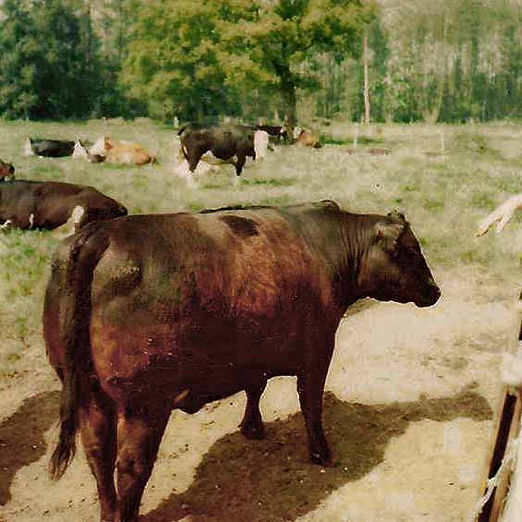
In one year they made 3,000 bales of hay from the grassland. We have shown below 2 pictures BEFORE clearance work was conducted and 2 AFTER. We’ve also shown a gratuitous picture of Eric the Bull, not taken from his best angle, we think.



We have shown left a plan of where we think Ken’s Pirbright land (shaded turquoise) was. It was drawn on a 1915 OS map, so shows few of the buildings we know today. We have shown the site of Dingley Dell as a red rectangle.
Most of this land had, in the 1800s, been part of Court Farm, owned by the Halsey family. It was sold by Henry Halsey 4 in 1922 to a Godalming property agent, Harold Baverstock. Mr Baverstock sold it the following year to Alfred Fry, who at that time was farming Stanford Farm. Alfred himself sold Stanford Farm the following year, but carefully kept the additional fields which he owned. We think that Ken Stephens bought some (but not all) of Alfred Fry’s land in 1964 from Eva Caroline Fry (of No 3, The Gardens and her son, Alfred Fry (of Vines Farm).
We have shown below a photo of Ken proudly standing next to a Citroen Light 15 in his younger days, and another looking stern in his Vickers office several years later. We have also shown a photo of Ken and Dorothy a few years after that.


We have added 3 more photos from the family collection, showing, on the left Ken aboard an enormous land-clearing machine, in the middle Ken and Dorothy at their diamond wedding celebration in 2004, and on the right, Ken trying to control Chloe, his first cow.


In 1970, Ken’s son, Ted, joined Optichrome, later becoming the company's chairman and owner. In 1992, the Stephens family moved to a bungalow in School Lane Pirbright, which, again, was named Dingley Dell. When the current owners moved into the house in 1992, they changed the name of the house from Dingley Dell to Givat Chayim, which we think is the name of a kibbutz in Israel. A side extension was built.
Much of the land was retained by the Stephens Family via a trust and still exists as a separate farm, Dingley Dell Farm, which is written about (briefly) as a separate section at the top of this web page.
Moyana
Moyana was built c1931 for Albert and Mollie Bridger on land that had been sold to Albert in 1927 by David Bayliss (refer Stanford House above). Albert submitted building plans to the local council in early 1928. But building a house in 1927-28 would have been a brave move for Albert at the time, as the British economy was at a low point, with low activity levels and high interest rates. But in 1929, Britain left the gold standard, causing interest rates to fall, and economic activity to rise sharply. House building in particular had boom years in the mid-1930s, so it seems that Albert managed to buy some land just before the rush.
Although Albert bought the land in 1927, we can’t find any trace of anyone living at Moyana until 1932. We suspect therefore that Albert waited 4 or 5 years before building on the plot, which in hindsight was financially a good move for him. Alternatively, he might have let the house out with a different house-name, but we think this unlikely. We have shown an extract from the 1928 building plans below.

Albert was born at Maybury in 1904, the son of a carpenter. Mollie (nee Stallard) was born in 1909 in Grayswood, near Haslemere, also the child of a carpenter. They married in 1932 in Grayswood and hopefully the two fathers had a lovely conversation there about carpentry things. At the time Albert was a builder living in Woking, and Mollie lived in Grayswood. They moved into the newly-built Moyana immediately after their marriage.
The choice of the house name is certainly unusual. Moyana is a word from a language used in Zimbabwe meaning Giver, or One who is wise. Would Albert or Mollie have known this in 1932? Well, maybe. In 1935 Albert wrote a long letter to The Surrey Advertiser in support of Italy’s warmongering in Africa. In retrospect Albert probably regretted writing the letter, but it shows that he had a deep interest in Africa. But Moyana was also the name of a house in Maybury near where Albert grew up. Maybe this was the inspiration for the Pirbright house name. We’ll probably never know for sure.
The Bridgers had 2 children while at Moyana. During WW2 Albert served with the Royal Army Medical Corps in North Africa. After WW2 they moved to Goldsworth Road in Woking, where Albert died in 1982 and Mollie in 1989.
c1950, David and Ethel Ryder were living in Moyana. We know very little for certain about David and Ethel, and we have found few records of their background. Ethel appears to have been born Ethel Walmsley in Birkenhead in 1897 (the daughter of a wealthy Iron founder) and married a Frank Drinkwater (a veterinary surgeon) in 1920. The pair split up at some stage, as in 1951, when one of their children was married in Scotland, Ethel was living in Pirbright as Ethel Ryder, and Frank was living in West Kirby. However, we can’t find any record of Ethel marrying again. Apart from the fact that David played cricket for Pirbright, opening both the batting and the bowling, we can’t trace his background. Perhaps Ethel remarried a Mr Ryder and David was his son from an earlier marriage.
The Ryders sold Moyana in the early 1960s, and by 1964 Maurice and Olive Hives were living there. Maurice was born in 1913 in Barrow, the son of a schoolmaster. By 1939 he and his family had moved to Hinckley, where his father was a headmaster. Olive (nee Burke) was born in 1924 in Epping.
They married in Denbighshire in 1945 and by 1951 were living in a caravan in Chilworth. By 1953 they had moved to Hazel Avenue on the Bellfields estate. They moved to Moyana c1963, but left Pirbright in the early 1990s. Maurice died in 2002 at Shepperton. Olive died in 2011. We have shown 2 photos of Olive, right.


The house was the sold to a Mr & Mrs Martin, and again in 1995 to a Jonathan and Julia Bellairs. In 2009, the Bellairs moved to Guildford, and house was sold. It was sold yet again in 2015 to the current owners. A recent agent’s photo of the house is shown below (with thanks).

Properties to the south of the Stanford Brook
We will now cross the Stanford Brook and look at the 5 properties on the south side of the Brook, again working north to south.
Stream Farm (previously Fellmore Mead, Fellmores, Fellmoor, Filmer’s and Stream House Farm)
We wrote in the Stanford East section that in 1807 Stream Farm comprised 4 fields (5 acres in total) and were owned copyhold by Mary Giles (or Gyles), who was the widow of Philip Gyles (1724-1803). At that time there was no building on the land.
We can trace the history of this piece of land as far back as 1670, thanks to the Pirbright Manor Court Rolls. At that time the land was called Fellmore Mead, and parcelled up with 2 acres at “Gibbs” (ie Gibbs Acre), which seems distinctly inconvenient, given the distance between these plots and the lack of easy transport in those days. The early history of Fellmore Mead from the Court Rolls is as follows:
-
1670: Richard Woods (1636-1724), who was the copyholder, sublet the property to John Hampshire of Merrow, a blacksmith.
-
1687: John Hampshire ended his tenancy and the property reverted to Richard Woods.
-
1724: Richard Woods died. His son, Richard Woods, passes the copyhold to Thomas Woods (1682-1759), who presumably is a close relative, but we haven’t been able to confirm this. He was also the miller at Upper Mill, where we refer to him as Thomas Woods 1, so we will do the same here.
-
1759: Thomas Woods 1 died. The property passed to his son, Thomas Woods 2 (1706-1766).
-
1766: Thomas Woods died. The property passed to his son John Woods (1735-1810).
-
1770: John Woods surrendered the copyhold to Philip Gyles (1724-1803).
-
1801: Philip Gyles took out a mortgage with John Collins for £145 (£9,000 today). This was John Collins who owned much of the land near Swallow Pond. We have told his story in the introduction to the Guildford Road - North section, where we refer to him as John Collins 3.
-
1803: Philip Gyles died, and the property passed to his widow, Mary Gyles (1725-1810). Mary (nee Harding) had been born in Headley. She and Philip married in Pirbright in 1761 and had 3 children.
-
1812: Mary Gyles died. The property passed to her son, John Gyles (1767-1840).
-
1825: Because the 1801 mortgage from John Collins had never been repaid, John Collins 3’s heir, William Collins (1772-1841), acquired the property.
-
1845: William Collins had died in 1844 without having any children. The property was then sold to outside investors, firstly to John Brown (in 1845) and then to George Street (in 1850). When George Street died in 1852, the property passed to his son, John Street.
-
1879: The copyhold was surrendered to James Avenell, the first local person to own it for 100 years. Over the next 6 years he took out 3 mortgages totalling £290 (today, £30,000), probably as a result of the difficulties affecting the whole of British agriculture at that time. We will now pick up the story at a detailed level.
As there was no dwelling on the property, one might ask, where did these copyholders live? We can assume that most of the Woods copyholders lived at or near Upper Mill, as that was where their principal place of work was. But as to Philip and Mary Gyles, we can’t find any other property (copyhold or leasehold) in which they had an interest, other than a small plot at Gibbs Acre (which contained no dwelling). So we assume that they must have lived in one of the many small cottages in Pirbright at that time – probably somewhere in the Stanford area.
The next question is when was a dwelling built on the site? We know from the maps that there was no dwelling on the site in 1807, but that there was a small dwelling there on the 1841 Tithe map. So we know that the house was built sometime between 1807 and 1841. The documentation behind the 1841 map tells us that the property was 6½ acres in size. Unfortunately the early censuses don’t always mention house names in the area, so we have had to make some educated guesses (which we have indicated in the text).
The first occupant that we can be sure of (in 1841) was Mary Gyles or Giles, the widow of John Gyles above (who had died in 1840). She appears in the 1841 Tithe Map documentation, so no guess was needed on this one. As the reader will have spotted, the spelling of the surname Gyles seemed to transform into Giles around this time. John and Mary had married in 1823, by which time Mary was a widow. She was born Mary Alderson, and had married a Daniel Stonard in Worplesdon in 1817. But Daniel had died aged 42 in Pirbright in 1822. We assume that Mary continued to live in the (unnamed) property until her death in 1843, aged 56.
In 1851, we think a 60 year-old widow, Jane Searle, was living there, now farming 20 acres (which means that some of the surrounding fields had been acquired). Jane’s husband, Benjamin, had died in 1848. They had previously been living at Merristwood Mead section, and we have told their story there. She was accompanied by her grandson, Charles Faggetter (whose story we also tell in the Merristwood Mead section), but also by one George Street.
George Street was the then owner of the copyhold to the property. He had been born in Shalford in 1783, and is described in the 1851 census as “Unmarried”. His will suggests this is not very accurate. He died in 1852 in Ripley (although living in Pirbright), leaving his copyhold in Pirbright to one of his sons, John Stevens Street, and making bequests of £5,600 (£600,000 today, so a wealthy man). His will mentions that he had 4 children. Now why would a 60+ year-old wealthy widower choose to live in a small farm with a 60 year-old widow? Well, one obvious answer comes to mind, but why did he mis-state his marital status on the census? And back in 1843, why had another man, George Boylett Junior, left his property to Jane (refer Merristwood Mead section section). All rather mystifying...
In 1861, Jane Searle and Charles Faggetter were still at the farm, which in the census was called “Fellmoor”. But by 1871 they had returned to “Merristwood Cottage” (today called Hockford Cottage).
In 1871 it looks as though Fellmoors was occupied by a Thomas Stevens, who described himself as born in Woking in 1821 and a farmer of 5 acres. He lived with a 20 year-old unmarried servant Caroline Collyer. But we can’t find any other information about either of these people, except that in 1881 Thomas was living at Hazel acre. Now there are no houses on Hazelacre, so we’re a bit puzzled about exactly where he lived that year. All in all, more mystery, and possibly 2 individuals wanting to disguise their true identities. They moved out of the area c1880.
From 1881, James and Louisa Avenell lived at the farm. James was the son of John Gyles Avenell and Sarah Avenell, who lived on The Green, where we have told their story. John Gyles Avenell was an agricultural labourer from Farnham. It is very tempting to think that James’s middle name of Gyles is somehow derived from John and Mary Gyles, who lived at Fellmoors a few years previously, and who we have referred to above. However, we can’t find a link. Sarah (nee Parfett) was born in Pirbright in 1818. Her mother was Maria Parfett, but no father’s name was entered in the register.
James Avenell was born in 1845. In 1861 he was an under-carter at Cowshot Farm. Louisa (nee Stonard) was born in 1844 at Pirbright, the daughter of John and Ann Stonard, who lived at Rayles Cottage, then known as Webb’s Cottage. Please also refer to the Stonard family page for more background on the Stonards.
They married in 1864 in St Michael’s Church, and the first of their 9 children (Lucy Avenell) was born 2 years later. In 1871 the family were living somewhere in the Stanford area, where James was an agricultural labourer, and in the mid-1870s they moved to Springfield Farm, presumably in connection with seeking work.
But by 1879 he had purchased the copyhold to Fellmoors, with the help of a mortgage. And in 1895 the copyhold was enfranchised. This meant that the copyhold arrangement ceased to exist, and the copyholder became the freeholder. Enfranchisement was a process which was happening across the country at the time, as a way of phasing out the outdated concept of copyhold, which was finally abolished in 1926. However James probably still had a large chunk of his mortgage outstanding, and it seems that he sold the freehold to Lord Pirbright in the late 1890s. The freehold was sold by Lady Pirbright to Henry Halsey 4 in 1909 for £460 (£48,000 today). However, during this time, the Avenells stayed on as tenants.
James worked as a farmer at Fellmoors, but also as a carman (which was similar to a modern-day delivery driver, but with a horse and cart instead of a white van). James died in 1902, aged 57, but the Avenell family continued at Fellmoors. By 1911 Louisa was living there with 3 of her sons, all of whom were still single and all of whom stayed in the immediate area for quite some time:
-
Charles Avenell, a carman (who had presumably taken over his father’s business), aged 33. Charles lived for a long time at nearby Stanford Cottage, where we have told his story.
-
Albert Avenell, a labourer, aged 29. Albert later owned the nearby plot on which Suncroft was built in 1958. We tell his story in that section.
-
Frederick (Fred) Avenell, a labourer, aged 27. Fred and his wife Emily lived for a long time at nearby Heather Bungalow, where we have told their story.
In 1921, Louisa was still at Fellmoors, aged 77. Charles was also still there, working as a smallholder (presumably on the 5-acre Fellmoors Farm), with his wife, Ethel Avenell (nee Smedley). And Albert still lived there, still single and working as a labourer at the Brookwood Necropolis.
But in 1922, Henry Halsey 4, strapped for cash put up for sale the remainder of his properties. The reasons and background for this are described in the Halsey family section. The sale included Fellmoors.
We have shown an extract from the sale plan below. The Fellmoors plot (coloured green) is exactly the same as it was when owned by Mary Gyles in 1807 (we have shown an extract from the 1807 map for reference, with Fellmoors coloured green). We have also shown the description of the property, together with 2 photos of the house. The distance shot with the poultry was taken in 1922. Judging by the size of the creeper on the house, and the age of the lads, the close-up was taken c1912.


The buyer of the property in 1922 was Esdor Faggetter. Esdor was a local builder and snapped up several of the Halsey properties offered for sale in 1922. However we are not sure that he did much work at Fellmoors. He allowed the Avenells to continue renting the house, so perhaps he saw it more as an investment, with a prospect of an increase in capital value.
But when Louisa died in 1928, the Avenells lease was terminated, and their time at Fellmoors came to an end. Charles and Ethel moved to Stanford Cottage where we have continued their story.
The new occupants from 1928 – we are not sure whether as owners or tenants, but probably the latter – were Henry and Sarah Daniels. Henry was born in Swindon in 1876, the son of a police inspector. Sarah (nee Foard) was born in Petworth in 1873, the daughter of a blacksmith. They married in 1900 in Lambeth and lived in Battersea, having 4 children there. Henry was a butcher by trade. They were living in Wimbledon, but by 1921 they had moved to Pirbright, briefly living at No 3, Pirbright Cottages. By 1924 they had moved to Fellmoors, where they lodged with Charles and Ethel Avenell for 4 years. But from 1928 they had Fellmoors to themselves.
Henry was Hon Secretary of the Pirbright Horticultural Society, which some may find a bit odd – a butcher doing horticulture. Sarah was appointed to the committee of the Pirbright Women’s’ Institute. In 1937 they retired to Farnham.
Around this time the cottage was sold to Ronald Armstrong-Jones, who lived at Stream House (refer section below, where we have told his story). The house was also renamed Stream House Farm at this time.
The next tenants c1937 were Percy and Margaret Barrett. Percy was born near Bicester in 1897, the son of a farm carter. Margaret (nee Wise) was born in the same area in 1901, the daughter of a farmer. In 1921, Percy was still living with his family, but near Banbury. Somehow they found their way to West End, where they both lived in Benner Lane. They married at West End in 1928. Percy was a labourer at the time. In the mid-1930s they moved to another house in West End, called Dunroamin. [This attempt at humour first surfaced in 1926, and was swiftly used by other house-owners for the next few years. Fortunately it seems to have fallen out of favour recently, although there is one example in Pirbright, written about further up this page.]
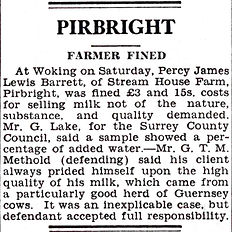
The Barretts moved to Stream House Farm in 1937, where Percy worked by looking after the cattle belonging to Ronald Armstrong Jones (refer Stream House below). The Barretts had 1 child.
In 1940 Percy had to defend himself against a charge of neglecting 11 heifers, which were grazing on his property. Percy had agreed to provide his grazing land for the heifers, but not food. The heifers were in a poor state, and one of them had died from malnutrition. The magistrates agreed that Percy was not responsible for feeding the cattle, and dismissed the case. However, he was not so fortunate in 1945, as the cutting (left) explains.
In 1945, Ronald Armstrong-Jones put Stream Farm House up for sale. The farm was 19 acres in size, and we have shown the (slightly blurry) plan of it below. Stream House Farm is coloured blue, and the farm buildings are located near the centre of the plan. We do not know who bought the farm.

A rather strange article appeared in The Banbury Guardian in 1948, which we reproduce below (with thanks). We cannot vouch for its veracity, mind you.


The Barretts lived at Stream House Farm until 1953, when they moved to No 17, Pirbright Cottages. Margaret died in 1973 and George in 1980.
The next occupants from 1955 were Alan and Peggy Harvey. We think that Alan was born in Guildford in 1918, the son of a butcher. Peggy (nee Allee) was born in 1922 at Albury, the daughter of a farmer. They were married in 1946 in Albury in a ceremony (see cutting, right) which some might think completely over the top, but everyone to their own...
A rather peculiar incident was reported in early 1958 (see cutting, left top). It is a little puzzling that the report doesn’t mention why the Harveys had a revolver in their house in the first place. The Harveys moved out of the property c 1958.
By 1959 Robert and Margaret Denning were living at Stream House Farm. We think that Robert, a Land Agent, was born in Hendon in 1910 and that Margaret (nee Wells) was born in 1913. They married at Petersfield in 1938 and spent the first years of their married life at Streatley. Shortly after moving into Stream House Farm, Robert appeared in the newspaper (see cutting left botom) for a rather unsavoury incident. His “excuse” was about as weak as an excuse can be. His fine of £15 would be £300 today.
We noted that the farm was referred to as “Stream Farm Kennels”, thus giving us a good fix on when the dog kennel business started at Stream Farm [In fact it started a couple of years earlier, as adverts were placed in the local newspaper in 1959]. We have shown below an early ad (from February 1959) and a later ad in Country Life from 1977. The kennels were to continue until 2019, when they closed.

I'm a paragraph.


c1964 the Dennings left the farm and Phil and Thelma Gray bought it. They had previously lived at West Hall Farm where they ran a kennels which supplied corgis to the late Queen Elizabeth II, among others. We have told the Grays’ story in the West Hall Farm section. Phil died in 1969, and we have transcribed below an obituary which appeared in The K.C.C. Kennel gazette.
It is with deep regret that we announce the death of Mr. Phil Gray, of Stream Farm, Pirbright, Surrey, England on November 5th 1969. Mr. Gray accompanied his wife Thelma Gray, on her recent visit to Australia, where she was senior judge at the Ladies’ Kennel Association’s Championship Show. The late Mr. Gray was making his second visit to Australia, having previously accompanied his wife, when she judged the Melbourne Royal, in 1961.
Mr. Gray, aged 72, was a retired bank manager, and spent his most recent years playing an active role in the management of their 25 acre farm, and the 100 dogs that were bred and kennelled at the world famous Rozavel Kennels. In addition he managed Mrs Gray’s extensive judging commitments, and the many editorial assignments she undertook.
A man whose hobbies included flowers, and an extensive knowledge of wines, but above all a man who loved meeting people. Everyone who came in contact with him during the 6 days of the L.K.A. show, will remember just how interested Phil Gray was in making new friends and discussing with them a wide range of subjects.
But perhaps no subject was closer to his mind than learning about and seeing as much as possible of Australia. Mr. Gray became ill two days after the L.K.A. Show concluded, as he and his wife were about to depart for Adelaide. We were then shocked to learn of his passing one week later. The funeral held on November 7th was attended by representatives of the K.C.C., the L.K.A., Mr. David Roche who flew from Adelaide and Miss Jenny Beresford who flew from Sydney, to accompany Mrs Gray back the next day, friends and club representatives from Victorian dogdom.
Phil Gray was the type of man, that those who knew him for even such a short time felt that they had lost a very dear friend. We join with Mrs Gray, and their only son Jeremy, in their sad loss, and extend our deepest sympathy.
G.H.E. Dear Mrs Edwards, “I would like to express my heartfelt thanks to all the people who have shown such kindness to my mother (Mrs Thelma Gray) during her late judging tour and especially for making my father so happy during the time preceding his untimely death”. Jeremy Gray.
Thelma stayed at Stream House Farm until the late 1970s, when the current owners bought the farm. The name of the property changed to Stream Farm, and the kennels business continued until 2019, when it closed.
Lussells (no longer exists)
We will now turn our attention to a property that no longer exists, and that very few current Pirbrighters would be aware of - Lussells. The property is first mentioned in the 1664 Court Rolls, after William Faggetter, the copyholder, died. So he must have held the copyhold prior to 1664, but we don’t know for how long he or his family were there. It seems from the Court Rolls that William also held the copyright to Hovers (today called Hovers Well), a property on the Aldershot Road. We have summarised the Court Roll records over the next several years below, starting with William.
-
1664: William Faggetter (??-1663) died. His will makes no mention of a wife or children. The Court Roll describes the property as “Land and pasture and appurtenances”, but no mention of a dwelling. The copyhold of Lussells passed to his nephew, William Faggetter (1660-1710), who lived in Ash. As William was only 3 years old, his father, Henry Faggetter (1629-99) acted as his guardian.
-
1712: William died. The property passed to his son, William Faggetter (??-1750). The property had been significantly upgraded during the previous 50 years. It now comprised “a messe or tenements” (ie a dwelling), barns, stables and outhouses and 11 acres of arable and meadow land.
-
1740: William Faggetter sold the copyhold to William Linnard (??-1767), a shoemaker. William Linnard also owned the copyhold of Gander Hill (better known these days as The Fox pub). We have written about the Linnard family in the section dealing with The Fox pub. Lussells was now 40 acres in size, but there is no mention of a dwelling. We guess that whatever dwelling had existed in 1712 was a fairly flimsy affair, which didn’t last very long as a dwelling.
-
1763: Lussells appears on the Rocque map of 1763 (shown below left) towards the left side, mid-way up. But it was probably just being used as a barn by then.
-
1767: William Linnard died, and the property passed to his son, George Linnard (1739-1809).
-
1789: George Linnard sold the copyhold to the Lord of The Manor, Henry Halsey 1.
In 1789, Lussells was folded into the surrounding area and called Fillmoor Lands within the Halsey Pirbright estate. It later formed part of Rails Farm, still owned by the Halsey family. Along with Rails Farm it was later offered for sale (but not sold) in 1885, sold in 1922, and sold again in 1945. We refer the reader to the Rails Farm section for the details of these sales.
We have marked with red rings on a section of today’s OS map (below, right, copied with thanks) where the Lussells buildings were according to the 1841 Tithe map. Both were unoccupied in 1841 (ie used as farm buildings). No trace of them exists today (at least we couldn’t find any). If the reader is tempted to compare the 1763 and 2026 maps shown below, take care! The maps are oriented differently, the scale of each map is very different, the buildings and tracks have changed and the course of the stream has changed in the intervening period. Apart from all that, they correlate pretty well.


In a car, the next 4 houses must all be accessed from the right turning half a mile down the Aldershot Road to Henley Park Lake. The area is not often visited by non-residents, so we have re-shown the current OS map, left, which shows the 4 houses clustered together near Henley Gate (which is at the very bottom left corner of the map. An alternative way of accessing the properties (on foot) is via the delightful curving track coloured grey.
Bourne House (previously Dog Kennels)
The history of the area near Bourne House dates back to 1672, when a William Martyn was granted the copyhold of 2 acres of waste land “lying near Smallbourne”. We think that William Martyn (Martin) was born in Pirbright in 1631, the son of George Martyn, who had been born at “Gibbes” (ie Gibbs Acre) in 1606. William married Mary Christmas in 1655, who gave birth the following year to John Martyn. Mary may have been a member of the Christmas family in Worplesdon. The Court Rolls record the following transactions:
-
1679: A cottage now exists on the property (presumably built by William Martyn).
-
1707: William Martyn died and the property passed to his son, John Martyn.
-
1709: John Martyn had mortgaged the property to a Robert Gunner, but did not pay off the mortgage. Hence the property passed to Robert Gunner. It was described as a tenement (ie cottage), edifices, outhouses, gardens and orchard, so it seems that William Martyn had worked hard to improve the property.
-
1718: Robert Gunner passed the copyhold to his son, Richard Gunner.
-
1739: Richard Gunner sold the copyhold to James Atfield, “a labourer of Pirbright”.
-
1775: James Atfield died. He directed his wife, Sarah Atfield to be his executrix and to sell the property.
-
1778: Sarah Atfield duly sold the copyhold to James Davy, who had to take out a mortgage of £35 (worth £5,000 today). The interest rate was 4 ½%, which was normal for the times.
-
1823: Following James Davy’s death in 1822, the copyhold passed to a James Paine. James Paine lived at Henley Park Farm, and seems to have been acting on behalf of Henry Halsey 2, who was in reality the beneficial owner.
Who were these people? Well, we can’t trace the Gunners or the Atfields with any certainty. So we will just deal with James Dav(e)y. He was born in 1752 in Pirbright, the son of Richard Davy (1727-77) and Ann, nee Shorter (1728-55). Richard had been born in Pirbright.
In 1776, James married Elizabeth Cronney (probably Croney) from Worplesdon. Elizabeth was born c1753. They had 5 children, one of whom, Arthur Davey, later lived at Cowshot. Another son, Henry Davey, later lived in the Almshouses (today, Longhouses) with his wife, Sarah in 1851. The 1805 Halsey Survey lists James as occupying a house on the site of today’s Bourne House. It is the small rectangle in plot 77 on the map shown left. James died in 1822 and Elizabeth possibly in 1850.
After James Davey’s death in 1822, the property was subsumed into the Halsey estate. Henry Halsey 2 decided to put the property to good use as the kennels for the Henley Park hunting dog pack. We assume that the dogs were kept in outbuildings, while the cottage was occupied by the dog-keeper, but this may not be correct.
In 1841 the cottage had only one acre of land attached, and the Tithe records show it as being occupied by a Charles Colyer (plot 283 on the Tithe map shown right). The 1841 census records are not specific as to who lived where, but they suggest that it was Henry and Ann Collyer who lived there. Henry was a gamekeeper, which is consistent with him taking care of the dog kennels attached to the cottage. Henry was born in Pirbright in 1803, the son of James and Jane Collyer, who lived at Upper Green, where we have told their story. Ann (nee Harrison) was born in 1803 in Frimley Green. They were married in Pirbright in 1822 and had 9 children.


Ann died in 1844, aged only 41. It looks as though Henry soon remarried – to Elizabeth Rackley (nee Harrison), who just happened to be Ann’s younger sister. Elizabeth was 9 years younger than Ann and her husband (Mr Rackley) had recently died. One might ask whether this was legal. From our limited research, the answer appears to be a pretty cut and dried “No”. It had been prohibited in the Marriage Act of 1835, and was only permitted several years later in the accurately-named Deceased Wife's Sister's Marriage Act of 1907. We assume that Henry and Elizabeth were aware of this little problem, which might explain why they travelled to Marylebone to get married.
Henry and Elizabeth moved to one of the new cottages at The Laundry (refer Stream House section below). They had 4 children and later moved to Normandy, where Henry died in 1865.
We now need to point out that, for the next 60-odd years, it is easy to work out who lived in the dog kennel area, but unfortunately the records do not specify which families lived in which of the 2 houses (today’s Bourne House and Stream House). We have made our best guesses, but we will probably never know for sure.
In 1851 we think that the cottage (ie today’s Bourne House) was occupied by John and Mary Thorn, who had relocated from Westcott. John described himself as a servant and then as a labourer. By 1851 they had 6 children, the youngest 4 of whom had been born in Pirbright. By 1861 the family seem to have dispersed, with some of the younger children being cared for, and others living with relations.

Around this time the building was known as Dog Kennels, although the 1841 Tithe records had made no mention of this. The West Surrey Times reported an amusing story in February 1858, which we have reproduced left. It is interesting that the newspaper refers to the “Old Dog Kennell”. We think that this was not meant to imply that the building had been used as a dog kennel for a long time; just that it was no longer being used as one at the time of the article. The article suggests that it was instead being used to keep pigs in 1858.
The 1861 census does not seem to show anyone living at the cottage. But in 1864, a newspaper cutting tells us that an Albert Booker lived at “The Kennels, Pirbright”. He was the keeper to an Edward Brettle, who was the tenant of at Henley Park at the time.
We know that the building ceased to operate as a dog kennel, and that a laundry was built nearby in the mid-1800s. And from that time onwards both buildings included dwellings. But when exactly did all this happen? The records are not clear. Indeed they are contradictory, so we will try to make some sense of them.
The 1851 census records that a laundress, Mary Faggetter, lived at one of the 3 houses recorded as “Dog Kennell”, which suggests that the laundry existed then. And the 1861 census has the addresses “1 and 2 Laundrey”. So we can infer that the next-door building (today’s Stream House) was operating as a laundry by 1861, and quite probably in 1851.
Later censuses record a laundress (in 1871) and 2 laundrymaids (in 1881) living in the cottages. But the censuses still record them as Dog Kennels. The 1873 OS map clearly shows today’s Stream House as “Laundry”. And the cutting, right, from an 1881 edition of the Surrey Advertiser (with thanks), refers to a very mundane matter of no interest to us (or anyone else, probably). But it does mention The Laundry. All this confirms the near-certainty of the laundry’s existence in today’s Stream House by 1861.
We don’t know for sure the reason why the dog kennel fizzled out, and a laundry was built nearby at this time. But public wash-houses had been legislated for in 1846, which probably made an immediate difference to the way people looked in public. Henry Halsey 2, the owner of Henley Park at the time, may have wanted to keep ahead of the masses and have his own private laundry. Maybe he just thought that his shirts weren’t clean enough under the previous arrangements. He also may have grown a little tired of hunting with dogs by then.
However, the name of the Dog Kennels was used for the surrounding area and did not change to The Laundry until later. The 1871, 1881 and 1891 censuses all used the address “The Kennels”. The last reference to the Kennels we can find in the records (actually in the Pirbright School admission register) was in October 1892. This seems surprising: It may be a 21st century way of thinking, but we would imagine that people would have been fairly keen to change their address from “Dog Kennels” to “Laundry”, rather than waiting 30 years to do so.


By 1871 James and Emma Heathorn were living at the cottage. James was born in Normandy in 1836, the son of a shopkeeper.
Emma (nee Mansell) was born in Chiddingfold in 1840, the daughter of Matthew (a farmer) and Mary Ann Mansell. One of Emma’s sisters was Maria Mansell (born 1824), who married Edward Mason. In 1857 Edward Mason inherited Bullswater Farm and Pullens Farm. We have written more about them in those sections. It was surely this connection with Pirbright that brought James and Emma here in the late 1860s after their marriage at Farnborough in 1864. They had one daughter, in 1865, while living at Cobbet’s Hill, where James was working as a steward at Henley Park. They moved to Pirbright sometime between 1865 and 1871.
By 1881 the cottage was called Bourne Cottage, and in 1891 Smallbourne Cottage. In the meantime, James continued his role at Henley Park. We haven’t been able to find out much about the Heathorns, so we’ve included a cheery press cutting (left) which mentions James at the bottom.
James died in 1900, but Emma stayed at the cottage until she died in 1907. We have shown below an announcement of James’s death.

Reuben Richards was the next occupier from c1909 until 1910. Reuben was born c1860, probably in Farnham, the son of a “Sheriff’s Officer”. By 1881 he was a stock dealer in Guildford, and in 1905 he was living at Stanford House (refer section above) with a 10-year-old daughter, who was attending Pirbright School. He was a rather unsavoury character, with newspaper reports of drunkenness, assaults (often with his siblings) and unpaid debts. His brother, Isaac, became a horse-slaughterer at Peasmarsh. One later owner of Isaac’s house had discovered broken glass under the floorboards – apparently placed by Isaac to catch rats. Perhaps understandably the father of Reuben and Isaac left the bulk of his estate to a married daughter, and nothing to any of the boys. In the spirit of openness we should mention that Reuben was (distantly) related to one of the Pirbright Historians.
He left Pirbright c1910, and by 1921 he was a wardrobe dealer in Gosport. We think that he was married twice and died in 1944 in Portsmouth.
By 1910 William and Sarah Ratcliffe were living at Smallbourne Cottage. William was born in 1870 in Farnham, the son of a dairyman, later a farmer. Sarah (nee Snuggs) was born in 1870 in Hartley Wintney. Her father was Caleb Snuggs (a great name!), who was a grocer. They married in Farnborough in 1894. At the time William was a butcher.
By 1901 they had a family of 4 children, and were living at Little Flexford Farm in Normandy, where William was a farmer. But c1905 they moved to Pirbright, having added a further 3 children to the family. They initially lived at No 1, Stanford Cottages, were we have shown a photo of him. But by 1910 the family had moved to Smallbourne Cottage. In 1911 William described himself as a gardener.
They lived at Smallbourne Cottage until WW1, after which they moved to Connaught Road, Brookwood. Sarah died in 1918. William died 37 years later in 1955.
By 1921 William and Mary Ann Harding were living at Smallbourne Cottage. William was born in Waltham Cross in 1861, the son of George Harding, a gardener who had been born in Woking in 1815. Mary Ann (nee Aves) was born in 1863 in Woodham Ferrers, Essex c1863, the daughter of an agricultural labourer. They married in 1893 at St John’s, both living in Mayford at the time. William was a printer.
Mary Ann died in 1940 and was buried in St Michael’s Churchyard. William left Pirbright in the late 1940s, possibly moving to Farnham, and died in 1955.
George and Marjorie Crichton were the next occupants of Smallbourne Cottage in 1956, we assume as owners. George was born in 1894 (we think, in Glasgow). During WW1 he joined the Royal Scots Guards and served as a private until 1919. He then moved southwards and in 1921 was a salesman for Hoover Suction Sweeper Co Ltd, boarding at Whitley Bay.
Marjorie (nee Grieves) was born in Kingston in 1892, the daughter of a fine art printer.
They married in Guildford in 1932 and moved to Knaphill High Street, where in 1939 George was a draper and outfitter. George may have kept the Knaphill shop going for a year or two, but presumably their move to Pirbright was a retirement choice.
Marjorie died at St Luke’s Hospital in Guildford in 1965. George remained at Smallbourne Cottage for a few years, but then moved to West Byfleet, where he died in 1978. As far as we know they had no children.
Brian and Margery Dowling moved into Smallbourne Cottage in the mid-1970s. Brian was born in Slough in 1916, one of 7 children of Thomas and Edith Dowling. Thomas was the General Manager of a Slough-based Civil Engineering contractor. Evelyn Margery Street was also born in Slough (in 1919), the daughter of a building contractor.
They married in June 1945 at Chobham. The newspaper cutting (right) gives an example of how WW2 could affect peoples’ lives at that time. They moved to Pirbright in 1947, living first at Winkfield in Chapel Lane, then at Burrow Hill House and lastly at Hatchers, Little Green.
Brian served for 2 years on the Pirbright Parish Council, becoming chairman before resigning in 1973. In 1987 the Dowlings held a celebratory lunch to mark their 40 years of living in Pirbright. We have shown the guest list and 3 photos of the occasion (including one of the Dowling family with their two daughters) below. We hope that all the guests on the list will eventually get a mention elsewhere on this site (but apologies if some don’t!). We have also shown a photo of the house at around this time.


The Dowlings moved to Hatchers in 1996 in a straight exchange of property with Michael and Karen Mauerhoff. Brian died there in 2004 and Margery in 2017. We think that the next owners extended the house significantly, and also renamed it to Bourne House. The house was sold again to the current owners in 2008.
Stream House (Previously, Laundry Cottages, then Smallbourne, Little Hey)
By 1841, a cottage and adjoining building had been built a little way to the south-west of the Dog Kennels (today’s Bourne House - refer section above).
The cottage was shown (coloured pink) on plot 284 on the 1841 Tithe map (shown right), and is the forebear of today’s Stream House. It was twice as big as the Kennels, and we assume it was split into 2 semi-detached dwellings. The Tithe records describe them as one of 10 labourers’ cottages in Pirbright at the time, and unfortunately do not specify exactly who lived there.
The adjoining building on the Tithe map (coloured black) we think was probably built as a laundry for Henley Park.

We have written about the link between the older Dog Kennels and the newer laundry in the Bourne House section (above).
The 2 semi-detached cottages were used to house 2 (and sometimes 3) families, mainly staff who worked in the next-door Laundry. But by 1916, the cottages were amalgamated into one dwelling, which has become today’s Stream House. We will first deal with the semi-detached cottages until 1916.
The cottages from 1851 to 1916
Ever since the property had been built, it had been let to tenants direct by the Halsey family. However, when Lord Pirbright became the tenant of Henley Park in 1889, his lease included the Laundry. Understandably, he continued to sublet the cottages at the Laundry to the various tenants, who would not have noticed much, if any, change from the previous arrangements.
When Lord Pirbright died in 1903, Lady Pirbright continued this arrangement for a few years. When her lease on Henley Park ended in 1906, the lease was transferred to the new lessees, Lord and Lady Roberts. Lord Roberts died in 1915, and Lady Roberts continued to live at Henley Park. She also continued to sublet the cottages.
Returning in time to 1851, we think that the Laundry Cottages was occupied by 2 families – the Collyers and the Faggetters.
We will call one of the cottages “Cottage 1” and the other “Cottage 2”, and allocate the occupants over the next few years to one or the other cottage as seems most sensible. There may have been a 3rd cottage on the premises, but we can’t be certain who lived there. So we will just stay with 2 cottages. First, Cottage 1.
Cottage 1
In 1851 the family in this cottage comprised a widow, Mary Faggetter, and her family. Mary (nee Bartlett) was born in Chobham in 1794, and married Joseph Lambert in Pirbright in 1823. They had 2 children, but Joseph died in 1829, aged 42. His gravestone can be seen in St Michael’s Churchyard. In 1831 Mary remarried Henry Faggetter, a widower, and they had 3 children. But Henry died in 1838, aged 55.
In 1841 Mary had been living at Millstream Cottage, where we have written a little more about her. She was accompanied by her 3 children with Henry, one of her children from her previous marriage, and one of Henry’s children from his previous marriage. That sounds rather complicated and potentially fraught with all sorts of familial difficulties...
In 1851 Mary had moved to the cottage next to the laundry, now with just 3 of her children. That sounds a little easier to manage. She was a laundress, no doubt working at the laundry next door.
She was still at the cottage in 1861, still working as a laundress, now with one daughter (unmarried, but with a daughter), and another of her grandchildren. The 1861 census recorded the address as “1 Laundrey”. By 1871 she had moved to Pirbright Green, still working as a laundress, aged 77, living with a 10 year-old grand-daughter. She sounds as though she had a pretty tough life and died in 1873, aged 79.
In 1871, Thomas and Elizabeth Marshall were living at Cottage 1. Thomas was born in Ash in 1845, the son of an agricultural labourer. Elizabeth was born in Pirbright in 1847, the daughter of Henry and Elizabeth Stevens, who lived at West Heath. Henry was an agricultural labourer. We have written more about the Stevens dynasty in the Stevens family section. They married in 1868 in Pirbright and had 11 children. The family soon moved to Whipley Farm in Worplesdon, where Thomas worked as an agricultural labourer.
In 1881, Richard and Esther Woods were in Cottage 2. Richard was born in 1842 at Headley in Hampshire, one of 12 children of an agricultural labourer. Esther (nee Loe) was born in 1848, also in Headley, and the daughter of an agricultural labourer. They married In Headley in 1866. In 1871, they were living in London, with Richard working as a carman (ie someone who drove a horse and cart, delivering stuff). We don’t know what made them come to Pirbright, but they didn’t stay long. Richard died in Addlestone in 1888, and Esther in 1901 after remarrying.
In 1891, Henry and Eliza Horne lived in the cottage. Henry was born in 1834 at Normandy, the son of a farmer. Eliza (nee Collyer) was born in Ash in 1835.
They married in 1857 in Ash, at which time William was a coachman. The couple had 7 children, but very soon moved back to Normandy, where Henry worked as a market gardener.
From 1899, Mrs Jane Robinson lived at Cottage 1. Jane (we’re unsure of her maiden name) was born in 1847 at Farnham. She had married a Joseph Robinson, an agricultural labourer who had been born in Ash in 1833, and they had 5 children. They had lived in Normandy, with Jane working as a laundress, but Joseph died in 1898. Only 2 of Jane’s children still lived with her, both daughters, and both laundresses. So the Laundry Cottages in nearby Pirbright must have seemed a sensible place to which to move. Jane died in 1903.
By 1909, Alfred Musk had moved into Cottage 1. Alfred was born in Huntingdonshire in 1872, the son of a farm labourer. Annie (born Rose Annie Gale) was born in 1875, also in Huntingdonshire, the daughter of a farmer. They married at St Neots in 1902 and had one son. By 1909 they had moved to Pirbright, and we can’t fathom how they chose Pirbright as a place to live. Alfred was a gamekeeper, probably for the Roberts at Henley Park, but Annie did not give an occupation (we were expecting “laundress”) on the 1911 census. They stayed at The Laundry until 1919, when they moved to No 6, Pirbright Cottages – not the house at Fox Corner, but one of the cottages in Normandy on the Aldershot Road, where he was an under-gardener. Alfred died in 1956 and Annie in 1966.
Cottage 2
Henry and Elizabeth Collyer had moved from nearby Dog Kennel into Cottage 1 by 1851, and we have told their, er, rather dubious story in the Bourne House section above.
In 1861, William and Susannah Harrison lived at Cottage 2. The 1861 census recorded the address as “2 Laundrey”. William was born in Frimley in 1799, and was the elder brother of Elizabeth Harrison, who married Henry Collyer. Henry and Elizabeth were the previous occupants of the cottage. Susannah (nee Bridger) was born in Farnham in 1805. They married in Pirbright in 1824 and had 2 children. Their first child was born just 8 months after their marriage. They lived for a while on the Henley Park estate, William working as a labourer for Henry Halsey 2, before moving to 2 Laundrey (as the 1861 census described it) in the 1850s. They lived in the cottage until c1883, when they moved to Worplesdon, where William died the same year. Susannah moved to Hale, near Farnham, and died in 1894.
The next occupants in 1883 were William and Sarah Thayer. William had been born in Alfold in 1832, the son of a labourer. Sarah (nee Mitchell) was born in 1833 in Dunsfold, the daughter of an agricultural labourer. They married in Farncombe in 1856 and had 4 children. They lived in Shalford until moving to Pirbright in 1883. In 1891 William was a gardener and Sarah a laundress (presumably working at the adjoining laundry). William died in 1896 and Sarah in 1897, both in Pirbright.
In 1897 John and Jane Langford moved into Cottage 2. John was born in Herefordshire in 1832, the son of a jeweller. Jane (nee Gardner) was born in 1834 in Canterbury. They married in Gillingham, Kent in 1858 and had one daughter. John served in the Royal Engineers until his retirement in 1876, aged 42. In 1881 John was a warder at a camp on War Dept lands, but the location of this particular camp was not revealed in the census. In 1891 he was a War Dept warder, but this time there was no secrecy in the census – the Langfords were living at Stoney Castle in Pirbright. They must have liked Pirbright, as they moved into Cottage 2 after John retired for the second time in 1897. Jane died in 1901 and John in 1906, still living at Cottage 2.
In 1907 John and Eliza Worsley and his wife moved into Cottage 2, having previously been living at Haslemere. Both John and Eliza were born in 1871 in Warrington and raised there, and we have no idea why they came south (in the early 1900s). John was a coal merchant. In 1908 while at Pirbright, he hired out his horse to James Stonard. A couple of weeks later he found the horse and James Stonard “near the Fox beerhouse”, with the horse in poor condition. James Stonard was fined £2 (£200 today) for cruelty to the horse. For unknown reasons, John only stayed a year in Pirbright before moving to Wood Street Village. But none of these lovely Surrey villages seemed to appeal to the Worsleys: After a couple of years at Wood Street Village, the family fled back to the north (Weaverham in Cheshire, to be precise).
In 1908 Elizabeth Hursey moved into Cottage 2 with her 4 young children. Elizabeth (nee Lamport) was born in Farnham in 1868, the daughter of an agricultural carter. She had married William Hursey (born in Ash in 1864) in Ash in 1888. In 1901, William was a general labourer, and the family were living somewhere on Stringers Common, Worplesdon. They moved to Pirbright in 1902, and had been living at various places in Pirbright since then.
In 1907 the family was living at Rails Cottage, when William died. Elizabeth subsequently had a 5th child the following year, so it must have been a very tough time for her and the family. We can only guess that the family moved to Cottage 2 after William’s death because Elizabeth needed to work as a laundress. Help was at hand, as in 1910 her brother, William Lamport, and his family moved to nearby No 3, Stanford Cottages. William’s support must have been a great help to Elizabeth. To help make ends meet, Elizabeth decided to take in lodgers. At the time of the 1911 census, she had 3 single men, aged 18-28 under her roof. Elizabeth, not surprisingly, was working as a laundress.
In 1912, Elizabeth married a gardener called William Cook (b 1881) and they went to live in Hersham. Then, in 1915, Elizabeth’s eldest daughter, Evelyn, married in St Michael’s Church Arthur Cook, a soldier at Kingston. Arthur Cook was William Cook’s younger brother. That is the first instance we’ve known of a daughter marrying her mother’s husband’s brother.
But then, just 5 months later, Arthur was sadly killed in action in France. After all their troubles, we hope that things went well for the family going forward.
Cottage 3
The 1871 census is one of only 2 which records 4 families living at “Dog Kennels”. One of these 4 families was living at today’s Bourne House, leaving 3 Laundry Cottages to accommodate the 3 other families. We have arbitrarily allocated one of these families, the Thompsons in 1871 and Sarah Weller in 1881, to Cottage 3. It is the only year where we can positively identify a family living in Cottage 3, although there may well have been others.
And so we have assumed that William and Elizabeth Thompson were living in Cottage 3 in 1871. William was born in Ash in 1835. He was the 2nd of 9 children of Richard and Elizabeth Thompson, who moved to Pirbright and farmed Rails Farm, where we have told their story. Elizabeth was born in 1836, the daughter of Benjamin and Harriett Stevens. Benjamin was the Parish Clerk. He and his family lived at various places in Pirbright, including The Green, where we have told their story.
William stayed in the Ash area for a while, working as a servant at Flexford in 1851, and as a gardener at North Camp in 1861. He and Elizabeth married in Ash in 1863, and soon returned to Pirbright, where William continued working as a gardener. They had 9 children, but then William died in 1885, aged only 49. Elizabeth became the caretaker of the Reading Rooms on Pirbright Green, where we continue her story.
In 1881 we have assumed that Sarah Weller was living alone in Cottage 3. To add to the complexity, we are not absolutely sure who Sarah Weller was. She may have been Sarah Faggetter, born in 1835, the daughter of Henry and Mary Faggetter, who lived at Cottage 1 (refer section above), and who was a laundry maid. By 1891 she had moved to Knaphill.
We can’t trace with any certainty any records of a third family living in the cottages after 1881.
The house from 1916 onwards
It was probably around 1916 that the old laundry with the attached 2 or 3 small cottages was converted into one much larger cottage (as we shall see shortly). We can’t trace any building plans for this, however.
By 1916 John and Florence Charnock were tenants of newly-combined cottages. They renamed it Little Hey, which certainly has a more rural feel to it than “Laundry”. They also owned a property in Guildford on the Farnham Road for a while. John was born in Worcestershire in 1884, the son of a cooper/innkeeper. While still a child, John’s family moved to Hazel Grove in Stockport. John became a mechanical engineer and worked on the Union-Castle shipping line as an electrician. On one of his travels to Canada, he married Florence Finch Weeden (or McGaul) in Vancouver in 1912. Florence had been born in 1870.
In 1922 Henry Halsey 4 included both today’s Stream House and Bourne House in the (almost) final auction of his property estate in Pirbright. He also included Henley Park in the auction. In all, the property auctioned was 1,300 acres (roughly 2 square miles). The map prepared for the sale was a large one, which explains why the extract we have shown below is such poor quality – our apologies! Stream House is coloured red and Bourne House yellow. The blue area was woodland attached to Rails Farm. We have also shown a photo of The Laundry around this time.


We have also shown (right) the details for today’s Stream House, which was 4 acres in size. A few points of interest:
-
The text clarifies that the 3 original cottages had been combined into 1, which was a good size (5 bedrooms in 1922 would have been quite a rarity).
-
The surrounding area shows a great similarity to today’s map. Very little has changed (except for the fact that the houses are bigger). Henley Gate can be seen at the left of the map.
-
The cottage had been let by Henry Halsey to Lady Roberts. As described above, this arrangement had been in place since 1906.
-
John Charnock is confirmed as the sitting tenant.
The Charnocks purchased Little Hey for £710 (£35,000 today) and lived there for the next 16 years. Florence was an active member of the local WI, often arranging games and plays, and became a Vice-president. In 1933 she placed the advert (below) for a new business venture. We have also shown another ad (masquerading as an article) from the same year. In 1935 Florence’s name was one of the 100 consolation prize-winners of the Milk-Tea competition, organized by the Daily Mirror. What could that have been about? We’re baffled.


We know that John liked pigeon racing, competing in several competitions. But in 1937 the Charnocks moved to another quiet cottage nearby - Layton Cottage in Rickford, which we have described on another website. Florence died in Eastbourne in 1958. John died in 1964, still living at Layton Cottage in Worplesdon. His estate was valued at £25,000 (£500,000 today).
The new occupants in 1937 were Major Ronald Owen Lloyd Armstrong-Jones, MBE QC DL and Mrs Gwendoline Carol (known as Carol) Akhurst Armstrong-Jones. Names like that deserve some explanation, so we shall try to oblige by summarising their early lives. First, Ronald (1899-1966).
-
Ronald’s father was Robert Jones (1857-1943). He was a physician and psychiatrist from Wales. Robert changed his surname to Armstrong-Jones to distinguish himself from another Robert Jones. We have it on good authority that this is a fairly normal thing in North Wales, where there are lots of Joneses, Davieses, etc.... Robert was knighted in 1917, and then appointed a CBE. He could also boast the following initials: JP DL FRCS FRCP FSA. He married Margaret Elizabeth Roberts (1868-1943), of whom more a little later in this section. Robert died in 1943.
-
Ronald was born in Ilford in 1899. He was educated at Eton and Oxford, and, during WW1, was commissioned as a Second Lieutenant in the Royal Regiment of Artillery. After the war, he became a barrister.
-
Ronald was married 3 times:
-
Firstly in 1925 to Anne Messel, later Countess of Rosse, with whom he had 2 children. The marriage ended in divorce in 1934. We have shown a photo of their marriage, right. Note the young guard of honour.
-
Secondly in 1936 to Carol Coombe (see more below). They had one child.
-
Thirdly in 1960 to Jenifer Unite, an air hostess. They also had one child.


And now, Carol (1912-66), Ronald’s second wife, who lived with him in Little Hey (today’s Stream House).
-
Carol’s father was Sir Thomas Melrose Coombe (1873-1959), an Australian businessman. He had the distinction of playing first-class cricket, but only one game (for Western Australia). Thomas was a philanthropist, which is what he was knighted for. However 7 years later in 1931 he was found guilty of tax evasion. The same year, his business folded, and the family soon decamped to England (Epsom, in fact).
-
Carol was born in Perth in 1911. She came to England in 1930, a year before her father’s financial difficulties, and stayed at The Savoy Hotel. She wanted to be an actress, apparently (as the reader can probably guess from the photos, left and right).


Ronald and Carol were engaged in 1936, an event that gained some publicity, as can be seen from the cutting, right. They were married 2 months later in fashionable Hanover Square.
They bought Little Hey immediately afterwards in 1936, which seems odd. After all, why would such a high-profile couple buy such an out-of-the-way property, probably lacking in many mod cons? One possible reason is that it was a form of hideaway, far from the madding crowds of their professional lives. If so, it was a pretty good one. The house is quite difficult to get to, being way off the beaten track. The newly married couple could probably let their hair down, completely undisturbed.
There is another reason, less obvious, but probably more likely. We mentioned a little earlier that Ronald’s father (Robert Armstrong-Jones) had married a Margaret Elizabeth Roberts. Margaret was in fact the daughter of Lord and Lady Roberts who had been the tenants of Henley Park (including The Laundry) from 1906 to 1922. Lady Roberts had died in 1925, but perhaps had passed on good stories about Henley Park and The Laundry to her daughter, Margaret. For good measure, it seems that the Armstrong-Joneses also bought Rails Farm and Rails Cottage, although these may have been earlier transactions.
Ronald and Carol lost no time in renaming the property (from Little Hey to Stream House). They then made significant alterations to the house by adding 2 wings (each with 3 small dormer windows) in 1937. Despite the addition of all these dormer windows, the building still essentially remained a bungalow. An extract from the Building plan is shown, right. We have also shown a very natural photo, left, of Carol learning how to fish at Stream House.


In 1939, Ronald’s butler, a Thomas Kirkpatrick, was found guilty of stealing £242 (£14,000 today) worth of jewellery from the house. Kirkpatrick blamed his downfall on drink (he owed The White Hart £2 – equivalent to £120 today). Ronald testified that some of his wines were disappearing and “it was obvious” that Kirkpatrick was responsible. He (Kirkpatrick) was sentenced to 6 months’ hard labour.
We only know of one photo of Ronald during his time at Stream House, and here it is (left), at a game shoot. He is the gent in the middle with the glasses. By 1942, the property had been converted to include up to 5 flats. We don’t have much information on these flats (we couldn’t find any building plans, for example). Perhaps they were intended for families evacuated from London during WW2. Some of the families (eg George and Winifred Joslin) remained at Stream House until the early 1950s. George (born in Lambeth in 1905) was an aircraft fitter. Winifred (nee Cobb) was born in Southampton in 1903. A letter from “P Joslin” was printed in the local newspaper in 1951 (shown right), about which we prefer to make no comment. None of the 5 Joslin children’s’ names began with the letter P, so we’re mystified who actually wrote the letter. On a more trivial note, we were amused that the 1944 OS map continued to show the house name as The Laundry.


Although Ronald Armstrong-Jones sold his other land in Pirbright (Rails Farm) and Stream Farm (refer earlier section)) in 1945, he chose to retain Stream House.
We have saved until this point his main claim to fame. He was the father (via his first wife, Anne) of Anthony Armstrong-Jones, who married Princess Margaret in 1960. It is tempting to think of Anthony and Princess Margaret escaping to Stream House for secret trysts away from the world’s press. Alas, Anthony’s father had sold the property by 1956, but it was not until 1958 that Anthony met the Princess.
Ronald and Carol divorced in 1959. Carol married a second time soon after her divorce to a Giuseppe Lopez. However the couple died in a car accident in 1966. Carol was apparently the first person that her stepson, Anthony Armstrong-Jones told of his engagement to Princess Margaret.
In 1954, Ronald put Stream House up for sale. We have shown an advert in Country Life (with thanks), left. The property had increased in size from its original 4 acres to 13½ acres, possibly by adding the land on which Wood House (see below) now stands. Describing the property as “on the village outskirts” strikes us as classic estate agent-speak – in reality on a cold winter’s evening it must feel miles from anywhere.
After WW2, Stream House remained as flats until 1954, by which time John and Eleanor Waggott were the only remaining occupants (in Flat 5). They had lived in the flat since c1950, and Eleanor was on the Pirbright WI committee. John hit the local headlines with a serious traffic misdemeanour (shown right). Hard luck, John! The Waggotts then moved to Connaught Road, Brookwood and later, St John’s. Eleanor died in 1962 at the Nuffield Nursing Home in Woking under anaesthetic during an operation, aged 51.
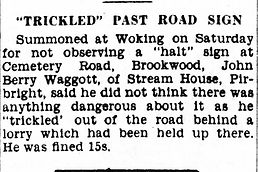

We think that the property was bought by Messrs Buckley and Wauchope. We do not know who these gentlemen were, but we suspect they may have been estate agents, as the 1955 article (right) implies. But in 1956 the property was bought by Stuart and Sheila Cassy. We hope that the windows had been repaired prior to their viewing appointment.
Stuart was born in Billericay in 1927, the son of an advertising executive. Sheila was born Sheila Pearson. They married in Fulham in 1950 and initially lived in Central London. They moved to Stream House in 1956, but only stayed about 4 years before moving to Woking, then Normandy. They later moved to Winchester, where Stuart formed an advertising agency. He may also have had an interest in fast cars... We think that the couple divorced and later remarried to other partners. Stuart later became a property developer and died in 2023, aged 95.
The next owners of Stream House from c1960 were Kenneth and Kathleen Miles. Kenneth Gordon Villette Miles was born in Sanderstead in 1908, the son of a surgeon. Kathleen (nee Bowler) was born in Wandsworth in 1900, the daughter of a British civil servant who worked for the Canadian Government, but who later became a hat-maker (that’s some career change). They married in Hersham in 1930, when Kenneth was a timber merchant. In 1939 they lived at West End with their 3 children. Kenneth was now a manager and secretary of a timber importer. After WW2 they lived in Sussex, but they returned to West End before moving to Stream House. They left Stream House in 1970, moving to Sussex.
In 1970 an Irene Smith and her family purchased Stream House. The phone directory entry was in the name of Barry Smith, who was presumably her husband (or son), but we cannot be sure which. We understand that the house was sub-divided c1987 to allow occupation by two different parts of the Smith family. The subdivided area was called (fairly logically) West Stream House, and we have written something about it below.
We think that the Smith family sold Stream House c1990 to John and Lavinia Lomas.
The house was sold to new owners in 2008. By this time, the building was looking pretty dated. The bedrooms were on the ground floor, the dormer windows were small by modern standards, and the rooms on the upper storey were quite limited in height. The exterior was run down, as shown by the photos below, which were taken around this time.


As a result, the house underwent significant improvement and now looks considerably smarter than it did 20 years ago. The house was sold a couple of years later in 2010 to the current owners.
West Stream House
We think that West Stream House was created c1987 as a subdivision of Stream House (above) to create separate living accommodation for part of the Smith family, who were living in Stream House at the time. Some members of the Smith family remained in the house until 2008, when the house was sold to the current owners.
Wood House (prev Woodwinds)
We don’t know when Wood House was built, but we think that it may have been in the early 1960s, when the house was originally called Woodwinds. By 1962, Dr Ian and Jennifer Silver were living there. Ian was born in Chertsey in 1924, the son of an insurance broker. Jennifer (nee Pixley) was born in Guildford in 1927, the daughter of a bullion broker. In 1939, the families were living 2 doors away from each other on the Chobham Road from Knaphill, although Ian was away for a lot of the time at school (Harrow).
During WW2, Ian became a Temporary Sub-Lieutenant in the Royal Naval Volunteer Reserve. He and Jennifer married nearby in 1948. They lived at Dimbula on the Bagshot Road in Brookwood and had 3 children. In 1970, 8 years after their move to Woodwinds, as explained in the press cutting right, the couple divorced. Susan de Carteret lived at Heatherwood, not far away, just up the Aldershot Road. Thus ended 2 marriages in Pirbright. We couldn’t help noticing that Jennifer’s maiden name was Pixley, while Susan’s was Puxley...

By 1971, an AC Morris was living at Woodwinds, which was also serving a purpose as an occasional meeting point for the local fox hunt.
By 1981 Ian and Diane Ogilvy were living there, but they had probably moved in some years before, during the 1970s. They changed the name of the house to the current Wood House. Ian was born in Woking in 1943, the son of an advertising executive, Francis Ogilvy. His uncle, David Ogilvy was known as “The father of advertising” and founded the well-known advertising agency Ogilvy & Mather. This company was taken over by WPP in 1989, and Uncle David was appointed chairman of the enlarged WPP. Ian’s mother, Aileen (nee Raymond), had been married to Sir John Mills, the well-known actor, before marrying Francis.
Diane (nee Hart) was born in Hove in 1943, and in 1962 had married an Anthony Lucock from Brighton. But the marriage didn’t last, and both parties remarried in 1968.
Ian Ogilvy was educated at Eton and chose to enter the acting profession – not surprisingly, given his parents’ backgrounds. In the 1960s he was living with his mother, Aileen, in Kensington. Ian’s acting career took off in 1978, when he played the role of Simon Templar in Return of The Saint. In the original series of The Saint, Roger Moore had played the lead role, so it is not surprising that Ian was considered as a possible replacement for Roger Moore in the role of James Bond in the early 1980s when he (Roger Moore) announced his intention to stand down (which in the event he failed to do).
Ian went on to star in many West End plays, films and TV roles. He co-starred in films alongside actors such as Boris Karloff, James Mason, Bobby Darin, Geraldine Chaplin, Vincent Price, Tom Courtenay, Candice Bergen, Meryl Streep, Goldie Hawn and Peter Cushing. He appeared in over 100 TV shows between 1964 and 2010 (his last was in a Miss Marple episode – The Mirror Crack’d). We’re not sure whether this is an honour, but he was hi-jacked by Eamonn Andrews for an episode of This is Your Life in 1979. Below are 2 photos (with thanks) of Ian, clearly taken some years apart.


Ian and Diane had one child, Titus, in 1969. They didn’t stay long in Wood House, and divorced in 1983. A newspaper article printed 5 years later (shown below, with thanks) told the background of this. Wood House with its 9 acres and trout lake gets a couple of references. Ian married Kathryn Holcomb in 1992, and later became a naturalised United States citizen.
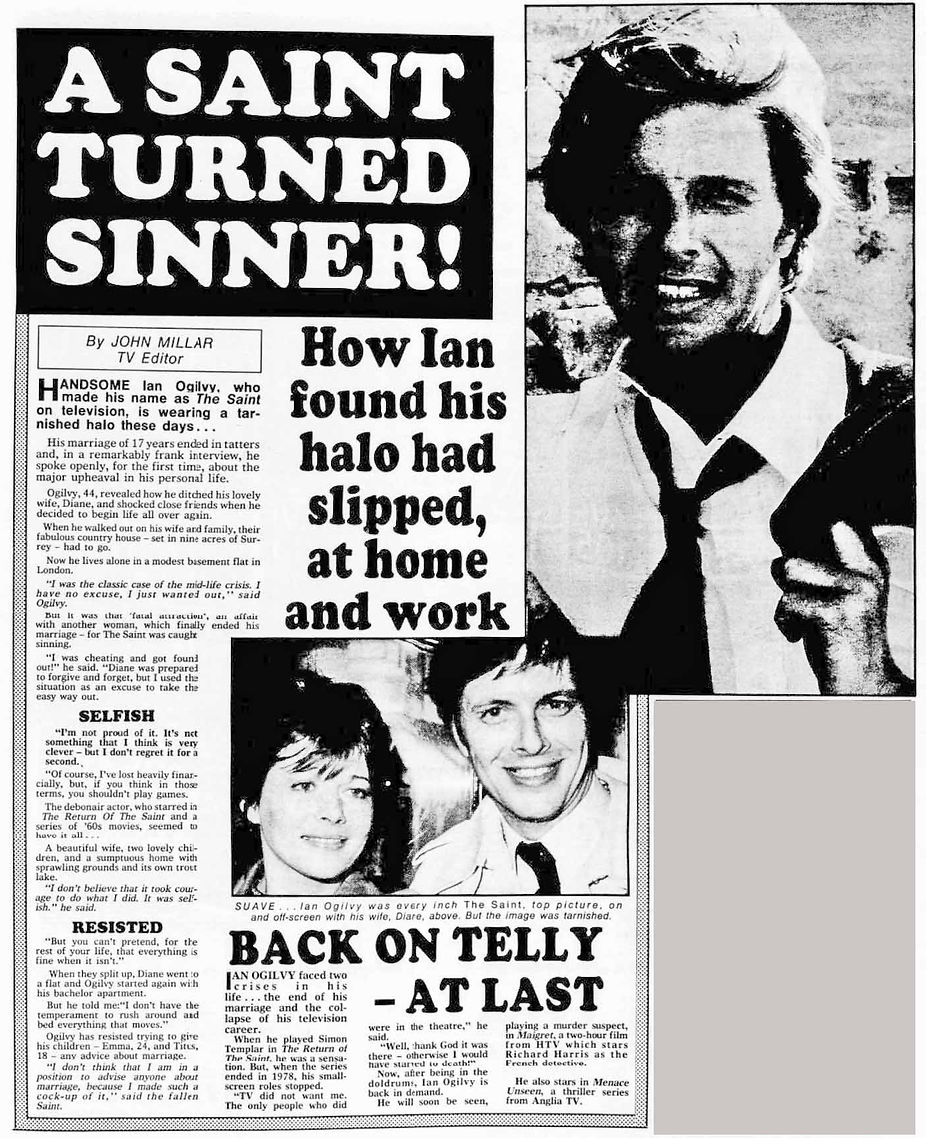
Wood House was bought some time in the 1980s by the current owners.