

The Green - The Terrace
This section covers the 24 properties on the east side of the Guildford Road between The White Hart (to the north) and Cove Bridge (to the south). Or, to put it another way, the 10 houses in The Terrace (aka Pirbright Terrace) and Brook Cottage, plus the 13 houses in Cowbridge Meadow.
We will start at the northern end and work our way southwards down to Brook Cottage, and then finish at Cowbridge Meadow. The text is split into 3 separate sub-sections, as it makes it easier to understand the early history:
-
The Terrace
-
Brook Cottage
-
Cowbridge Meadow
Below is an extract from the current OS map, along with a table of property construction dates.


We have shown an extract from the 1805 Halsey survey, left. Unfortunately, the detail is not very clear. However, the land where Pirbright Terrace is today is shaded in a delicate salmon colour. It is numbered as plot 122 and contains several small buildings.
The sharp-eyed will have spotted that the plot shaded light blue is also numbered plot 122 and is called Gibbs Acre. Sure enough, the light blue plot matches closely the site of today’s residential street called Gibbs Acre, which we have written about in the Gibbs Acre section. In 1807 both plots were owned by the same person - Mary Gyles.
It is possible that Mary was Thomas Gyles’s widow, although we can’t be sure of this. There was another Mary Gyles in Pirbright at this time. She was the widow of one Philip Gyles, and was the copyholder of what is today Stream Farm. We think that these 2 Marys may have been 2 different people.
Just before we launch into these 3 sub-sections, we must mention Molly the Horse. Molly was a much-loved white carthorse who inhabited Downers, or Downward Meadow, the field on the other side of the road to The Terrace in the 1960’s/1970s. Downers was actually the original name for the piece of land where The Terrace now stands and some surrounding land. It probably derived from someone called Downer in early times, but this person has not yet been identified.
Molly belonged to Frank Martin, who lived at Wickham Farm and then Sunset Cottage in Church Lane. Frank used to work Molly, raking and dragging the fields by the church, when he could catch her. He would walk across the field with her harness and Molly would start to play her game. As soon as Frank got near her, she would race off, not to be tempted by food. She was only caught when SHE had had enough of the chase and felt sorry for Frank. Some remember Molly running around on the old school football pitch until she was caught by Frank.
The children would enjoy feeding her carrots and petting her. Others would find great amusement in hearing Molly pass wind. Apparently the sound of escaping gas seemed to go on for ages....
Sub-section1: The Terrace
The Terrace area until 1897
The first reference to the area where The Terrace is today is as a plot in the Court Rolls of 1662. The plot only extended about 100 feet back from the main road (ie, it included where the buildings are today, but excluded their gardens). It was therefore only ½ acre in size. Back in 1662 it was referred to as “Part of Downers”. We can’t trace Downers itself, and as described above, we don’t know who Mr (or Mrs) Downer was. At that time (1662) the property was a smithy (or forge). Quite possibly the village blacksmiths had occupied the same property for many years beforehand, maybe even dating back to the earliest known days of Pirbright (the 1200s).
Here is a summary of the main sequence of events from 1662 to 1897:
-
1662: The existing copyholder, John Faggetter, died. The copyhold passed to his son, also called John Faggetter (who we will call John Faggetter 2). The property was ½ acre in size and was “lying near a lane called coebridge lane”. It was “adjoining to a certain Smith’s shop of the said John Faggetter”. Coebridge is presumably a reference to nearby Cove Bridge, where the Guildford Road passes over the Hodge Brook.
-
1668: John Faggetter 2 surrendered the property to his wife, Katherine, until their son (John Faggetter 3) reached the age of 28.
-
1683: John Faggetter 3 sold the copyhold to John Gyles, blacksmith.
-
1731: John Gyles died and the copyhold passed to his wife, Sarah, and then to their son, called John Gyles 2.
-
1766: John Gyles 2 died, and the property passed to his eldest son, John Gyles 3 (although Sarah was granted permission to live in the property for life).
-
1799: John Gyles 3 died and the copyhold passed to his son, called John Gyles 4.
-
1803: John Gyles 4 surrendered the copyhold to his son, Thomas Gyles.
-
1823: Thomas Gyles surrendered the copyhold to James Howard for £200.
-
1845: James Howard died and the copyhold passed to Mary Howard, who we think was his sister-in-law (see notes below).
-
1856: Mary Howard died. Mary Boylett and Phoebe Howard inherited the copyhold. We think that Mary and Phoebe were the granddaughters of the Mary Howard who inherited the property in 1845. We have written a little about Mary and Phoebe in the notes below.
-
1880: Mary Boylett died and the copyhold passed to Charles Boylett. Charles was the husband of Mary Boylett, who had inherited the property in 1856 (see notes below)
-
1897: The property was enfranchised, ie Charles Boylett became the freehold owner.
-
We have written some notes on the various connections between these people below. The records are not easy to interpret with certainty and so we have had to make some assumptions.
John Faggetter 1 (1587-1660) was born in 1587. He married Mercy Lee (1598-1674) in 1621. Mercy had been born in Pirbright in 1598, the daughter of a Henry Lee (1577-1631 or 1635). We assume that John 1 was a blacksmith, as the Court Rolls from the 1660s refer to the property as a Smith’s shop.
Their first child, John Faggetter 2, was born the following year in 1622. John Faggetter 2 became a father to a daughter in 1638. We cannot trace his marriage, although we think his bride’s name was Katherine. Their daughter was named Mercy, no doubt after John 2’s mother. John 2 fathered another child, John Faggetter 3, in 1655.
John 2 then surrendered the property to his wife, Katherine, in 1668. This was a legal device by John to protect the rights of his wife. Manorial custom of the time sometimes gave widows the right to keep only a portion of the land (often half). Thus John’s surrender of the property to Katherine before his death would allow her to own it fully. It looks as though John 2 died in 1678, followed by Katherine in 1681.
John 3 then seems to have acquired the copyhold of “part of Downers” (even though he may not yet have been the required 28 years old). John 3 waited 2 years until 1683, at which point he sold the copyhold.
John Gyles acquired the copyhold from John Faggetter 3 in 1683. For whatever reason (eg, perhaps they were non-conformists), records of baptisms, marriages and burials of the Gyles dynasty are scanty, but we have written what we do know.
John Gyles died in 1730, and the property passed to John Gyles 2 and then to John Gyles 2’s wife, Sarah Gyles (although we can’t find any record of their marriage). John Gyles 2 (who was a blacksmith) died in Pirbright in 1764, and the property passed to their eldest son, John Gyles 3. Sarah was granted permission to live in the property for life. She died in 1780.
The Court Rolls report that John Gyles 3 died in 1799, that the property passed to his son, John Gyles 4, and then to John 4’s son, Thomas Gyles. The Land Tax records align with the Court Rolls, but we can’t find baptism, marriage or burial records of any these people.

It was some relief to us to arrive at 1823, when James Howard acquired the property from the hard-to-identify Gyles dynasty. James Howard (1770-1841) had a brother, John, who rented Cowshot Farm from Henry Halsey 1 and 2, and they both worked Cowshot Farm together. John married Mary Harris (born in Hampshire in 1789) in Pirbright in 1808. They had a son, John Howard (the younger), the same year. James purchased the copyhold of the “Part of Downers” plot in 1823. He died in 1841 (at which point the plot passed to his and his brother John, who died in 1843. In his Will, John left his blacksmith’s shop, occupied by Widow Wheeler (see Patience Wheeler below) for her lifetime, then to his son, John Howard the younger.
John’s wife, Mary then inherited Cowshot Farm and also became the copyholder of the “Part of Downers” plot. Mary died in 1855.
John Howard the younger married a lady called Ann Loveland (born in Horsell in 1817). We can’t trace a record of this, but it seems to have occurred c1838. They had 2 daughters, both born in Pirbright: Mary Howard (born 1837) and Phoebe Howard (born 1843). Mary married Charles Boylett, the son of a tailor, in 1854 in Guildford when she was aged 17. And so it was that Mary Boylett and Phoebe inherited the copyhold when their grandmother Mary died in 1856. We don’t know what happened to Phoebe (she may have sold her share to Mary), but when her sister, Mary died in Woking in 1879, the entire copyhold was passed to Mary’s husband, Charles Boylett.

We have shown the same area in the 1841 Tithe map, left, using the same colouring as for the 1805 map above (our apologies if you didn’t like it first time around). The Terrace area is clearly numbered 13 and contains one dwelling (in red) and 3 outbuildings (black). Note the slight kink in the wall by the southernmost outbuilding. It can still be seen in the wall outside No 10 to this day.
The description of plot 13, “Cottage, smithy and garden” confirms that the property was still being used as a smithy. It was half an acre in size, owned (freehold) by John Howard (as we have already written), and occupied by a Patience Wheeler.
Patience Wheeler (maiden name unknown) was born in 1776. About 21 years later she married Henry Burchett (born 1777 in Windlesham). They moved to Shepperton and they had 3 children (one of whom died in infancy). However, their marriage appeared to have foundered. Patience moved to the Woking area with her 2 surviving children, while Henry seems to have returned to Windlesham, working as a bricklayer.
In 1832, Patience married James Wheeler in Godalming. In the marriage register Patience described herself as a widow, which, ahem, may not have been quite correct. James was a widower, but we know very little about him. They seemed to first live in Pirbright from c1833. James was receiving Poor Law payments.
In 1851 Patience was living in the “Smith’s shop” on the Lower Green, which we assume is the same property as in 1841. She described herself as a blacksmith’s widow, which we assume refers to James Wheeler, her second husband, who may have died in Guildford in 1847.
By 1851 Patience was sharing the cottage with William and Hannah Boylett. Hannah, aged 39, was Patience’s daughter from her first marriage. William Boylett was a blacksmith, born in Woking in 1802. William and Hannah married in 1838 and had 10 children. Hannah had also previously given birth to a daughter in 1835. Patience died in 1855 in Pirbright, and by 1861 the rest of the family had moved to East End in Chapel Lane, where we continue their story.

We have shown a plan of the area, we think from around 1897, left. The buildings are more or less the same as in 1841, although the forge has been extended. The cottages in the middle have been extended a little, and are now described as cottages in the plural, rather than a single cottage. We have referred further to this in the text above. The slight kink in the wall is still there.
On 29 January 1897 the property was enfranchised to Charles Boylett by Henry Halsey 4 for an unknown fee. Below left is a watercolour by Mary Cawthorn’s cousin, Miss Rucker, sometime between 1885 and 1890. It shows the area where the Terrace would soon be built (looking from the south). The right-hand side of the drawing shows what could be the smithy (in the foreground) and the cottage behind it. It correlates very well with both the Tithe map of 1841 and the OS map of 1873. But I’m afraid we can’t identify the Pirbright labourer in the road.
On the right is an earlier drawing (date unknown), taken from the other direction, which looks to be the same scene (although the labourer had by then gone somewhere else).


1897 onwards
We pick up the story on 6 April 1897 at the point when Lord Pirbright bought the strip of land containing the old smithy from Charles Boylett for £340 (equivalent to £38,000 today). Charles had acted fast, as it was just 2 months after Henry Halsey had enfranchised the property to him. It all sounds pre-planned to us.
Lord Pirbright was an MP named Henry de Worms, who selected the title “Lord Pirbright” when he was ennobled in 1895. He constructed many affordable rental homes in the village and was widely regarded by locals as an important benefactor. He marked most of his cottages with a plaque containing the letter “P” and the year of construction, most of which can still be seen today.
Lord Pirbright’s affordable homes were (and still are) solidly built houses mainly for the working classes at reasonable rents. We think they were built to the standard formula of the times of a sitting room, kitchen and scullery downstairs, plus 3 bedrooms upstairs. Mains water was provided, and the cottages used “earth closets”. These seem to have worked like a normal WC with a flush system, but using dry soil instead of water. The used soil would normally be allowed to compost for a few weeks, and then be used in the garden.
Middle class nimbys were outraged by the cottages. Miss Cawthorn, at Langley House, sniffily called the Terrace ‘coronetted villas’. The smithy (or forge) moved a few yards to the south side of The Green. We have written more about Lord Pirbright in the Pirbright Cottages section.
We will now deal with The Terrace - firstly as a whole and then house-by-house – followed by Brook Cottage, and then the recently-built Cowbridge Meadow.
Nos 1-11, The Terrace
One of Lord Pirbright’s first projects in Pirbright was to build The Terrace by demolishing the smithy and related outbuildings and constructing cottages on the strip of land.
We have shown an extract from Lord Pirbright’s 1897 plan for building Nos 1 and 2, left. The 2 earth closets can be seen in the furthest corners (ie top left and top right) of the buildings, each marked as “EC”. The buildings retain this shape today, give or take the odd extension.
The writing is poor, but the neighboring plot on the left hand side of the plan is marked “Property of Friary Brewing Co”, not surprising, as it is the plot on which The White Hart stood. The title also states “houses and shops”, showing that Lord Pirbright intended to build more houses on the strip of land.
John Faggetter, a descendant of the 1661 John Faggetter, submitted the plans for bye-law approval to Guildford Rural District Council. Throughout Victorian times most of the Faggetters were in the building trade, including all four of John’s sons, two of whom were sadly killed in WW1. The quality of their brickwork was unsurpassed. Below is a photo of John in later life.
The following year (1898) Lord Pirbright followed up by submitting a plan for 8 more houses (which actually turned into 9). The extract from the building plan, shown below, includes some matters of interest:
-
It refers to Nos 1 and 2 as “New shops”, ie confirming that they had already been completed. These shops have direct frontages onto the road, whereas the proposed houses are set back from the road slightly.
-
Behind Nos 9, 10 and 11 the plan indicates a “Smiths and Wheelwrights shop” would be built. We don’t think that this ever happened. Instead, the southernmost building (Nos 9 and 10) was enlarged to include a third house (No 11).
-
On the right hand side of the map is Mr C Thompson’s house. This was today’s Brook Cottage, which we have written about further down this page.


In general, residents of The Terrace seemed to have kept their houses for longer periods than other roads in Pirbright. There are many examples in this section of families living in the same house in The Terrace for 40 years or more. This must have built up a spirit of camaraderie, and so it should be no surprise that the enterprising residents of 1997 staged a Centenary party to celebrate the Cottages’ first 100 years. We have shown below the invitation, the songsheet and a press report of the event, as well as 3 photos from the day itself. It must have been a terrific event, so well done to the organizers and participants! By the way, we would love to know the tune to which the song was sung…


Before we consider each house, here are some pictures of The Terrace:
-
Top left: The name of Willis on the board of No 2 dates this photo to between 1900 and 1904. It’s a poor quality photo, but we’ve included it as it’s not often one sees a herd of cows wandering along Pirbright roads these days.
-
Top right: Dating we think from the early 1910s, as one of the cottages has a good growth of ivy on it. Today’s Brook House is hidden behind the trees on the extreme right.
-
Bottom left: This photo was taken a little later, perhaps in the 1920s. The rails on the bridge over the Hodge Brook (bottom right and left) are looking weathered and the ivy has progressed upwards. Today’s Brook House is more visible. We don’t know who the people are, but we would guess they were local residents.
-
Bottom right: This photo was taken in the 1960s by a member of the local WI. It shows Nos 7-11 as well as Brook Cottage. Lord Pirbright’s distinctive “P” plaques are easily seen on the gables.


We will now look at each of the cottages in turn, starting at the northern end with No 1.
1, Pirbright Terrace
The first occupants of No 1 from c1899 were John and Ada Lambson. John was born in 1876 in St Marylebone, the son of a cheesemonger. Ada (nee Hart) was born in 1860 (and so was 16 years older than John), the daughter of a butcher who lived in High Street, Woking (today the area is called Old Woking). John and Ada married in 1894 in Guildford. They had one son. John was a hairdresser and presumably used No 1 (which had been designed as a shop) for his hairdressing salon (or whatever the 1899 equivalent of a hairdressing salon was called).
They remained at No 1 until 1905 when they moved back to Woking. Perhaps Pirbright people weren’t having their hair cut as often as John was hoping. Ada died in 1910, aged 50, leaving £1,200 (today £120,000). John was only 34 at the time, and the following year was living with his mother in Wood Green. During that period, he was employed as a picture framer. Sadly, he died in 1915, aged only 39 by shooting himself in the heart, suffering from depression.
The next occupants from 1905 were Edwin and Eliza Cartwright. Edwin was born in 1874 in Wandsworth, the son of a tailor. Eliza (nee Howard) was born in Horsell in 1872, the daughter of a farmer. They married in 1906 in Woking. Edwin was a tobacconist at the time, and it looks as though, now that they were married, they decided to set up their own shop. Lo and behold, a hairdresser’s salon in Pirbright became available, and they took the opportunity. Carpe diem and all that.
They had 3 children, and for a while were joined in the tobacconist/newsagent shop by Eliza’s widowed mother, Mary Howard. This would surely have been handy for baby-sitting duties while the parents minded the shop. They also employed a young hairdresser, William Little, about whom we have written a little (sorry!) lower down.
In 1916, after the death of Lady Pirbright, the cottage was bought by Eliza Cartwright. It seems likely that she also bought No 2 (refer below), although we do not know this for certain. The Cartwrights continued to run the shop, but c1919 decided to change tack from tobacco, newspapers and hairdressing to groceries. Accordingly, they moved into the grocery next door at No 2, where we pick up their story, below.
The next occupants of No 1 from 1919 were William and Rosina Little. William was born in Rotherhithe in 1888, the son of a waterside labourer at the nearby docks. Rosina (nee Howard) was born in Pirbright in 1887, the daughter of Henry and Mary Howard. Henry was a bricklayer’s labourer. At the time of her birth, the Howard family was living at Blatchford Cottages at the northern end of Chapel Lane, and we tell their story there.
We don’t know what brought William to Pirbright, but they married here in 1907. At that time William was a hairdresser and gave his address as No 1, so it seems that he was working for Edwin Cartwright, continuing John Lambson’s hairdressing business after John’s departure. Rosina was living at No 5 with her family (refer section below).
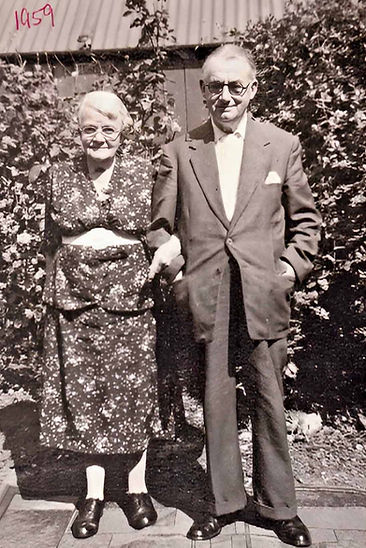
After their marriage the Littles lived in a house on The Green, probably in one of the flats above Boyletts Stores. William probably continued to work as a hairdresser at the Cartwright’s shop at No 1. During WW1 he served as a private in The Queen’s Regiment. As an older married man with children, he would have been spared the front line. They had 8 children, all of whom were born in Pirbright. One of the children died in infancy.
When the Littles moved into No 1 (c1919), they continued the business run by the Cartwrights. Sure enough, in the 1921 census the shop was described as “Hairdresser, Newsagent and Tobacconist”.
In 1925 the Littles moved to Windlesham. We have shown a photo of William and Rosina, left. Our hunch would be that it was taken around 1959. William died in 1972 and Rosina in 1974.
In 1925 Joseph and Laura Reeves took over the shop. Joseph was born in Reigate in 1874, the son of a hairdresser who became a taxidermist. Laura (nee Lepine) was born in Wimbledon in 1879, the daughter of a bookmaker.
They married in Reigate in 1903. At the time, Joseph was following in his father’s footsteps by working as a taxidermist. They lived in Reigate for a while. In 1911 Joseph was still following in his father’s footsteps, by working as a hairdresser and taxidermist. By 1921 he seems to have abandoned taxidermy and gave his occupation simply as hairdresser. Probably a smart move. But at the time of the census of 1921 Joseph was living and working in Dorset, while Laura and their daughter were living in the family home in Connaught Road, Brookwood. That must have been tough for all 3 of them.
It must have been something of a relief for the whole family to move into No 1 in 1925. They remained at No 1 for about 15 years. But the 1939 Register records that Joseph at that time was incapacitated, and that Laura was running the shop as a newsagent and tobacconist. There was no mention of hairdressing. An 18 year-old girl, Nina Benfield was also living in the cottage as a “Companion help”. But Joseph died the following year. We have shown a copy of the newspaper report of his death. Eliza Cartwright, who had previously lived at No 1 (refer above) was mentioned. Laura soon moved to No 4, The Gardens and died there in 1959.
The next occupants from c1941 were George and Kathleen Packer. George was born near Salisbury in 1888, the son of an innkeeper. His family moved to a pub in Petersfield, and in 1911 George married Edith Smith (born 1885) in Shalford. George was a butcher at the time. Their first child was born 5 months later, and they had a further 7 children. In 1921 George was a meat salesman, and the family was living in Walnut Tree Close, Guildford.
But it seems that the marriage turned sour, as by 1933 Edith was living in a house off the Stoughton Road with 5 of her children, while George was living in a flat in North Street, Guildford with a “Kathleen V Packer”.
George and Kathleen soon moved into a house in Liddington Drive. Kathleen was in fact Kathleen Rickards (born in Salisbury in 1906), unmarried when she moved in with George, and styled herself as his wife. Kathleen had had a daughter in 1932 in Salisbury and named her Jean Packer, so that suggests their affair started c1931 or earlier. In 1939 George was a “news distributor” (ie a newsagent). His and Kathleen’s house was named Sarum, presumably named after their places of birth.
George and Kathleen only married in late 1946, a few months after Edith died. We wonder whether Edith had refused to get a divorce, which had led to George and Kathleen’s pretence of being married. They married locally (but not in Pirbright). George and Kathleen only stayed a few years in Pirbright before returning to Liddington Drive c1947. We have shown, right, a page from the 1947 Village Fete, promoting George and also Leonard Nind at next-door No 2. George died in 1957, and Kathleen moved to Frimley, where she died in 1993.
The next occupants of the shop at No 1 were Edwin (Ted) and Winifred (Win) Watkins. They bought the shop from Eliza Cartwright (a previous occupant, who had moved into No 2 several years earlier). Ted was born in Easthampstead, near Bracknell in 1907. His father in 1911 ran “Coffee and dining rooms” at their home, which by 1921 had morphed into a “Confectionery business”. Win was born Winifred Thompson in 1912 in Pirbright. Her parents were Albert and Ellen Thompson, who lived at West Hall Farm, where we tell their story.
Ted and Win married at St Michael’s in 1938, when Ted was living in Connaught Road, Brookwood. At the time, Ted ran the WH Smith book store at Brookwood Station, and Win was at West Hall Farm. Below we have shown a photo of Ted and Win’s wedding, complete with the names of everyone in the photo.
We have also shown (left) a newspaper report of their wedding. At the top of the report is the name of Joseph Reeves (refer above), the then newsagent living at No 1 at the time.


After their marriage they moved into Winkfield in Chapel Lane and produced two sons. When Ted was called up for WW2, Win ran the book store. She remembers one day walking to work from Chapel Lane to the station when she heard a bomb explode behind her. The bomb crater can still be clearly seen on our heathland today. We have shown 2 early photos (right) of the Watkins family. The photo on ther far right was taking in front of Winkfield. The other photo was taken somewhere in Pirbright. The Watkins family moved into No 1 c1947. Win became Hon Treasurer of the Pirbright Scouts Association.
In 1951 Ted bought Upper Law Meadow. The history of this is described in the Law Meadows section, but we will summarise it as follows: In 1955 he built 3 houses (Willowbrook to Ganavan) on the land. Then in 1956 he made a failed attempt to build 92 houses and 6 shops on the land. In 1957 Ted donated the land for a Scout Hut to be built on the land.
The Watkins family moved into the Post Office on The Green c1962, and then to No 6 (refer section below) in the early 1970s. Ted died in 1991 and Win in 2010, ending the Thompson dynasty which had been such a part of Pirbright for 150 years.
We have shown 2 photos below. The left-hand photo shows Ted and Win (on the left) at the 1960 British Legion dinner. The right-hand photo shows Win in her later years.


In 1962 Percy, Rhoda and Peter Netherton purchased the shop at No 1, with the help of a mortgage from the previous owner, Ted Watkins. Percy was born in Holbeton, a small village in South Devon in 1903, one of 14 children of a farm labourer who became a domestic gardener. Rhoda (nee Bond) was born in Plympton in 1908. Her father described himself as a “Sick berth steward” and worked at a Convalescent Home.
Percy and Rhoda married in Plympton in 1925 and moved to Bridport. They had a daughter the following year, but she died in infancy. Percy worked as a domestic gardener like his father. They had a second child, Peter, in 1940.
The Netherton family moved to Henley Park in Normandy in 1945, when Percy answered an advert in a gardening magazine for a head gardener to produce food for local workers. In 1947 there were 7 gardeners at Henley Park. From 1948 until 1961 the family lived in one of a pair of cottages at the Pirbright Road entrance in front of the Vokes factory, called Gardener’s Cottage, which was demolished in the late 1970s. In 1948 Percy re-laid the lawn in front of the mansion. Peter used to enjoy using a machine for making flowerpots of compressed earth when he got home from school.
When they moved to No 1 in 1962, we suspect that Peter did most of the work in the shop. In 1966 Peter married Patricia (Pat) Stevens at St Michael’s. The same year they installed a caravan in the garden. They had one daughter. Initially Pat helped in the shop, but later, she left. Percy died in 1979 and Rhoda in 2003 (aged 95). We have shown a photo of the shop from the 1960s, left.
Peter was a walking encyclopaedia on his family history on the borders of Devon and Cornwall. He also showed a keen interest in local archaeology – he found several articles of interest in the Pirbright area. We have shown pictures of some of these articles below (an Elizabeth I coin from 1661, an eerie-looking clay pipe bowl, neolithic-age stone hand-tools and an echinoid fossil).
Peter also had the foresight to keep the dozens of cartoons on re-used envelopes which Ian Gammidge, a local cartoonist, used to pay his weekly bill….


Peter struggled to manage the shop with only his elderly mother and closed it down in the late 2000s. Thus, the newsagent shop closed after nearly 120 years. Peter died in 2016, but the house is still owned by members of his family.
2, Pirbright Terrace
The first occupants of No 2 from 1899 were James and Mary Ann Wilson. James was an engine fitter, born in Woking in 1861, the son of an agricultural labourer. Mary Ann (nee Ledger) was also born in Woking in 1861, the daughter of an agricultural labourer in Saunders Lane. Although No 2 had been built as a shop, it seems unlikely that James and Mary ran it as such. They had had 6 children by 1899 (a further 5 were soon to follow) and James’s jobs before and after their stay were engineering-related. The Wilsons moved around the West Surrey area quite frequently thoughout their lives. They only stayed one year in Pirbright before moving to St John’s. By 1939 James was living in New Haw. Coincidentally he lived not far from the Research Institute there, which has connections with the Pirbright Institute today. However, neither entity had even been thought about when James lived in Pirbright.
The Wilsons were followed in 1900 by William and Jane Willis. William was born in Odiham in 1849, the son of a farm carter. Jane (nee Binstead) was born in Epsom in 1849, the daughter of a labourer. They married in 1874 and had 3 children. Initially the Willises ran a shop near Worthing, but by 1891 they had moved near to Lewes, where William worked as a coachman. We don’t know what enticed William and Jane to move to Pirbright, but they only stayed 4 years before moving to a shop in Fleet. We have shown a photo of the Willis’s Pirbright shop in the introductory section of this page – it’s the photo with the cows wandering along the road.
We can’t imagine what made William and Jane leave Pirbright in 1904 to move to a shop in Fleet. They retired to Hampshire, where Jane died in 1928 and William in 1940.
The next occupants of the shop at No 2 were Wilfred and Harriet Paris. Wilfred Marshall Paris was born at Hadlow, near Tonbridge, in 1873. His father was a baker and painter, which strikes us a rather unusual combination. Harriet (nee Swan) was born in the same village as Wilfred, but 8 years earlier, the daughter of a farm labourer. They married (probably in Hadlow) in 1897. By 1901 Wilfred was running a bakery in Hadlow High St. But in 1904 they were attracted by the bright lights of Pirbright and moved into No 2. In 1911 Wilfred described himself as a vbaker and confectioner.
The Parises stayed at No 2 until 1918, at which point they returned near to Hadlow. Maybe the bright lights of Pirbright were just too bright for them. In 1921 Wilfred was looking for work. They had no children. In 1939, Wilfred was living in Woolwich, where he was running a grocery shop. Harriet had died in 1938, and Wilfred died in 1950.

It was at this point (in 1919) that Edwin and Eliza Cartwright decided to move out of the newsagent’s shop at No 1 and run the grocery business next door at No 2. We imagine that the grocery business was considerably larger than that of a newsagent/tobacconist, and so it seems like a sensible move, despite the poor economic environment in the UK at the time. As we explained in the section dealing with No 1 (above), Eliza had bought No 1 (and, we suspect, No 2) in 1916, and so it would have been an easy move for them.
We have told the story of the Cartwrights’ early life in the section dealing with No 1 (above). To continue, Edwin had joined the RAF in July 1918, in the closing stages of WW1. By 1918, the upper age limit for conscription had been raised from 41 to 51, making 44-year-olds eligible to be drafted He transferred to the RAF Reserve in 1918 and was deemed to have been discharged in 1920.
Edwin died in 1933. We have shown a copy of a press notice of his death, left. Eliza moved to Stoughton and died there in 1949. We know that Eliza sold No 1 to Ted Watkins in 1947, and we imagine that she sold No 2 at the same time, possible to the next occupants.
The next shopkeepers at No 2 were Leonard and Gladys Nind. Leonard was born in Rushden, Northampton in 1904, the son of a publican, later a hotel proprietor, even later a wine merchant. In 1931 he married Gladys Moss in Northampton. They had one son in 1932 while living in Northamptonshire. Leonard lost his job and made the decision to rent the grocer’s shop at No 2. They came south to Pirbright in March 1933, but only a few months later in August, Gladys died in dreadful circumstances (see cutting right). She was aged only 26 (Leonard was 29). This must have been absolutely shattering for Leonard and his young son. The pond in question was Swallow Pond.
The following year, a story in the local newspaper featured Leonard and one of his neighbours, Nevill Medd-Sygrove from Brook Cottage (refer section below) in a fiercely-fought court battle (see cutting, left). The newspaper could not resist making an awful pun in the sub-title, but under the circumstances we will refrain from following suit.
In 1937 Leonard remarried Lilian Palmer, aged 19 in St John’s. Lilian was born in Greenwich in 1917, the daughter of a master carpenter and lived in Knaphill. The Ninds had one daughter. In 1945 Leonard was Group Scoutmaster of the Pirbright Scout Group, but the Nind family left Pirbright in 1948. Leonard died in Dorset in 1970. Lilian remarried in 1973 and died in Walton-in-Thames in 2011, aged 94. We have shown a photo of Leonard, left in his ARP uniform during WW2.


The next shopkeepers at No 2 from 1948 were Albert (Bert) and Vera Newnham. Albert Thomas Victor (“Bert”) Newnham was born in the Isle of Man in 1902, the son of a house painter called Araunah Newnham. Vera Marion Marrable was born in Uxbridge in 1913, the daughter of a cost accountant. They met when they were both living in Guildford. Bert was a grocer’s assistant, living near to the Guildford Cricket Ground. Vera was a nurse, living the other side of the railway tracks. Maybe she worked at the (old) Royal Surrey County Hospital on the Farnham Road.
They married in Guildford in 1937 (press cutting shown right). On the marriage certificate, Bert recorded his father’s occupation as “art decorator”, a step or 2 up from the earlier “house painter”. In 1939 Bert was still a grocer’s assistant and they were living just off the Stoughton Road with one son. They had a further 2 sons during WW2.
But by 1948 Bert presumably felt that he could handle a grocer’s shop himself, and so they rented (or perhaps purchased?) the shop at No 2. They threw themselves into local life: Bert chaired the Pirbright Old-time Dance Club and was on the committee of the Pirbright Scouts Association. He also MC-ed a Parish social event in 1953. He was a lay reader at the church and was involved in the Red Cross cadets’ training activities.
Vera was a member of the Pirbright British Red Cross Society, where she was a Nursing Superintendent. She is remembered as being quite strict by the children who her young charges. Once when she was ill she insisted on the children going out and practicing their home nursing skills alone.
Many of the Pirbrighters of the time remember Newnham’s Stores fondly. Their mums would fill out an order form on a Friday, and the delivery boys would pedal round the village the next day on bikes that were too big for them, delivering the orders. The bags of broken biscuits in the shop were considered a special treat. As were the bags of broken crisps (at 1p per bag).
We have shown 3 press cuttings below. The left-hand cutting, from 1963, demonstrates one of the less pleasant aspects of the world. The central cutting from 1961 describes the sporting prowess of the 3 Newnham boys, in particular Keith, who was a sprinter. And the right-hand cutting, from Chichester in 1987, tells a wonderful story of Bert’s life (with a surprisingly good photo, as well).


Bert died near Chichester in 1993. Vera returned to the Guildford area, living at Wonersh, presumably to be close to some of her children. She died in 2011, aged 97.
After the Newnhams left Pirbright in 1970, the shop was taken over by Philip and Violet Palmer. As with their predecessors, we don’t know whether they rented or bought the shop. Philip was born in 1910 in Camberwell, the son of an optical turner. Violet Cavel Collins was born in Croydon in 1916. They married in 1939. At the time Philip was working in an estate agent’s shop, while Violet managed a baker, confectioner and caterer’s business in Wandsworth.
They had one son and moved away from Pirbright sometime during the 1970s. Violet died in Tooting in 1987, and Philip died there in 1993.
The next occupants by the early 1980s were Malcolm and Alice Tanner. We think that they may have lived in Mayford and run the store (Tanner Stores) from there. By 1992 the name of the shop had changed to Bentley’s Stores and the new proprietors were John and Jacqueline Bentley.
From the early 2000s the occupants of the shop were a Mr & Mrs Taylor, and it was around this time that No 2 was converted into an antiques shop (see photo, right).
But the antiques shop closed, and, for a while, the 2 closed shops were something of an eyesore.
The shop was sold in 2006 and sold again in 2009. The new owner (a development company) gained planning approval to convert the property to full residential use.
The shop was sold again to the current owners in 2014 and is now a private residence.

3, Pirbright Terrace
The first occupants of No 3 were Thomas and Emily Smith. Thomas was born in Brighton in 1873, the son of a groom, who died when Thomas was aged 6. Emily (nee Mansell) was born in Woking in 1873, one of 11 children of a postmaster. She spent her early years living at Chertsey Road, Woking, before her family moved to Portsmouth. Thomas and Emily married at Portsea in 1897 and moved to Pirbright. They had 3 children here. In 1899 Thomas was a baker, and we imagine he was working at the shop next-door at No 2.
They stayed in Pirbright until early 1901 when they moved to Brighton, where Thomas was a clothier’s assistant. Interestingly their 3rd child was baptized at St Michael’s in October 1903, although the family was living in Brighton. It seems that they made the (in those days, long) journey back to Pirbright especially for the baptism. Thomas gave his profession as “traveller”, which might suggest part of the reason. By 1921 the family was still living in Brighton, where Thomas was now a clothier’s manager. Thomas died in 1949 and Emily in 1951.
The next occupants of No 3 from 1901 were Charles and Elizabeth Wilkins. Charles was born on the Isle of Wight in 1872, the son of a “dealer”. Elizabeth (nee Matthews) was born in Southampton in 1874, the daughter of a yacht mariner. They married in Alton in 1899 and in the 1901 census Charles gave his occupation as a plumber and painter. They had 4 children in Pirbright, and, during their stay, Charles had a couple of newspaper mentions relating to the Providence Chapel. One of these commented on the quality of his singing! The Wilkins family moved away from Pirbright c1912, we suspect in search of work. In 1921 the family was living at Bulford Army Camp, Wiltshire, where Charles worked as a plumber. They were still there in 1939.
The next occupants from 1912 were William and Mary Ann Crouch. William had moved to Pirbright in 1891 and married Mary Ann (nee Norman). They initially lived at Springfield Farm, where we have told the story of their early lives, and then East End in Chapel Lane. By 1912 they had produced all 6 of their children, and so perhaps they needed a little more space than had been the case at Springfield Farm or East End. William also had 2 children from his first marriage and Mary Ann had given birth to a child in the Guildford Workhouse just before her 19th birthday.
In 1921 William was a gardener for Edgar Stephens at Hogleys Farm. They were still living at No 3 in 1939, when William described himself as a retired nurseryman. Mary Ann died there in 1948, and William in 1951. We have shown a local newspaper notice of his death (left).

After William’s death the Crouch family retained strong links with Pirbright. We have written about 5 of William and Mary Ann’s children below. (Their 6th child married and immediately left the area).
-
Alfred (1893-1957) served as a private in the Queen’s Regiment in WW1. In 1918 he was wounded and taken as a Prisoner of War. In 1925 he married Gertrude Collier in Guildford. They soon moved to No 3, Model Cottages at West Heath, where we continue their story. One of Alfred’s children, Ronald Crouch and his wife Enid, returned to live at No 3 in the early 1960s before moving to No 13, Upper Stanford Road later in the 1960’s. They stayed there for 30-odd years.
-
Grace Ethel (1895-1970) married Albert Bailey at St Michael’s in 1918. They lived initially at Blatchford’s Row (in Chapel Lane), before c1937 moving to No 2, Council Cottages at West Heath, where we tell their story.
-
Henry (1897-1958) served as a private in the Queen’s Regiment in WW1, like his elder brother, Alfred. In 1919 Henry married Dorothy Trower (from Knaphill) at St Michael’s Church, and in 1921 they were living (albeit briefly) in No 9 (refer section below). They lived for a while at No 5, Council Cottages in the late 1920s, and then moved to Woking, where Henry worked as a heavy labourer.
-
George Vernon (1906-1982) married Alice Ryall in 1931 at Chertsey. He was a “funeral chauffeur” at Brookwood Cemetery in 1939, living at the cemetery with Alice. In 1949 they moved to No 7, Stanford Cottages, where we continue their story.
-
Reginald (1910-1997) married Irene Bradley in Guildford in 1930. They followed Reginald’s brother, Henry, by moving to No 5, Council Cottages, where we continue their story.
After William’s death in 1951, we can find no records of occupants of No 3 until 1966, when Peter and Sarah Raven moved there. Peter was born in the Guildford area in 1943. Sarah was born Sarah Rands and was living in Connaught Road, Brookwood. They married locally (not Pirbright) in 1965.
Peter was a garage proprietor and ironically first came to our notice in 1966 when he pleaded guilty to using a silencer which had been altered to make it noisier. Peter’s middle name was Sylvester, but we don’t know if he was connected to Silvester’s Garage in Normandy, or whether (more likely, we think) he worked at Clarke’s Garage along the road.
By 1974 the Ravens had moved out of No 3 into another Pirbright house where the family still lives. No 13, The Gardens – Sarah still lives there, so can’t mention. It seems that Peter may have moved out of the family home a few years later and may have died in Penrith in 2019.
By 1974 Charles and Ethel Dean moved into No 3. They had previously lived at Bakersgate Bungalow for over 40 years. We have written about their history (including photos and some delightful memories from one of their children) in the Bakersgate Bungalow section.
After the Deans moved to Devon in 1987, Robert (Bob) and Mary Laker moved into No 3. Bob was born in 1931, the son of Arthur and Mary Laker, who lived at Beech Cottage in School Lane. The Lakers soon moved into what is today Swallow House. Arthur was a well-known builder and decorator in Pirbright and in his later years chaired the Parish Council.
Bob Laker joined the RAF after WW2 and served in Germany. We have shown, right, an extract from one of his letters home in which he gave his observations on German food and drink.
He and Mary Clarke married locally (though not in Pirbright) in 1962. Bob, who followed into his father’s business, is probably best remembered for being a stalwart member (later captain) of Pirbright Cricket Club, slow bowling being his forte. Below is a photo of Bob, Mary and their family, together with a couple of action shots from the Pirbright ground, and one of Bob with friends in his later years.


Bob died in 2011 and Mary stayed in No 3 until 2014. Until that point, we don’t know who owned No 3 – was it owned by any of the occupants, or did they rent the house? But in 2014 the house was sold to the current owners.
4, Pirbright Terrace
The first occupant of No 4 was Elizabeth Honor Panter. Elizabeth (nee Rawles) was born in Westminster in 1856, the daughter of a tailor. In 1876 she married James Panter in Lambeth. James was the son of an agricultural labourer from near Bedford. He was 17 years older than Elizabeth, so it is no surprise that they didn’t wait long before starting a family. In fact, their first child was born 2 months after their marriage. They were to have a further 6 children. They moved to Pirbright in the 1880s, and lived at Jubilee Villa on The Green and then Cove Cottage. James was a boot- and shoe-maker by trade. The Panter family had a few run-ins with the school. The school log-books report several incidents as follows (Trigger alert: We use the language written in the log book at the time, which some may find uncomfortable reading today):
-
Mrs Panter being very abusive because she said her children had been turned out in the storm (which was entirely false).
-
One of the children was spoken to for copying the dictation lesson and removed to another place. He then became very surly, threw down his pen and refused to go on with his work, although requested to do so several times. As he was leaving the room he used very insolent language. He should have been punished corporally, but being subject to fits, the master deemed it prudent not to do this.
-
One child was punished for disorder.
-
Another child (a daughter) was punished for lying, disobedience and gross impertinence.
James died in 1899 in the Royal Surrey County Hospital. Around the same time, Cove Cottage (which was where the Panters had been living) was pulled down and so Elizabeth moved for a few months into the newly-built No 4 with her children. In 1902 Elizabeth left Pirbright and married a Samuel Barnett (who was 2 years younger than her) in Pimlico. She died in Essex in 1940.
The next occupants from 1899 – again only for a short time – were Thomas and Louisa Grover. Thomas was born in Woking c1878. In 1891 he was attending the Shaftesbury School for destitute and homeless children in Bisley. This sounds a rather mournful place. It stood just off Shaftesbury Road, where HM Coldingley Prison is today.
Louisa was born in Chertsey c1877. They married in Woking in 1898, when Thomas was a milkman living in Westfield, while Louisa (nee Street, the daughter of a bricklayer) was a domestic servant living in Kingfield. They left Pirbright in in 1900 and moved to Reading where Thomas was a collector for a Tea merchant. In 1906 they were living at Chilworth, but Thomas (who was working as a waiter) was charged with embezzling one shilling, given to him to pay to an insurance company. We don’t know the eventual result of the case. Thomas died in 1907, aged 29, and we’re not sure what happened to Louisa. She may have had 2 children after Thomas’s death.
At the time of the 1901 census the property seems to have been empty, but shortly after the census a Peter Moffat moved in. At the time of the census he was living at Deep Cut as a railway labourer (born c1868). Other than that, we know nothing about him except that he had a child at the local school and stayed in No 4 for 2 years to 1903. The next residents were Jesse and Elizabeth Deptford. They lived in No 7, No 4 and No 9 for short periods, and we have told their story in the No 9 section below.
From 1905, Percy and Lilian Death (later changed to Deeth) lived at No 4. Percy was born in Woodham Ferrers, Essex in 1874, the son of an innkeeper. Percy’s occupation in 1903 was an innkeeper in Dover. We can’t think how he found his way to rural Pirbright in the early 1900s. But he did.
Lilian Faggetter was born in Pirbright in 1879, the son of John and Sarah Faggetter (refer Faggetter family section). The Faggetter family was living on The Green, where John was working as a bricklayer. Percy and Lilian married at St Michael’s in 1903, and they had 2 sons, Cyril and Arthur. Percy by then was a clerk (exact job not specified).
But Percy died in 1909 in Westminster Hospital when Lilian was aged just 30. Lilian left No 4 immediately, and in 1911 she was working as an assistant to an aunt and uncle in Guildford who were caretakers of the Guildford Council offices. All 3 of them were living in Commercial Road, Guildford. One of the 2 children was living with another aunt and uncle (in Cobham) and the other was with Lilian’s parents. We have shown below a photo of Lilan and her 2 sons, taken we imagine sometime during or shortly after WW1.
By 1920 Lilian was living at Hatchers with the Cawthorn family, for whom she worked as a housekeeper. In 1921 the younger son, Arthur, was at school in the Hambledon Institution at Godalming, but we’re not sure where Cyril was at the time of the 1921 census.
In 1931 a very unsavoury incident occurred in which Cyril was accused of the attempted murder of a young lady, Ida Duxford, who lived in Olive Cottage, Rickford and her mother, Sarah. One would suppose that the attacker would have had the sense to make himself scarce, but instead, he was found “at the top of a tall elm tree about a quarter of a mile away”. Ida had several cuts to her neck and face, having been slashed by a razor. Sarah’s arm and wrist were broken from having been thrown down the stairs. During the trial, it emerged that Cyril had proposed to Ida, but that Ida had refused to become engaged to Deeth “because he had a bad temper”. He was sentenced to 18 months in prison. After he was released, Cyril married and settled in Farnham. He died in 1986, leaving an estate worth £100,000. Ida also married, settling in Mayford. She died in 1983.
Lilian stayed as housekeeper to Mary Cawthorn. Arthur married Margaret Parker in St Michael’s Church in 1936. A son arrived the following year, and we have shown, right, a wonderful newspaper article from 1937 celebrating the family longevity.


Arthur and Margaret emigrated to Brisbane after WW2. Lilian, who was left Hatchers for her faithful service by Mary Cawthorn, moved to Hatchers and stayed there until the mid-1950s. At this time she moved to Aldershot, where she died in 1971, aged 91.
After Lilian left No 4 in 1909, Albert Willie and Alma Wiggins rented the house. Albert (born in Woking in 1879) was the son of Moses and Emily Wiggins, who both hailed from Berkshire, but moved to Bisley in the 1880s. By 1883 they had moved to Pirbright (at West Heath), where Moses worked as a carpenter and joiner.
Alma (nee Smith) had been born in Hertfordshire in 1881, the daughter of a stone mason. Like Albert’s parents, Alma’s parents decided to move to Surrey, choosing to live in Connaught Road Brookwood. Albert and Alma married in Woking in 1901 and, later the same year, moved into No 5, New Cottages at West Heath, near to Albert’s parents. In 1909 they moved to No 4, The Terrace.
Albert was the insurance agent - ie salesman - for Prudential Insurance in the area from the early 1900s. During WW1 he joined The Queen’s Regiment but had to be operated on for appendicitis. As a result, he never saw active service. Albert and Alma had 8 children, and by 1918 had moved back into No 5, New Cottages at West Heath, where we continue their story.
One of their sons, Albert Wiggins (1903-1986), had a rather complicated love life, which we have written about in some detail in the section relating to No 1 Cottage at Newmans. It’s worth reading!
In 1918 William and Rosina Little were living at No 4. They only lived at No 4 for a very short time before moving into No 1 (refer section above), where we have told their story. Later in 1918, Alice Boardman was living at No 4 with her 3 children. Alice (born 1881 in Bethnal Green) was a widow. Her husband, Alfred Boardman (a racquet string maker) was killed in Flanders in 1916, serving in the Royal West Surrey Regiment. The Boardmans had been living in Hackney, but we don’t know why they came to Pirbright. They only stayed for a very short while.
In 1921 John Frost and Lily Sherman were living at No 4. John Sherman (born 1893 in Pirbright) was the son of Thomas and Ann Sherman, who engaged in a fair bit of property development in Pirbright in the early part of the 20th century. We have written about them in the Bullswater Farm section and the Pirbright Institute section. John had been born into a relatively wealthy Pirbright family, so it is a bit of a mystery why he and his family were living in The Terrace, which had been established by Lord Pirbright for the less well off. But they were.
Lily (nee Aldridge) was born in Burghfield, near Reading in 1891, the daughter of a journeyman bricklayer. Lily and John married in Berkshire in 1919, had one son and moved initially to Pirbright, living at No 4. In 1921 John was a motor driver for an Aldershot confectioner. By 1939 they were living near Reading, where John ran a shop.
The next occupants of No 4 from c1922 were Percy Harold Jesse and Dorothy Fry. Percy was born in 1897 in Pirbright. He was the son of James and Alice Fry, who lived at Gibbs Acre and then Jubilee Cottage. James worked as a porter at Brookwood Cemetery. Percy served in the 11th Battalion of the Queen’s Regiment, having enlisted towards the end of WW1. We have shown a photo of him, right.
Dorothy was born Dorothy Bricknell Dew in Aldershot in 1900, the daughter of a farm labourer. In 1911 Dorothy’s family were living in Cranleigh. Percy and Dorothy married in Hambledon in 1920, with Percy and his father both giving their occupation as undertaker. They lost no time in starting a family. In fact their first child was born 6 months after the marriage. They had a second child a few years later.
In 1921 the family was living with Percy’s parents at Jubilee Cottage. Percy had followed his father by working at Brookwood Cemetery (as a labourer). Percy and Dorothy moved into No 4 c1922. In 1939 Percy gave his occupation as coffin maker and funeral… (illegible). We assume that he was still working at Brookwood Cemetery at this time, having done various jobs there over the years.
In 1970 a local newspaper ran an article (left) on the Frys, which is a heart-warming read. They lived at No 4 until Dorothy died in 1982. We think that Percy moved out of No 4 a year or so later and died in 1988. The Frys had lived at No 4 for over 60 years. Percy’s parents had lived at Jubilee Cottage for 55 years. We have shown below a photo of Percy and Dorothy (who is on the right).
No 4 was sold c1989, and sold again to the current owners in 2021. A recent agent’s photo of the house is shown with thanks, right.
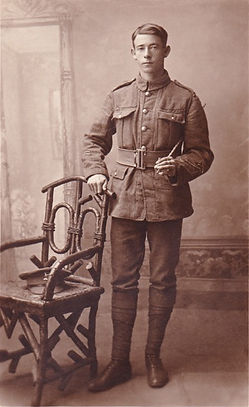


5, Pirbright Terrace
The first occupants of No 5 in 1898 were Henry and Mary Daborn. Henry was born in East Clandon in 1824, the son of a wheelwright. Mary (nee Stovold) was born in Albury c1830, the daughter of a carpenter. They married in Southwark in 1852 and had 13 children. They moved around Surrey quite a bit – West Horsley (1861, when Henry was an innkeeper), East Clandon (1871), Kingston (1881), Camberwell (1891) – before settling in Pirbright in 1898. They only stayed at No 5 for a few months before moving to No 11, where we continue their story.
The next tenants in No 5 were Daniel and Emma (sometimes Laura) Hill. At least we think that those were their names – the data on the censuses seemed to change with each new census. Here is what we know about them: Daniel was born near Swindon in 1845. There doesn’t seem to be any record of his father, but his mother, Jane Hill, was a servant. When Daniel was 15 he was boarding with a family in Oxfordshire. Emma (nee Brown) was born in Basingstoke in 1840, the daughter of a corn porter. They married in Basingstoke in 1868, and had 10 children, 4 of whom died young. They lived in Basingstoke (1871), Lewisham (1881) and Hartley Wintney (1891), before coming to Pirbright. During this time Daniel was a house decorator. They lived at No 5 until 1904, when they moved to Connaught Road, Brookwood. In the 1911 census Daniel was a bootmaker. Emma died in 1915, and Daniel in 1928.
The next tenants from 1904 were Henry and Mary Howard. The alert reader will have noticed that the name Howard has already been mentioned in this section. In fact 3 different Howard families have already been mentioned, and we think that Henry and Mary were a fourth Howard family. Henry was born in Pirbright in 1854, the son of William, a labourer, and Ann Howard, who lived at the Pirbright Almshouses (today rebuilt as Longhouses) in the 1850s. William, baptized here in 1815, was the illegitimate son of Horsell-born Elizabeth Howard, on parish relief at the time, but who married John Alderton in 1822. In 1873, her grandson, Henry, married Mary Parsons in Aldershot. Mary had been born in Pirbright in 1857, the daughter of Thomas and Esther Parsons, who were living at Church Cottage. Thomas was a farm labourer.
Henry and Mary initially lived in Burrow Hill Cottages (Sandpits) but later moved to Searle’s Cottages in Chapel Lane, where they lived next door to Mary’s parents. Searle’s Cottages were sold in 1903, and we think that is what made the Howards move to The Terrace.
By 1900 they had 12 children (11 boys and one girl), 2 of whom had died young. Henry worked as a bricklayer’s labourer. In 1911, four of the children – all teenage boys - were living with Henry and Mary in No 5. That must have been fun for them all.
The 11th of their 12 children, Percy William Amos Howard, served in The Queens (Royal West Surrey) Regiment, but was killed in action at Bullecourt in 1917. We have written some more on Percy in the WW1 Memorial section. We have shown two press notices of his death below. Four more of their sons also served, but fortunately survived.
One of their sons, Leonard (Len) Howard, the 9th child, born in 1892 and a gardener in 1911, seen here shortly after WW1, served in the Medical Corps. He married 19-year-old Clara Ellen North at St Michael’s in 1919.
In the 1921 census, Len was a painter living in Chiswick, but the same year he also appears in the Electoral Register at No 5 The Terrace with his younger brother Walter and mother Mary. In September 1921, her husband Henry had died, and this was probably the reason for Len’s return. He and Clara (who also had a daughter before they married) had 4 daughters and 2 sons, four children being born at No.5. If you scroll down this page a little way, you will find a wonderful photo taken in the mid ‘20s outside the back of Nos 5 and 6. The two ladies on the right-hand side of the fence (ie at No 5) are, left to right, Clara Ellen (Len’s wife) and her sister Isabel Kate. From 1921 to 1923 there was mother and these two sons at No 5. In 1924, Sidney Frank, the youngest son (see below), joined them.


Mary died in 1928 and we have shown a press announcement of this, left. It helpfully lists many members of the Howard family.
Len, Clara and his growing family moved next year to the newly-built 15 Council Houses (Thompson’s Close).
Sidney (Sid) Howard decided to stay in No 5 with his new wife, Gertrude (nee North, sister of Clara, above). Gertude had been born in Guildford in 1893, like her younger sister Clara, the daughter of a farm carter who lived at Sutton Green. Sid and Gertrude had married in Guildford in 1926. They had one daughter, Mary Bessie Rosina, in 1928, who was born just one month after her grandmother Mary’s death. Sid worked as a labourer.
Sid and Gertrude remained at No 5 for the rest of their lives. Their daughter, Mary Bessie, married James Oxford in 1948. James lived at Gibbs Acre. Gertrude died at No 5 in 1959 and Sid in 1977.
The next occupants of No 5 were Christopher (Chris) and Honor Kelland. Chris was born in Surrey in 1944. Honor (nee Ditchburn) was born in Scarborough in 1951. They married in Southampton in 1973. They lived a few years at No 5 before moving to Normandy.
Sometime during the 1980s the current occupants bought No 5.
6, Pirbright Terrace
The first tenants of No 6 were Daniel and Elizabeth Fry. Now the surname Fry was very well-known in Pirbright a few years ago. There was a Fry family which originated in Farnham, came to Pirbright in the 1870s and purchased a great deal of land in Pirbright during the early 20th century. But as far as we can tell, Daniel was not related to this latter family. So in this section we will focus on Daniel and his family.
Daniel was born in Farncombe in 1829, the son of William and Mary Fry. Presumably for work-seeking reasons, William and Mary and their family came to Henley Park in Normandy prior to 1841. William worked for Henry Halsey 2 on the Henley Park estate as a carpenter. By 1851 the Fry family had moved to Pirbright, living at West Heath. Daniel started work as a sawyer and in 1851 was lodging at a house a couple of doors away from his parents. Perhaps his parents’ house had become too crowded (there were 6 children and a grandchild there). Or perhaps Daniel preferred a bit more freedom.
In any case the following year (1852) he married Eliza Stevens (aged 19) at St Michael’s. Eliza did not give her father’s name in the marriage register. Looking at the baptism register, she was either the daughter of Henry and Jane Stevens (born in 1832) or of Richard and Martha Stevens (born 1834). We think the latter is more likely for 2 reasons: First, there are some peculiarities in the way that Richard and Martha treated their children (as told in the Newmans section). And second, Eliza may have been more likely to overstate her age, rather than understate it. If so, she would have been only 18 at the time of her marriage.
They lived somewhere near The Green (though we’re not sure exactly where). But Eliza died 7 months after the marriage, we think in childbirth. Tragically, the child, a daughter named Eliza, died 15 months later.
A month later, in 1854, Daniel married Elizabeth Simmonds, daughter of Allen and Rhoda Simmonds, who lived at Duchies Cottage. In 1862, Daniel and Elizabeth moved into The Duchies, which was next-door to where Elizabeth’s parents lived. This would have been very handy for them, as they had 7 children, with 3 more to come. By 1881 they were living at Hogleys and in 1891 on The Green near The White Hart (though we’re not sure of which house).
They moved into No 6 when it was built in 1898, but by 1901 had moved to Gibbs Acre, leaving No 6 for the use of their youngest son and his wife, Ernest and Elizabeth Fry and their 2 children. Ernest (a painter) and Elizabeth stayed at No 6 for about 4 years to 1905 before moving to Connaught Road, Brookwood.
The next tenants of No 6 were Walter Henry and Eva Ann (Annie) Farminer. Walter Henry Farminer was born in Linchmere, Sussex in 1871, the son of a labourer. He was the elder brother of William Arthur Leonard Farminer, who also came to Pirbright and lived at No 1, Pirbright Cottages, where we have told his story (including his tragic death in 1953).
In 1888 Walter joined the Royal West Surrey Yeomanry at Guildford. He served in India during 1891-1894, and South Africa during the Boer War of 1899-1901. Perhaps Walter wasn’t great at arithmetic: His enrolment form in 1888 gives his age at 18, whereas in reality he was only 16 years and 9 months old.
In between these campaigns he married Annie (nee Prior) in 1895 in Bramshott (Hampshire). Annie was born in Hertfordshire in 1873, the daughter of a bricklayer. In 1891 she was working as a servant in Battersea, and we can’t think how or where the couple met. They had their first child 6 months after the marriage in 1896. In 1901 the Farminers were living at Searle’s Cottages in Chapel Lane.
Searle’s Cottages were sold in 1903, and we think that, as with the Howards in No 5, that was the reason for the family’s move to No 6 in 1905. They proceeded to have a further 4 children, the second of whom (born 1909) was called Walter Stanley.

Walter died of a carcinoma of the tongue at No 6 in 1946, aged 75 and was buried in St Michael’s Churchyard. Annie died in 1954. We have shown newspaper reports of their deaths, left and right.
We have also shown below one of our favourite photos of Pirbright. It was taken at the back of Nos 5 and 6, The Terrace, we would guess around 1927. Left to right are: Walter Stanley, Annie (half-hidden) and Walter Henry Farminer, and over the fence at No 5 Clara Ellen Howard and sister Isabel Kate North (refer section above). Note the bathtub hanging on the outside wall of No 5. There was probably no indoor bathroom then, and at that time the loo may still have been an earth closet.


After Walter died in 1946, one of their children, Ella May (“May”) Knight, moved into No 6 with her family. May (nee Farminer) was born in 1913, the youngest of Walter and Annie’s 5 children. In 1934 she had married Leonard Knight, a chauffeur, in Aldershot. We think that Leonard was born in 1895. May and Leonard had 2 children. May was well-known as a petrol pump attendant at Clarkes Garage, seen below probably in the 1950s. Left is a photo of May in this role.
They took in boarders occasionally and lived at No 6 until c1975, when they moved out of the area.
We have shown below a photo from after May had moved out of No 6, showing her in front of her old house. Her daughter, Linda, is standing behind her (left), and the couple leaning over the fence are the Zumpes, who lived at No 7 (refer section below).

From 1976 Edwin (Ted) and Winifred (Win) Watkins lived at No 6, having purchased it. They had previously lived at Winkfield in Chapel Lane, then No 1 (refer section above) and then the Post Office on The Green, where we have written more about them.
Ted died in 1991 and Win died in 2010. In 2011 No 6 was sold to the current owners.
7, Pirbright Terrace
The first occupants of No 7 in 1898 were Jesse and Elizabeth Deptford. They only stayed in No 7 for a short while before moving in both No 4 and No 9 for short periods, and then settling in No 11 in 1908, and we have told their story there (refer section below).
The next occupants were Alfred and Annie Jenner. Alfred was born in Horsham in 1852, the son of an agricultural labourer. In 1871 he married Jane Baker near Billingshurst. They lived in various places in Sussex, with Alfred working as a bricklayer. They had 6 children before moving to Guildford c1895, where they lived firstly on the Portsmouth Road, and then on Bedford Road.
Then, in 1898, Jane died, aged 51. The following year Alfred married Annie Parrett in Frimley. Annie was born in Gloucestershire c1862, the daughter of a publican and unmarried. They moved to No 7 c1900, with Alfred continuing to work as a bricklayer. They had a daughter in 1903 and stayed at No 6 until 1906, at which point they moved to Kingfield in Woking. Alfred died in 1908, and in 1911 Annie was running a confectioner/tobacconist shop in Kingfield.
The next tenants of No 7 from c1906 were Charles and Elizabeth Foster. Charles was born in Fulham in 1867, the son of a baker. Elizabeth (nee Robbins) was born in Sunbury in 1871, the daughter of a railway labourer.
They married in Fulham in 1896. At the time, they were both living at the same Fulham address, and Charles was a baker. Charles’s surname was actually Serff, and this was the surname on his marriage certificate. But for some reason that we can’t fathom, he changed it to Foster after his marriage in 1896. Maybe he and his new wife thought the name Serff sounded too much like “serf”, which was the medieval word for an agricultural labourer in feudal servitude to the lord of the manor.
In 1901 (after the surname change) they were living in Sunnyside Terrace, Knaphill (near to the Nag’s Head pub), with Elizabeth’s brother and widowed father. At the time of the census, Charles was a patient in the Victoria Hospital on the Chobham Road in Woking. His occupation was a navvy, which is a complete change from his previous trade of baker. We don’t know what Charles’s ailment was, but wonder if part of the reason was trying to escape his in-laws for a few days.
They had a daughter, Queenie, in 1900, and moved from Knaphill to Pirbright c1902, living in No 10 (refer below). Obviously a move from Knaphill to Pirbright would have had several advantages – for example, the life would have been quieter and their house was a little closer to the nearest pub. They had another son, James in 1903. Charles continued to work as a general labourer.
The family only stayed at No 10 for 3 years before moving to No 7 c1906. Charles died in 1929, having been an invalid for 8 years. Elizabeth stayed at No 7 until 1957.
The next occupants of No 7 from 1956 were Walter and Doris Maud Zumpe. They overlapped with Elizabeth Foster by a year or 2. We don’t know much about Walter, although we think he was born in Germany, served in WW2, was taken prisoner of war and remained in Pirbright afterwards, like some of his countrymen.
Doris (nee Noldart) was born in 1923, the youngest of 13 children of Albert and Alice Noldart, who lived at Lawfords Cottages, and then Rose Cottage at Fox Corner. Albert was a labourer who spent 2 years in jail for a serious offence in 1931 involving one of Doris’s elder sisters. We have written about this distasteful story in the Lawford Cottage section.

Doris stayed in the family home at Rose Cottage until 1950, when she married Walter. They had one son in 1960. We have shown a photo which includes Walter and Doris in the section relating to No 6 (refer above).
Walter worked as a gardener and then a driver. He died in 2008 as did Doris in 2012. The house was sold in 2013 and, like many of the other Terrace houses had already done, extended.
The house was sold again to the current owners in 2025. We have shown an agent’s photo of the house (with thanks), left.

But the military life was not for Thomas. By the time he married Mary Anne Davey in 1895, he was a groom and the couple lived just off the Woodbridge Road in Guildford. Mary was born in Chobham in 1866, the daughter of a gardener.
They started a family immediately – their first daughter was born 4 months after their marriage. In all, they had 6 children. We have shown, right, a photo of the family c1898, just before they moved to Pirbright (the house in the background does not look like No 8). Note how Thomas’s jacket is done up with the top button – a fashion of the time, to allow the waistcoat and watch to be displayed. And note how dashing he is trying to appear.
8, Pirbright Terrace
The first occupants of No 8 from 1898 were Thomas and Mary West. Thomas was born in St John’s in 1870, the son of a gardener. By 1891 he had enrolled in the 1st Battalion, the Queens Royal West Surrey Regiment and was training at Aldershot. We have shown a photo of Thomas at this time (left).

They only stayed at No 8 for 2 or 3 years, moving to Chobham first and then Horsell. By 1911 the family was living in Knaphill, where Thomas worked as a house painter. Thomas died in 1925, aged only 55. In 1939 Mary lived at Sunnyside Terrace, Knaphill, just off the Bagshot Road. By (we think) coincidence, Charles and Elizabeth Foster had lived there in 1901, prior to moving into No 7 (refer section above). Mary died in 1952, aged 86.
The next occupants in 1902 were Harry and Elizabeth Simpson. Harry was born in Stoke-on-Trent in 1876, the son of a pottery manager named Moses Simpson. Elizabeth (nee Watson) was born in Sunderland in 1871, we think the daughter of a “plater of iron ships”. In 1901 Elizabeth was a parlourmaid in a large house in Pyrford, owned by a special commissioner, income tax, who sounds like someone many of us would wish to avoid.
They married in Frimley in 1902, when Harry was already living in Pirbright. He was working as a carpenter and living as a boarder in Brook House – see section below. Elizabeth was living in Frimley. They had 4 children. By 1921 the 3 eldest children (all girls aged between 14 and 17) were working as servants in larger houses in the area, though none of the houses were in Pirbright.
The Simpsons left No 8 in 1933, moving to Doiran in Saunders Lane. Elizabeth was still living there in 1939 with 2 of their children. Harry may have been living in Salisbury.
The next tenants of No 8 from 1933 were Albert and Helen Saunders. Albert was born in Pirbright in 1904, the son of Stephen and Florence Saunders. Stephen was a bricklayer’s labourer. He and Florence lived at West Heath, where we tell their story, and later Cook’s Green. They had 8 children, of whom Albert was the 6th.
Helen was born in Croydon, also in 1904. In 1921 Helen was living with William and Emily Oliver at No 1, Model Cottages, West Heath. She is described as their daughter, single, aged 16, but her name is recorded as Helen Draper. This suggests that she may have been adopted. We cannot find her in the 1911 census and know nothing about her early life.
Albert and Helen married in Guildford in 1927, with Helen now using the surname of Oliver. They had 4 children, the first of whom was born just 2 months after their marriage. Albert worked initially as a driver but changed tack in the 1930s to become a gardener. From 1935 they were joined at No 8 by Olive Saunders (born 1896), Albert’s elder sister, who was unmarried. Sometime during WW2 the Saunders family moved to Andover. Helen died in Andover in 1980, and Albert in 1982.

The next occupants from c1945 were Thomas (Tom) and Winifred (Win) Boylett. Tom was born in Camberwell in 1905, the son of Henry and Sarah Boylett. Henry had been born in Pirbright, and he and Sarah lived at what is today Heath Oaks on the Guildford Road, where we have told their story. Win (nee Baldwin) was born in Orpington in 1915, the daughter of a tobacconist/confectioner.
Tom and Win married in Bromley in 1936. They lived in Pirbright, initially in Stanford House (1937), and then at Wayback (1938-39). In 1939 Tom worked as a public works contractor. In 1946 Frederick and Elizabeth Mileham were living with them in No 8, but this was temporary, as the Milehams soon moved to Pirbright Camp and then No 4, Brunswick Road, where we have told their story.
Tom became secretary of the Pirbright Old Time Dancing Club in 1954. We don’t think that they had any children. Tom died in 1977 and Win stayed in No 8 until her death in 1994. We have shown a photo of their gravestone in St Michael’s Churchyard, left.
The cottage was sold in 1995, and possibly again in 2007, before being sold to the current owners in 2011.
9, Pirbright Terrace
The first occupants of No 9 in 1898 were 43-year-old Jesse and Elizabeth Ann Deptford. Jesse was born in 1855 in Amport, which is near Thruxley Aerodrome, but on the other side of the A303, near Andover. His father was an agricultural labourer. Elizabeth Ann (nee Hodges) was born in 1852 at Cold Norton in Essex. They married in Clerkenwell in 1876.
As Police Constable 217, Jesse had left the Metropolitan Police G Division at Clerkenwell in April 1899 to become the caretaker at Lord Pirbright’s Hall, which was opened in June that year. Likely His Lordship had advertised the job, and maybe Jesse had had enough of arresting the drunks and villains of the Pentonville Road.
A year or so afterwards, the Deptfords moved to No 4, The Terrace (refer above). Another reason for them moving out of London could have been that Elizabeth was ill, as she died at No 4 in 1904. Jesse remarried a lady from West Horsley, Beatrice Daborn, three years later. In 1908 the Deptfords moved into No 11 (refer section below), where we continue their story. There were no children (in either marriage).
In 1902, new occupants arrived at No 9 from Fleet. They were Henry and Elizabeth Sayers, together with two of their five children. Henry was a 49-year-old gardener, born in Guildford, the son of a farmer’s carter. Elizabeth (nee Hall) was born in 1847 in Dublin. They married in Woking in 1874.

One of the 2 children who lived with Henry and Elizabeth was Agnes Elizabeth Sayers. Agnes was born in the Goldsworth area in 1878 and brought with her an illegitimate son, Rupert William Baynes Sayers (born 1895 in Hartley Wintney). Agnes had another illegitimate child, born at No 9 in 1902, with the name Vera Ethelberta Barker Sayers. She was baptised in Pirbright. We think that Vera was handicapped, as she was in a ‘Hospital for Incurables’ in Hampstead by 1911. But Vera was made of strong stuff, as we think that she lived to the age of 82, dying somewhere in Surrey in 1984.
Ronald Sayers (born 1909) was the third illegitimate child of Agnes, who, in 1911, was a cook at the Church of England Institute (forerunner of the NAAFI) at Pirbright Camp. In 1910, a year after Ronald’s birth, a case at the local magistrate’s court cleared up the mystery of who Ronald’s father was (refer cutting, left).
Then in 1914, 38-year-old unmarried mother, Agnes, married the same George Gosden (a 50-year-old widower who was a bricklayer). He had been living at No 6, Longhouses, where we have told his story. Twins arrived later that year, then a daughter in 1918. So, Agnes bore 7 children in all, only 3 born in wedlock. In those days, this would have been rich pickings for wagging tongues! Both Ronald and Rupert married, Ronald going to live in Dorking and Rupert living at no. 9 for a time (see below).
The other son of Henry & Elizabeth who lived with them, was Arthur Edward Sayers (born 1886). He left shortly after the family moved into No 9 to join the 8th Hussars. Being a Regular Hussar, he was sent to France early in the Great War. On embarkation leave at the end of October 1914, aged 29, he married a 34-year-old local girl, Alice Chapman, who was pregnant at the time, as she gave birth to a daughter in April next year. Barely a month later Arthur was killed at Ypres. The tragedy would end more happily for Alice, who remarried in 1920 to Samuel Barker of No 2, Model Cottages, West Heath, where we continue her story.
Also off to war went Agnes Sayers’ eldest illegitimate son, 20-year-old Rupert, who signed on in the Royal Flying Corps in April 1915, a month before his uncle Arthur died. A Squadron Air Mechanic, he served in France for almost the entire war and was discharged in 1921, a year after he married a Horsell girl, Mabel Mary Butler.
Henry Sayers died in 1919. By 1921 Elizabeth was a patient in Brookwood Asylum and she died the following year in 1922. Both are buried in Pirbright churchyard.
At No 9 in 1921 there were no less than three families, all three newly-weds. In total there were eight souls including 2 new-borns crammed into this small semi. How on earth did they all cope with cooking, washing, bathing and two squalling babies? The families were:
-
Rupert and Mabel Sayers (refer above, and more about them below).
-
Henry and Dorothy Crouch and their 7-month-old daughter. They soon moved to No 7, Model Cottages, West Heath, where we tell their story.
-
Walter and Raynor Searle and their 8-month-old daughter. Luckily, we have a (wonderful) wedding photo of the Searles (shown right). The Searles are the couple on the right of the picture. Walter was a Gunner in WW1 and later became caretaker of Lord Pirbright’s Hall, like Jesse Deptford. Their only son, Derrick (only recently died), was a much-loved Pirbright resident who lived at No 14, The Gardens, where we have told his story. The Searles moved into The Bays on The Green, where we tell their story.


Rupert and Mabel Sayers were the sole occupants of No. 9 from the early 1920s. Back in 1910, at the age of 15, Rupert was one of three boys (John Stevens and Isaac Bonner were the other two) charged with stealing golf clubs and balls from Worplesdon Golf Club. Rupert had returned the club that he had stolen and so was discharged. The other two boys were fined.
Rupert and Mabel had six children, none baptised at St Michael’s, but all went to school in Pirbright. Mabel died in August 1936 in sad circumstances. We have shown, left, a report of her inquest. It’s not a pleasant read.
Rupert carried on living at no. 9 for almost two years before moving to Bagshot in 1938 as a nursery foreman and subsequently remarrying.
In 1938, the next occupants of No 9 were Thomas and Mary Gunner. 28-year-old Thomas Gunner, a gardener, was one of the many Worplesdon-born Gunners. He had travelled all the way up to Maryhill, Glasgow and back in July 1938 to marry 30-year-old Mary Shanks. Although born in Glasgow, she had been in Pirbright for at least five years, living at Sunnyside in Rowe Lane as a domestic servant to two spinster ladies. Bryan Gunner, their only son, was born on September 9th, 1939.
At the time of the 1939 census, Mary was a patient at Guildford Hospital in Warren Road. This was three weeks after the birth, so there may have been complications, and this could be the reason the couple had no more children.
At least two families were living with the Gunners during WW2, but neither of them was from Pirbright or lived in the village after the war. Although he was in the Auxiliary Fire Service in 1939, it is likely that, aged 28, Thomas was called up, so the additional rent would have been handy for Mary.

In 1944 the owner of Nos 9, 10 and 11, Robert Faggetter died in a cycling accident on the Guildford Road near Church Lane. Robert lived in Connaught Road, Brookwood and was the son of Esdor David (Ned) Faggetter, a prolific builder and probably the largest owner of Pirbright properties, who had died in 1941. Robert was unfortunately intestate, and his properties were put up for sale (see newspaper cutting, left). For good measure there were a few other properties a bit further afield in the sale. The stated income from the Pirbright properties (£865 pa) would make the properties worth around £700,000 in today’s money. So, a very tidy portfolio, especially considering that house prices were severely depressed in early WW2, so not a true reflection of their value today.
We will write about the Faggetter family in the Faggetter family section at some future date.
The properties were bought by Willem Frederik van den Ende of 30 Orchard Drive, Woking, nurseryman, and Cornelis van Vessem of Cheapside, Horsell, nurseryman, for £780. William owned 40 acres or so of farmland in Pirbright (including Grove Farm). We have written about him in the section dealing with the houses Aldersford to Ganavan in the Guildford Road North section
Neither of these gentlemen ever lived in the properties. Rather they treated them as investments.
Bryan Gunner started school at Pirbright in 1945 and transferred to Knaphill in 1950. Sadly, just two years later his mother Mary died at the age of only 44.
Thomas, with a young son and a house to look after, would almost certainly have needed help with the housekeeping. He chose not to remarry. Instead, his widowed younger sister, Annie moved in with him. Annie had married Eric le Feuvre, a grocer’s assistant, in 1938 and they had one son, Paul. They lived in Manor Road, Guildford (off the Stoughton Road), but Eric, serving in the RAFVR, died in Malawi right at the end of the war, in September 1945.
Annie le Feuvre and young Paul lived in Furze Hill Cottage for a while, then with her parents (Charles and Patience Gunner) at No 10 Pirbright Cottages, before moving to No 9 in 1952 with her brother Thomas immediately after his wife Mary’s death. Here they lived together for about 5 years, the two boys growing up, until Annie remarried in June 1957, as reported in the newspaper cutting, right.
What it does not mention is that 42-year-old Alec Martin’s first wife, May, had only died the previous autumn. Married first in 1939, with 3 children, the eldest was 17 and the youngest 8 when he married Annie. But it appears that their marriage was no success, as they either separated or divorced and she appeared back at No 9 with her brother Thomas as Annie Le Feuvre in the late 1960s.
Thomas Gunner died in 1972, but Annie le Feuvre stayed at No 9 with her nephew Bryan Gunner. We have shown, left, a low-quality (apologies) photo of her taken in 1990, when she was 77, two years before she died. The next year, bachelor Bryan also died, aged only 59, and was buried on June 3rd. He left an estate of £147,000 (equivalent to £340,000 today), which suggests that perhaps he bought No 9 at some stage.


So, just the two families, the Sayers and the Gunners, lived at no. 9 for almost 90 years. In 1996 the house was sold to Miranda and Stuart Allen. They had married in 1986 and had two sons. The house was sold in 2013, again in 2014 and again in 2022 to the current owners.

10, Pirbright Terrace
We’ll start our discussion with a very, very small point. Those with very sharp eyes will have noticed a kink in the wall outside No 10, and perhaps thought that this was due to some builder’s error back in 1897. Actually, the kink dates back a long way and appears on the 1841 Tithe map (shown left). It denotes the boundary of the property at that time, which has evidently not changed since.

The first occupants of No 10 in 1898 were Sergeant Harry and Charlotte Lewis. Harry was born in Shrivenham, Oxfordshire in 1867, the son of a shopkeeper. Charlotte (nee Stagg) was born in 1862 in Welwyn. Her father was a labourer who also ran a beer shop, but who died when Charlotte was just 2 years old.
Harry and Charlotte married in Kilburn in 1890. We don’t know much about Harry’s early military career, other than what was reported in the press cutting (left) published in 1916 after he was killed in action at The Somme. By that time, he had reached the rank of Major. He had been awarded the DCM (Distinguished Conduct Medal), which was an award for gallantry, ranking just below the Victoria Cross.
The cutting mentions that Harry spent time at Aldershot, but at the time of the 1901 census he was stationed at The Guards Camp at Pirbright Barracks. This is probably the period when he lived at No 10 (which was 1898 to 1901), serving with The Grenadier Guards.

The next occupants of No 10 were Sergeant Thomas and Catherine Sullivan. Thomas was born in London in 1874. His father was a Chapel keeper in Westminster. Catherine (nee Woollard) was born in 1875, near Brentwood, the daughter of a soldier who fought in the Indian Mutiny of the 1850s.
Thomas was a Sergeant in the Grenadier Guards, and he was presumably on the same posting as Harry Lewis, who was his predecessor at No 10. Thomas had more luck than Harry and survived WW1. He and Catherine had 9 children, 2 of whom were schooled in Pirbright.
The next occupants of No 10 from c1902 were Charles and Elizabeth Foster. In 1906 they moved to No 7 (refer section above), where we have told their story.
The next occupants of No 10 from 1907 were Frank and Grace Stonard. Frank was born in 1882, the eldest child of Alfred and Alice Stonard. Alfred was a gardener, born and bred in Pirbright, and we have written more about them in the section dealing with No 1, Longhouses, where they lived from 1884.
Grace (nee Henderson) was born in 1882 in Edinburgh, the daughter of a licensed victualler (ie a pub landlord). In the 1890s her family moved from Scotland to Bethnal Green, where Graces’s father was running the Duke of York pub. They married in London in 1907. At that time Frank was a baker living with his parents in No 1, Longhouses, while Grace was living in Balcombe St, near Marylebone Station. The same year Frank was nominated by the Parish Council to fill a vacancy in the local Fire Brigade.

The Stonards had 3 children, all born in Pirbight, but Grace died a month after giving birth to the third child, which must have been highly distressing for the family. The following year (1913), Frank remarried Mary Ann Harwood at St Michael’s. Mary had been born in Pirbright in 1876, the daughter of James and Elizabeth Harwood, who lived at West Heath. Frank and Mary Ann had no children as far as we know.
Mary Ann died at Pirbright in 1950. Frank died 8 months later the same year.
The next occupants from c1951 were Ronald and Dorothy Follett. Ronald Benwell Follett was born in Guildford in 1924, the son of a shopkeeper. Dorothy (nee Cooper) was born c1929 in Guildford, the daughter of an Army Officer.
They married locally (not Pirbright) in 1949. Ronald’s address at that time was in Tottenham (where he worked as a clerk), whereas Dorothy gave her address as No 10. They had 2 children and stayed at No 10 until at least 1964.
From the late 1960s Timothy (Tim) and Richard Milligan were living at No 10. Tim (born 1940) was one of 3 children of Peter and Rosemary Milligan, who lived in Merrow. Peter was a medical practitioner. Richard Milligan was a cousin of Tim. Tim opened the batting for Pirbright Cricket team (with Terry Kinsella of No 10 Upper Stanford Road). In 1969 he played “the innings of his life” (according to the Surrey Advertiser) by hitting 98 for Pirbright in a thrashing of Wood Street. Tim hit 17 fours and 2 sixes before being caught on the boundary just 2 short of his century. Cousin Richard (batting at No 3) hit 22. Tim was a lawyer by trade. The Milligans left No 10 c1973.

From c1973, Alastair and Susan Sell lived at No 10. Alastair was born in 1944 in Surrey. His parents lived in the wonderfully named Crazies in Upper Edgeborough Road in Guildford. Susan (nee Dowdeswell) was born in Surrey in 1947 and grew up at The Mount in Guildford, and then East Loxwood Hall in Loxwood (which was on old Manor House). Her father, who worked in the family printing business in the Rodborough Buildings in the centre of Guildford, was elected to Guildford Town Council and President of the local Round Table as well as Guildford Chamber of Commerce.
They married at Midhurst 1970, when Alastair was a PE teacher. They lived at No 10 until the early 1980s, but divorced a few years later. Both Alastair and Susan remarried. We think that Alastair later lived in Jacob’s Well and died in 2020.
The current owners moved into No 10 in the 1980s. One night in 2025 they had a most unwelcome visitor: A car managed to obliterate the wall outside the cottage and end up in the owners’ front room. The driver was found wandering the Green in in a state of ‘confusion’. We don’t know how the accident was caused.
Left is a recent photo of No 10.
11, Pirbright Terrace
The first occupants of No 11 in 1898 were Henry and Mary Daborn. They moved into the cottage having spent a few months in No 5, which must have been built a little earlier than No 11. We have written about the earlier history of the Daborns in the No 5 section (refer above).
Henry died just over a year later, in July 1900, aged 76. From that time, the youngest of their 13 children, John Daborn, (born 1873 in East Clandon) moved into No 11 with his mother. Mary died in 1908, and John then moved into Woodbine Cottage on Dawney Hill occupied by a widow, Lucy Stevens (as well as her 5 children and 3 other boarders).
From c1908 Jesse and Beatrice Deptford lived at No 11. Jesse had previously lived at No 7, No 9 and No 4 (refer sections above) and so would have been getting to know the houses in The Terrace pretty well by now. But his first wife, Elizabeth, had died in 1904. Jesse remarried Beatrice Daborn in 1907. Beatrice was one of the children of Henry and Mary Daborn, who had lived in No 11 from 1898 and had been born in West Horsley in 1867. She was a dressmaker. From what we can see, their marriage was the first between 2 occupants of The Terrace. c1921 both Jesse (aged 65) and Beatrice moved to Queen’s Lodge, Bisley Camp (used by the Queen’s Westminster Rifles), where they worked as caretakers. In 1926 they moved to Knaphill. Jessie died in Brentford in 1935 and Beatrice in Ealing in 1956. There had no children.
The next occupants of No 11 from 1921 were Sergeant John and Beatrice Hamilton. John was born in Southend in 1894, the son of a soldier. Beatrice (nee Taylor) was born in 1892 in Ashbury, Berkshire, the daughter of a domestic gardener. They married in 1915 in Alvescot, Oxfordshire, while John was serving in WW1. Their visit to Pirbright was a very short one. At the time of the 1921 census John was stationed at Pirbright Camp with the 1st Battalion of the Grenadier Guards.
By 1922 John and Lizzie Daborn had moved into No 11. John was the same John Daborn who had been living at No 11 between 1900 and 1908 (refer 3 paragraphs above). After leaving No 11 in 1908, he lived at Woodbine Cottage on Dawney Hill and in 1912 married Lizzie Stevens in Camberwell. Lizzie was born Lizzie Davis in Ockham in 1863 and was thus 10 years older than John. She had previously been married to Arthur Charles Stevens and they had lived at Woodbine Cottage on Dawney Hill.
Arthur and Lizzie Stevens had one daughter, Lizzie Stevens, in 1903 but Arthur died in 1904, aged 44. It was 4 years later, in 1908, that John Daborn moved into Woodbine Cottage with Lizzie. A year later John and Lizzie had a daughter, Mary Ann, and it was 3 years later that they married.
In the 1921 census John was working as a painter for the National Rifle Association at Bisley Camp. Lizzie died in 1928, aged 65. John and his daughter, Mary Ann remained at No 11, and during the next few years some parts of the cottage were let out to sub-tenants. One such was Harriett North from Sutton, who moved into No 11 in 1929, but died 9 months later.
In 1931, Mary Ann married Patrick Dowling, a soldier from Pirbright Camp. They had a daughter, Eileen Mary Dowling, in 1935, but 2 years later in 1937 a tragedy occurred, as written in the press report, right.


In 1939 John worked as an assistant cook. He died in 1940 and was buried in St Michael’s Churchyard.
After John died there were some short-term tenants at No 11:
-
During 1945-46 Olive Ethel Edna Saunders. Olive (born 1896) was the elder sister of Albert Saunders, who lived at No 8 and Olive lived with him there from 1937. We have written about the Saunders family in the section relating to No 8, above. Like Albert, she had been brought up at No 2, Cook’s Cottages. Olive soon moved in with the Challen family at Manor Lodge in Mill Lane and then Burners. We think that she was probably a housekeeper in these last 2 houses. She never married and died in 1958.
-
During 1947-49, Sidney and Nellie New and their 4 children. Sidney was born in Reading in 1905, the son of a jobbing gardener. Nellie (nee Saunders) was born in 1915. Despite having the same surname, we don’t think that Nellie was closely related to Olive Saunders, her predecessor at the cottage. Sidney and Nellie married in Uckfield in 1938. Sidney worked as a farm carter. After a couple of years, they moved to Sutton Green and then to Fetcham.
Then in 1951 until the early 1970s Henry J and Georgina E Neale moved into No 11, possibly as owners. We can’t trace the Neales. We can only find one Neale couple with these forenames, but that Henry died in 1948 while our Henry remained on the Electoral Register until 1962.
The next occupants (possibly owners) from c1973 were John MP and Jean M Knight. John was born in 1942 and was brought up in Connaught Road, Brookwood, the son of a lab technician. Jean (nee Boylett) was born in 1932, the daughter of Tom and Win Boylett, who were living at No 8 (refer above).
They married at St Michael’s Church in 1963, when John was a store manager. We have shown a newspaper picture of the happy couple, left. They had 2 children, but John, who may have worked at Romans Garage across the road, died of emphysema in 1988, aged only 46. In 1993 Jean remarried John Burrows, a widower from Farnham and we think they decided to live in Farnham.
The cottage was sold in 1996, in 2003, in 2008, and again in 2014 to the current owners.
Sub-section 2: Brook Cottage
Directly south of the salmon-coloured plot described in the Pirbright Cottages sub-section above, but just to the north of the stream, is where Brook Cottage is today. It is an elegant house with some lovely Victorian decoration on the outside, but passed unnoticed by the many motorists – they would (should) be keeping their eyes on the Mill Lane turning and the upcoming bend in the road.
In 1805, the site formed a small part of the western side of the field called Cowbridge, which was part of the estate marked as Jordans. Jordans became Grove Farm, and we have written about its early history as part of the Grove Farm section. The field called Cowbridge gave its name to the recently-built street named Cowbridge Meadow. We have written a little about this street in the Cowbridge Meadow sub-section below.
By 1841, the field (3 acres in size) had been renamed Barn Field (presumably because of the large building in the middle of it), and it formed part of Henry Halsey 2’s 58-acre Court Farm.
What happened after 1841 to the piece of land where Brook Cottage stands today? Between 1841 and 1882, the answer is – precious little. Barn Field stayed unchanged as part of Court Farm. The barn in the centre of the field never made it onto the OS map – perhaps it had fallen down or was removed by 1873.
But c1881 it seems that Henry Halsey 2 sold the small part of the field that is today’s Brook Cottage to Charles Thompson. Charles was born in Willey Green in 1844, the son of Richard and Elizabeth Thompson, who moved to Pirbright c1857. They farmed Rails Farm, where we have told their story. We have also devoted a whole section to the Thompson family here.
Charles married Lucy Luff at St Michael’s in 1869. Lucy was born in 1849 in Kirdford, near Lurgashall, the daughter of William Luff and his wife, Harriett. William had run a 160-acre farm near Lurgashall, but for some reason c1853 the couple and their 3 children moved to Pirbright, where he farmed a smaller (80-acre) farm - Wickham’s Farm. This seems to us like a step downwards - were the Luffs escaping some unpaid debts or some scandal perhaps?
After moving with her parents to Wickhams, she married Charles Thompson in September 1869 when already in a late stage of pregnancy. Their daughter Lily was born in 1870.
Then, in 1873, Lucy’s father, William, fathered a child whose mother was one Catherine Keddie, recently moved to Pirbright. William and Harriett were still married at the time, and so this would have caused much upheaval in the Luff family. Immediately the situation was known, William auctioned all the livestock, farming equipment and some household furniture and some time that year assigned his tenancy of Wickhams Farm to Albert Thompson. William moved out immediately. To make matters worse, Harriett, who may have been unwell for some time, died in 1874. The circumstances of her tragic death are set out in the press cutting, right. By the end of 1874 William and Catherine were living near Salisbury where they had married. Not a happy story.

And then, in 1876, sadly Lucy died, aged only 25. At this time Charles was a wheelwright. The Burial Register recorded her as Lucy Luff, but later Luff was crossed out and Thompson written above it. It would seem that she was known as Luff even to the minister or church officials.
A mere 6 months later, Charles remarried Annie Turner in Paddington, where Annie was living. It is possible that Annie had been working as a servant in Pirbright, met Charles there, and that their relationship began before Lucy’s death. Annie was born in Westerham in 1846, the daughter of a butler. In 1881, she and Charles were living on The Green between the Police House and the Old School. Charles gave his profession as a builder, and we assume that was because he spent a fair amount of his time during the next year or 2 building today’s Brook Cottage.
The cottage was built by 1882 and referred to as Cove Bridge – not surprising really, as the house was right next to the Cove Bridge (where the Guildford Road passes over the Hodge Brook). It was soon renamed Brook House. It was also sometimes known as Cove Cottage.
In 1885 Charles sold the property to John Cherryman (who farmed Causeway Green Farm). John Cherryman soon sold the cottage to Henry Halsey 2. Meanwhile, Charles and Annie continued to live in the cottage as tenants.


Charles and Annie had 4 children, but Annie died in 1888, aged only 42. This left Charles to look after 5 children. Lily (Charles and Lucy’s daughter) married a George Parsons in 1890 when she was aged 20. 6 months later the couple had a child. In the 1891 census Charles was living in the cottage (referred to as Brook House) with his 5 children and one grandchild (George Parsons was absent). Aged 46, this must have been quite a handful for Charles, who now described himself as a builder.
In 1901 only one of Charles’s children, Lottie, was living with Charles (who was now working in his original trade of wheelwright). Additionally, he had let out part of the cottage to a short-term tenant, a widow called Jane Blower (or Bloor) and her daughter. In 1911 Charles was now living with a niece, a nephew and 2 boarders. He died in 1919, aged 74. We have shown a press notice of this, left, and a photo of Charles, right.
A descendant of Charles Thompson has conducted a great deal of research and written in detail about the Pirbright Thompsons in a separate section on this site devoted to the Thompson family.

Shortly after Charles’s death, Henry Halsey 4 included the cottage (referred to as Cove Cottage) in the list of properties to be auctioned. It was purchased (in 1919) by a Miss AM Goddard for £520. This was almost certainly Ada Goddard, the 39-year-old daughter of Edward Goddard, the landlord of the nearby White Hart. We have shown a photo of Ada, left, and told the story of the Goddard family in the White Hart section.
The next occupant in 1919 was Charles and Annie’s youngest child Lottie Wood. Lottie was born in 1883 and thus was only 5 years old when her mother died. She was living with her father in Brook House in 1901, and in 1907 she married Robert Wood in Guildford. Robert was born in Lincoln in 1881 and was a life assurance agent. They lived in Pirbright for the next 3 years and had 2 children. But by 1911 they were living in Spalding, which must have been quite a change for Lottie. Robert joined the Grenadier Guards but was sadly killed in action in September 1914, just 6 weeks into WW1. He was the first of the Pirbright War Memorial men to die.
Lottie returned to Pirbright to live with her father, Charles Thompson. But her younger child, Robert, died in 1919, only 10 months after her father, Charles, had died. That must have been a very difficult time for Lottie. In 1921 she was living with her 13-year-old daughter Winifred in Brook House.

She wrote a rather pessimistic little rhyme in the White Hart’s autograph book (pictured, left). The lower (more cheerful) rhyme was almost certainly written by Lottie’s brother-in-law, Robert Wood, who served in the Wiltshire Regiment as a Sergeant, before being transferred to the Royal Flying Corps (RFC) in mid-1916. He was discharged a year later as being no longer physically for war service (he was 46 years old at this time). We assume that the rhymes were written during Robert’s RFC posting (which presumably was spent at Farnborough), and hope that Lottie and Robert had a lovely drink at The White Hart.
Lodging with them was an 80-year-old widow, Ellen Stevens, who had previously lived at Burrow Hill. Also lodging there was a 19-year-old labourer, Frank Nelson Moore, who had also lived at Burrow Hill. Frank soon moved to Sandpit Cottages, and then to Knaphill.
Ellen died in 1923, and that left Lottie and her young daughter,Winifred, living alone in the cottage. In 1931 they moved to Brown Hatch, near Whites Farm, where we continue their story.
The next occupant of Brook House from c1931 was Lavinia Meredith Dease. Lavinia (nee Young) was born in India c1872, the only child of an Army Captain. It seems that she married a Conly James Dease in 1907. Conly was born c1855 and spent much of his life in India, where he held some role in the army. We assume that Lavinia and Conly were married in India c1907. They had one child, Sheila Margaret Maxwell Dease, in August 1907 in Bengal.
The Dease family returned to England soon after Sheilagh’s birth, but Conly died at St Bartholomew’s Hospital in 1914, when Sheilagh was only 7 years old. By 1920 Lavinia was living at Newton Road, near Paddington, running a tea room at nearby Lancaster Gate in Bayswater. Sheilagh, meanwhile, was being educated in La Sainte Union Convent in Bath (which the actress Imelda Staunton also attended many years later).
In 1925, aged just 18, Sheilagh married Frederick Neville Medd-Sygrove, a commercial traveller from Yorkshire. c1930, Lavinia abandoned her tea rooms and the family (Lavinia, Sheilagh and Frederick) moved first to Knaphill (Highclere Vilas) and the, c1931 to Brook Cottage. A rather amusing incident occurred at the nearby Nind Stores (in No 2, above) involving egg-throwing. We have shown the newspaper report when writing about No 2 (above), and so won’t repeat the detail here.
Sheila and her family moved to Frimley in 1934, but Lavinia stayed at Brook Cottage, until she died in 1937.
The next occupants of Brook Cottage were Edward (Ted) and Emily Coyne. For some reason, around this time the name of the house reverted to the old name, Cove Cottage.
Ted was the manager of the Fulks Butchers shop, about which we have written in the Green – South side section. He was born in Earlsfield in 1904, the son of a Scottish cook. Sadly, Ted’s father died aged 35, when Ted was only 3 years old. Emily (nee Reynolds) was born in 1903 in Biggleswade, the daughter of a domestic coachman. They married in London in 1926 and had 3 sons, the first 2 of whom were twins.
In the early 1930s the Coyne family lived in Wych Hill Lane in Woking, near to the Fulk’s Butchers shop there. It seems likely that Ted was working in the Woking shop and was then asked to run the newly-opened Pirbright shop (which opened in 1937, not far from the Brookwood shop, which had opened a few years previously). We have shown a photo of the Coyne family standing proudly in front of the shop (left to right) Ted, Emily, their son George & Bill ‘the lad’.

The Coynes remained at Cove Cottage until WW2, when they moved to Wayback on The Green. c1949 Ted opened his own shop on Brentmoor Road in West End and the Coynes moved out of Pirbright. A few years Ted and Emily moved to West Wittering, where Ted opened another shop.
In 1946, Francis and Irene Baitup were living at Cove Cottage. Francis had been born in Sussex in 1901. He moved to Pirbright c1936 and lived at No 2, Model Cottages, West Heath and then Stanford House, where we have told his early story. In 1939, the register of that year records Francis living at The Royal Oak as a poultry farmer.
Although he was working for the owner of Stanford Farm, Basil Guy, he would surely have been on good terms with the tenants of the pub, Percy and Emmeline Prince. But he also met Emmeline’s sister, Irene Puddicombe, who had been born in Swansea in 1902. Francis and Irene married in 1950 (locally, though not in Pirbright). The couple, both in their late 40’s, immediately moved to Merrow and stayed there until they died in 1975 (Francis) and 1987 (Irene).
6 years earlier, in 1940, Minnie and Fanny Goddard, who were the younger sisters of Ada Goddard, had moved into Cove Cottage. They were known affectionately (if not very politically correctly today) as Fat Fan & Thin Min. Ada had purchased the house in 1919. Minnie’s parents, who had run The White Hart since the 1880s, had died in 1916 and 1924, followed by Ada, who had died in 1926. Accordingly, Minnie and Fanny took on the role of running The White Hart until WW2. We have told the story of the Goddard family in the White Hart section, and shown a picture of them, right.
Fanny died in 1949; thus Minnie (aged 62) remained the only one of her 7 siblings still alive. We assume that the property had ended up in her name. She never married and as far as we know, she lived there alone after Fanny died.
Minnie lived at Cove Cottage until 1961, before moving to Brookwood Hospital, where she died, aged 73. 3 years earlier she had had to appear at Woking Magistrate’s Court, as the cutting below describes (in a rather amusing way).


The next occupants (owners?) of the house were Donald and Elizabeth Sinclair, who immediately changed the name of the house to Brook Cottage. Donald McGibbon Sinclair was born c1938, the son of a Scottish father and an English mother. His father, Robert McGibbon (Jock) Sinclair was an oilfield storekeeper, who worked for Shell, and whose work required a fair amount of travel. His mother was Vera Bramall (Ginger) (nee Hallam).
Elizabeth Mourdant was born near Grayshott in 1947. They married near Haslemere in 1965, and we think moved into Brook Cottage soon afterwards. They stayed in the house until the 1980s.
The next occupants from sometime between 1981 and 1987 were Brian and Marjorie Lingwood. Brian had been forecourt manager at Solomons Garage in Yateley, and then in Lightwater. We wonder if his move to Pirbright was because he had started working at the Volvo dealership (The Forum) just along the road here in Pirbright.
In 1999, the house was sold to the current owners.
Sub-section 3: Cowbridge Meadow
Cowbridge Meadow is a short cul-de-sac off Gibb’s Acre. It occupies the remainder of the old field called Cowbridge Meadow not occupied by Brook Cottage or the houses in The Terrace. We have written about the original Cowbridge Meadow (ie the old field) in the sub-sections above on The Terrace and Brook Cottage.
We think that the 13 houses in Cowbridge Meadow were built as affordable housing in the early 2000s and sold as leasehold properties.