


The South - Aldershot Road
This section deals with the 13 properties on the Aldershot Road from the mini-roundabout southwards as far as Newbridge Common. We will deal with the houses on the west side first (moving north to south), followed by those on the east side (again, moving north to south). We have shown below left an extract from the current OS map below (with thanks), together with a table showing the dates of each house. The table shows that, for a long period, Hovers Well (Hovers or Overs, as it was originally known) was the solitary habitation in the area.


West Side
There are 10 houses on this stretch of the Aldershot Road from Cramond Cottage as far as Burners and Chiff Chaffs. They are so well hidden behind a strip of land bearing dense trees that we would guess that many locals are unaware of their existence. The trees owe their existence to the fact that they sit on what used to be War Dept land (until the 1960s, when it was transferred to Surrey County Council). Hence no building took place on the strip of land.
The short road through the trees to the houses was, however, granted to the owner as a right of way in 1954. A search among the trees will (we are reliably informed) disclose evidence of road-building from a few years ago.
Each of these houses is on land which formed part of the old farm called Hovers (today called Hovers Well), which became The Nurseries between 1919 and 1930. We have set out the early history of the entire West side in the Hovers Well section below.

Cramond Cottage
Cramond Cottage was built just north of Hovers Well on land which originally formed part of the old farm called Hovers. We think that the house was built in the late 1970s, and that the first owners were John and Nancy Darlington.
John was born in Hartley Wintney in 1919, the son of a Lieutenant Colonel in the Royal Engineers. In 1946 he married Nancy (nee Richardson). Initially they lived at Frimley before moving briefly to Tadworth and then back to Frimley. In the 1960s they moved to Dawneys Corner, on Dawney Hill. John later married to Joyce Blow. He died in 2011, aged 92 in Battersea.
By 1988, Cramond Cottage had been bought by Brynley and Patricia Hutchinson-Jones. Brynley was born c1955 and the family later moved to Tilford. By 1992 the house was owned by a Johannes Admiraal. It was sold in 2002, sold again in 2007 and then sold again in 2016 to the current owners. We have shown left a recent agent’s photo (with thanks) of the house.
Cramond House
Cramond House is the house at the end of the drive leading off south-west from the mini-roundabout. The house includes a studio flat, and sits in c7 acres of land. As with the other houses in this section, it was built on land that had belonged to Hovers – refer section below.
Cramond House was built in 1935 for Thomas and Louisa Rawlins. We have shown part of the building plan right, which shows the proposed house (in red) and the existing house (today’s Hovers Well) in grey. The public footpath just north of Cramond House (well-trodden by certain runners) still exists today. The first mention of it we have found is on the 1873 OS map.
Thomas Rawlins was born in Stepney in 1873, the son of a Chartered Accountant. He studied at Peterhouse College, Cambridge. Like his father, he became a Chartered Accountant, working for his father’s firm, Smallfield Rawlins & Co in London. In 1907 he became a Freemason. At this time he was living in West Norwood.
Louisa Geraldine Connell was born in Alverstoke in 1869, the daughter of a Colonel in the Royal Artillery. Her father died (in Morocco) when Louisa was aged only 7, and the family returned to Guernsey (where her father had been born). She must have returned to England at some stage, as she and Thomas were married in Brompton in 1912. They lived in Pimlico.
In 1912, Thomas’s father (William Rawlins) had bought Melrose in Chapel Lane as a weekend escape house. However, he soon moved to Upper Norwood, and Thomas and Louisa took the opportunity to use the house for a similar purpose. We don’t think that they had any children.
In 1926 Louisa was elected president of the Pirbright Women's Branch of the Unionist Association in succession to the late Lady Stanley. She was later the President of the local Red Cross Association as well as the local Conservative Association (womens’ group) and a Manager of Pirbright Primary School. In 1950, Louisa paid for the renovation of the church clock. She was awarded an OBE.


We surmise that Thomas and Louisa decided to build Cramond House in preparation for Thomas’s retirement (he was aged 62).
During WW2, Smallfield Rawlins & Co moved out of London and set up business in Heatherside at Fox Corner, the home of Gladys Selous (wife of Frederick Selous, the big game hunter). Maybe Thomas was keen to reduce his commuting time (and cost). But on reflection, we think it was probably to proect the firm against the blitz). We have shown a photo of Thomas in uniform (left).
Thomas died in 1949 and Louisa in 1951, still living at Cramond House. They were buried in St Michael’s Churchyard.
From the early 1950s, The Hon Edward and Sally Jackson lived at Cramond House. Edward Lawies Jackson was the only son of George William Lawies Jackson, 3rd Baron Allerton (1903–1991). The Baronetcy had been created in 1902 for Edward’s great-grandfather, William Jackson. We have written a few words about William below, together with one of his sons.
William Jackson (1840-1917) made his fortune in the leather tanning industry. He also became Chairman of Great Northern Railway. He entered politics, becoming an MP in 1880. He then became Financial Secretary to the Treasury, was created a Privy Counsellor on 30 June 1890, and was appointed Chief Secretary for Ireland in 1891.
One of William’s sons, FS Jackson (1870-1947) was an outstanding cricketer, who played for Cambridge University, Yorkshire and England. His England career lasted from 1893 to 1905, and thus overlapped with WG Grace, who we have written about elsewhere. He was primarily a batsman, but also bowled fast-medium. He holds the distinction of being the first batsman to be dismissed in the "nervous nineties" on Test debut. He captained England 5 times, and later became President of the MCC and also Yorkshire Cricket Club.
As a boy, FS Jackson was educated at Harrow, where Winston Churchill was his “fag” (ie personal servant). He served as a Captain in the Second Boer War. In 1915 he was elected as an MP, then served as Financial Secretary to the Treasury, Chairman of the Conservative Party, and Governor of Bengal (where he evaded an assassination attempt in 1932).
FS Jackson died in 1947 of complications following a road accident. The Bishop of Knaresborough remarked later of his funeral: "As I gazed down on the rapt faces of that vast congregation, I could see how they revered him as though he were the Almighty, though, of course, infinitely stronger on the leg side." Below we have shown 2 pictures of FS Jackson. In the cricket photo (from 1899) he is sitting next to WG Grace (the big fellow with the beard).


Edward was born in Wetherby in 1928. His mother was Christine (nee Hatfield in 1903), who came from a line of wealthy Yorkshire landowners. His parents (George and Christine) divorced in 1934. Young Edward was educated at Eton. Sally was born in Cranbourne (near Windsor) in 1930, the daughter of a solicitor.
The Hon Edward and Sally were married in Cranbourne in 1953, and it is probably at that time that they moved into Cramond House. They had 2 children, but were later divorced. Both remarried in the early 1970s. Edward never became the 4th Baron Allerton, as he predeceased his father. On his father’s death, 9 years later, the baronetcy became extinct.
One of the Jacksons remained at Cramond House (with their new spouse) until at least 1975. One of their children was married in St Michael’s in December 1974. The bridegroom was Jeremy Purvis, who lived at White Lodge, Goose Rye Road. The register records the Hon Edward’s occupation as Farmer.
The house was purchased in the mid-1970s by John M (known as Michael) and Valerie (nee Turrell) Howard. The Howards married at Cobham in 1959 and we think had previously been living in East Clandon. Michael owned a men's’ outfitters called Frederick Howard in Walnut Tree Close, Guildford. The house was sold to the current owners in 2013.
Hovers Well (prev Overs, Hovers, then Collins Green, then Oak Cottage, then Nursery Cottage)
Hovers Well was originally known simply as “Hovers” and sometimes as “Overs”. The earliest reference to Hovers is in a 1536 survey (shown below). In case you’re having difficulty understanding the text, it describes a Thomas Fagetter being the copyholder since 1519 of a messuage (ie a dwelling) and land called Hovers formerly held by Henry Fagetter. Thomas also held a pasture land called Loveselle (which we think was later called Fellmore) formerly held by Henry Fagetter. The property continued to be held by the Faggetter family for almost the next 300 years.

From 1664 we can follow the Court Rolls for “Overs”. Unfortunately these records are not very clear as to the lineage of the various Faggetters. The current house on the property (Hovers Well) is a listed building, which is estimated to date from the 16th century. We therefore assume that, from this time, the Faggetters lived in the house and farmed the property. Here is a summary of the copyholders between 1664 and 1793:
-
1664: William Faggetter (we will call him William Faggetter 1 (1633-1664)) held (copyhold) both Overs and Lushers (later Fellmore), which in total comprised 45 acres.
-
1664: William 1 died and the copyhold of Overs passed to William Faggetter 2 (probably a nephew).
-
1722: A William Faggetter 3 (1710-1750) (possibly son of William 2) acquired the copyhold.
-
1776: Ann Faggetter (1720-1776) (William 3’s wife, nee Fladgate) died. She had inherited the copyhold from her husband, and bequeathed it to her eldest son, William Faggetter 4 (1738-1808). In February 1789, the Parochial Authorities had contracted with William Faggetter 4 for the care and maintenance of the poor in Pirbright for one year.
-
1793: William 4 surrendered Overs to Henry Halsey 1.

And so, in 1793, Hovers was added to the property portfolio of the Halsey family, as it would remain until 1919. The land tax records show that William continued to live at Hovers for 2 or 3 years afterwards.
By 1805, Hovers comprised 4 fields, totalling 12½ acres. An extract from the 1805 survey is shown left with Hovers shaded turquoise. An oddity was the Coach Road running east-west through the middle of the fields. This was the road from Frimley to Guildford, which we have written about in the early section on Pirbright Lodge. The 3 most southerly fields were arable. However, the most northerly field (where the garage now lies) was meadow. Perhaps this was because it abutted the Hodge Brook and may have been prone to flooding.
The property was occupied by Thomas Woods, who was the miller at Upper Mill, and who farmed the neighbouring 148-acre Court Farm. We think that Thomas effectively farmed Court Farm and Hovers as a single farm, but for some reason, the survey recorded them as separate farms. As to the cottage, the Land Tax records do not show anyone as living at Hovers.
In 1841 the house was occupied by “Elizabeth Harding and others”, which was a generic term used to describe the occupants of smaller properties in the Halsey estate and so tells us nothing.
After 1841 the house was usually referred to as Collins Green, and this is the name we will use from now on. Collins Green was also a term used to describe the surrounding areas as well. The origin of this name is uncertain, but almost certainly refers to the Collins family, who owned much of the nearby land in earlier years. We have written about the Collins family in the Guildford Road South section. We have also gone into further detail in the Collins family section.
In 1861, Martha Barrett, a needlewoman aged 41, was living at Collins Green with her young family. Martha, nee Worthington, was born at Ropley near Alresford in Hampshire, the daughter of a farmer. She had married David Barrett, a footman/butler in 1842. The couple moved from Hampshire to Pirbright in the late 1840s, living near The Green. They had 4 children, but David died in 1856, aged 40, and Martha moved to Collins Green for a short period, before moving to the Chapel Lane area. One of her 4 children, George Barrett, became the superintendent of the Chapel in Brookwood Cemetery.
By 1871 Benjamin and Ellen Fleet were at Collins Green. Benjamin , a blacksmith, was born in Brighton in 1846, the son of a blacksmith’s labourer. Ellen had been born in Portsmouth in 1848. They had one child and had recently moved to Pirbright from Portsmouth. They only stayed a few years in Pirbright. During the 1880s the house appears to have been empty.
In 1891, Jesse and Jane Martin lived at Collins Green. Jesse was born in 1866, the youngest of 8 children of James and Jane Martin. James and Jane Martin farmed at Whites Farm, where we have told their story. Jane, nee Hawkins in 1865, was the daughter of James and Mary Ann Hawkins, who farmed at Cowshot Farm.
Jesse and Jane married at St Michael’s in 1889 and had 7 children. After living at Collins Green, they moved c1895 to Whites Farm, living with Jesse’s parents, where Jesse worked as a carter and horseman. They then lived at a few different places in Pirbright, ending up at Leonards House (today Linnards) on Little Green. Jane died in 1941 and Jesse in 1944.
In 1897, Ben and Nona Gosden moved into Collins Green. Ben was born in 1867 in Pirbright, one of 8 children of Elijah and Emma Gosden, who had farmed at Little Cutt in the 1860s. We have told their story in the Little Cutt Section. Nona (nee Warner) was born in Pirbright in 1864, the daughter of Edward and Anne Warner, and thus the grand-daughter of William Warner who had run The Swallow pub at Newmans. We have told the Warners’ story in the Newmans section.
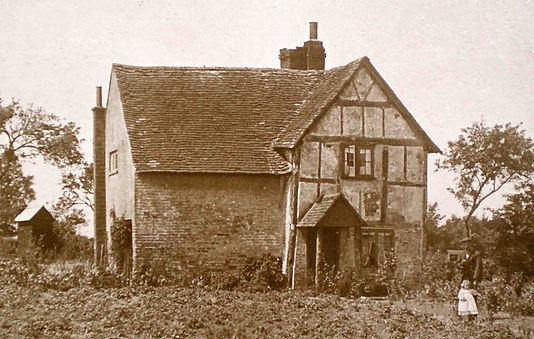
Ben and Nona married at St Michael’s in 1896. They had 2 children. Ben was a bricklayer. In 1906 the Gosdens moved to No 9, Model Cottages at West Heath, where we continue their story. We have shown 2 photos of Hovers in 1906 below.

This section is under development.
By 1910 we think that James and Alice Larby (Larbey) were living in the cottage, which the census tells us had been renamed Oak Cottage, Collins Green. There is some doubt around this, as the Larbys’ address in the Rates Index was given as Berners Cottage.
James Larby was born in Godalming in 1851, the son of an agricultural labourer. Alice (nee White) was born in Bembridge, Hampshire in 1859, the daughter of a labourer.
James joined the Royal Navy on his 18th birthday in 1869 as a volunteer, but his name appeared on the Police Gazette list of the Admiralty list of deserters from HMS Warrior in 1871. He was one of 13 men who were described as “stragglers”. We don’t know what happened as a result of this incident, but in 1877 he and Alice married in Portsea, when Alice was aged 17. James was a house painter. By 1881 they were living in Lambeth.
The Larbys moved to Pirbright c1898 and initially lived in the recently-built No 13, Pirbright Cottages, followed by Gibbs Acre and then Oak Cottage. James died while living at Oak Cottage. Alice moved to Portsmouth, where she died in 1931. They had no children.
In 1912, Henry Halsey 4 leased the property to Ronald Skelton in 1912 for a period of 21 years. Ronald and his family did not live in the cottage at first, as they were living at Thorner Cottage on The Green. But he was to purchase the Hovers property 7 years later, and so we have written a lot more about him a few paragraphs below.
By 1918 Thomas and Lizzie Sargeant were living at Oak Cottage. Thomas was born in 1890 at Bow, the son of a domestic gardener. Lizzie (nee Holman) was born in 1890 at Lindfield, Sussex, the daughter of a farm gardener. In 1911 Thomas was living in Richmond and was a gardener working at Kew Gardens, while Lizzie was a kitchenmaid (one of 8 servants) for Francis Baring-Gould at Merrow Grange.
They married in August 1912 at Balcombe, Sussex and 6 months later their only child, Horace, was born. Thomas described his profession as “Professional gardener”. When Thomas and Lizzie moved to Pirbright c1918, we think they were working for Ronald Skelton (refer below), who had leased the Nursery area, ie the fields south of Oak Cottage. The Sargeants stayed at Oak Cottage until 1923, when they moved to Tolworth, where Thomas worked as a Nursery manager.
In September 1919 Henry Halsey 4 put the cottage and adjoining land up for sale by auction. We have shown a copy of the relevant page in the catalogue, together with the accompanying map below.


Some points of interest:
-
The property is now called “The Nurseries”, which reflects its main use at the time.
-
The house is described as “old-fashioned”, which we regard as a euphemism for being in a state of some disrepair (Tut Tut, Henry Halsey 4, for allowing it to get in this state).
-
The property comprised 19 acres, of which nearly 5 were devoted to nursery. The nursery section is helpfully marked on the plan as a large rectangular block running parallel to the Aldershot Road
-
The property had been leased to Ronald Skelton in 1912 for a period of 21 years.
-
The boundaries of the property had been restored to closer to the 1805 boundaries. There was, though, now a large field on the west side. And the 2 northernmost fields (which existed in 1805) were absent.
-
The map shows a building in the extreme south-eastern corner (where the house Burners – refer section below - is today). This may have been an agricultural building (eg a shed) or a house confusingly called Oak Cottage, a predecessor to Burners.
The property was bought (prior to the auction itself) by the tenant, Ronald Skelton and a Mr Kirby for £1,000 (equivalent to a bargain £43,000 today) in equal shares. Mr Kirby was Percival (Percy) Kirby, who lived at No 5 West Heath Cottages, and who had been running the nursery in partnership with Ronald for the previous few years. Kelly’s Directory has entries from 1922 to 1927 for “Skelton & Kirby, Nurserymen and Landscape Gardeners”.
Percy Kirby was born in Leicester in 1871, son of a dental surgeon. During the 1880s, his parents appear to have separated. Soon afterwards, Percy, his mother and 3 sisters moved to London, seemingly with enough money to live comfortably. Percival became a Landscape architect.
Percy moved to Pirbright, and in 1921, became the first Hon Secretary of the newly-formed Pirbright and District Horticultural Society. As such, he wrote a letter to Lady Stanley asking her to become a Vice-President. The Society’s first show was held on 27 July 1921, and included such attractions as Bowling for a pig, and Climbing a greasy pole for a cock. Health and Safety or Animal Welfare rules would surely put paid to those sorts of games today. That year (1921) was so dry that the village pond dried up. The initial subscription for the 142 members of the Society was 2/6d (£5 today).
In 1922, Percy married Lucy Harwood. Lucy was born Lucy Taylor in Herne, Kent in 1882, the daughter of a farm bailiff. In 1908 she married Joseph Harwood, a “Horseman on golf links”, which sounds a little odd to our modern ears. Joseph had been born in Pirbright, and the couple lived with Joseph’s widowed father at West Heath. We presume that it was Worplesdon Golf Course where Joseph worked. In 1916, Joseph was called up and posted to the 14th Battalion of the Queen’s Regiment and sent to India. In the middle of May 1917, the battalion left Lahore in modern-day Pakistan for Tank on the Afghan border, as unstable and unhealthy a spot then as it is now. Joseph died there, presumably as a result of sickness brought on by the conditions (malaria, sand-fly fever and heatstroke were common). More details on Joseph’s life are on the Pirbright War Memorial page.
By 1921, Percy Kirby and Lucy Harwood (and Lucy’s 8 year-old son, William) were living at New Cottage, West Heath. In 1922 Percy and Lucy married.
In 1928 Ronald bought Percival’s share of the property. The 1929 Rating revaluation showed the nursery as being 21 acres in size - a considerable increase from its previous 5 acres, achieved by cultivating land on the western side.
But the same year the Skelton & Kirby business ceased, as shown by the advert, right, placed by Ronald in March that year. Percival was by then aged 58, and may have wanted to retire. The Kirbys moved to Alfold the same year, and Percy died in 1936.

We’ll now look more closely at the Skeltons.
Ronald had been born in Leeds in 1887, the son of Canon Charles Skelton. Shortly after Ronald’s birth, Canon Charles became the chaplain of Brookwood Asylum and Brookwood Cemetery. In 1891 the Skelton family was living next door to (just south of) The Nag’s Head in Knaphill, which seems a rather unusual location for a chaplain to live, but at least it was convenient for working at the nearby asylum.
Ronald went to boarding school at Oakham School, Rutland (also attended many years later by Stuart Broad, the retired England cricketer). After finishing school he returned to Knaphill (where his parents were still living next to The Nag’s Head) and started work as a landscape gardener. One of Ronald’s brothers went on to be the Bishop of Lincoln.
Canon Charles Skelton died in 1913, and his widow, Beatrice Skelton, soon left the neighbourhood of The Nag’s Head for the more salubrious surroundings of Pirbright – Thorner Cottage on the Green to be precise.
Dorothy (nee Druitt) was born in 1888 in Kensington, the daughter of a bank cashier. By 1911 she was living in Deptford with her brother and his family (but not working). Quite how Dorothy and Ronald met remains a mystery, but they married in 1915 in Kingsclere, north of Basingstoke. At the time, Ronald had been living at Thorner Cottage for 2-3 years, pursuing his landscape gardening interests, having taken out a 21-year lease on The Nurseries (ie the entire Hovers property) in 1912 from Henry Halsey 4.
Dorothy’s father, stepmother and brother lived with Ronald and Dorothy, possibly in the building at the South-eastern corner of the property. Her brother (Thomas Robert Druitt) married in 1918 and moved to Wales. But her father (Thomas Wyard Druitt) and stepmother (Mary Baker) remained with Ronald and Dorothy.
Ronald and Dorothy lost no time in developing the “old-fashioned” cottage, which they had renamed as Nursery Cottage. In May 1920 they gained approval to double the size of the cottage and add mod cons such as an indoor bathroom and a WC. The Skelton family moved into Nursery cottage soon afterwards. Thomas and Lizzie Sargeant may have continued to live in the old part of the house until 1924 (although they continued to call it Oak Cottage in the Electoral Register).
In 1926 the Skeltons gained approval to build a bungalow near the house. We have shown an excerpt from the building plan, right. The size of the Nursery Cottage plot is still the same size as it was in 1805, with the nursery stretching southwards. The site of the new bungalow is today a garage for the house.
The bungalow was built for Dorothy’s father and stepmother (Thomas and Mary Druitt – recently married), who lived there. They may have expressed some dissatisfaction with the size of the bungalow, as in 1929, an extension (extra bedroom and WC, and an enlarged living room) was added. However, this may not have been enough, as within a year or 2, they moved away to Windlesham.


After Percival Kirby left the business in 1929, Ronald became more ambitious. In 1932 he bid to buy 4 acres of Stoke Park in Guildford (at the Boxgrove roundabout) and turn it into a rock garden, swimming pool and tea rooms. He was refused by Guildford Town Council (by 18 votes to 2), because of certain (undisclosed) conditions which Ronald had insisted on.
By 1935, he had sold off some of his land for building purposes. Cramond House (refer section above) was the first house to be built. The same year he also built an office for himself, which later became a separate house, Collins Green. We have written its history in the section below.
We have shown a photo of Nursery Cottage, probably from around this period, left. The burst of garden flowers suggests that Ronald may have had some input into designing the garden.
In 1937 Ronald and Dorothy decided to move a few yards across the road to Newmans, where we continue their story. It wasn’t a very happy one, as Ronald died shortly after their move.
Nursery Cottage was sold to Alan and Ada Rees-Reynolds, who immediately renamed the house Hovers Well, thus resurrecting its original name. We assume that they spotted the name from the deeds (which of course today have been superseded). Alan was born Alan Randall Reynolds in London in 1909, the son of an estate agent in Twickenham. He became a solicitor, and in 1928 he was living in a house on leafy Park Road in Woking, working for a solicitor in Piccadilly. Ada (nee Hardy) was born in 1915, probably in Brentford. They married in 1936 at Gosport.
Alan changed his business name to Rees-Reynolds (for reasons unknown, but possibly to sound more posh) sometime in the early 1930s. But he remained on the Electoral Register as just plain Alan Reynolds until his move to Pirbright in 1937, when he suddenly became Alan Rees-Reynolds. Some might think that this (together with renaming his house from Nursery Cottage to Hovers Well) might suggest something rather pretentious, but we make no comment.
In 1939 Alan and Ada were living at Fords Farm with the Ricketts, for reasons unknown. During WW2 Alan served as a 2nd Lieutenant in The Queen’s Regiment. After WW2, Alan and Ada moved to Godalming, where they had 2 children. Alan died in 1982, still living in Godalming, leaving £250,000 (equivalent to nearly £900,000 today).
In 1939 Lady Janet Egidia Crichton Stuart and Penelope Packe-Drury-Lowe were living at Hovers Well. As their names might suggest, they were both “Society” people, and we assume that they decamped from London to Pirbright as war had recently been declared. We don’t know how long they lived in Pirbright, but by 1945 the Crichton Stuarts were living in The Old Vicarage in Chobham. In 1947 Penelope was living in Virginia Water.
Lady Janet (1911-1999) was born in London as Lady Janet Egidia Montgomerie, the second daughter of Archibald Seton Montgomerie. This gentleman (1880-1945) was the 16th Earl of Eglinton, as well as being the 5th Baron Ardrossan, of Ardrossan, the 17th Lord Montgomerie and the 4th Earl of Winton. He must have been a busy man. But he lived in Eglinton Castle, Ayrshire, so there were some compensating factors (although the castle today is a ruin).
In 1934 she married Lord Robert Crichton-Stuart (1909-1976), son of the 4th Marquess of the County of Bute. Right is a newspaper clipping of Lady Janet from 1945. If you’re interested, there are some other photos of her on the National Portrait Gallery website.
Lady Janet very nearly (but not quite) lived to see in the new millennium, dying on 30 December 1999. A notice of her death is shown below.
The 1976 phone directory lists a Captain JNA Critcton-Stuart (a mis-spelling of Crichton-Stuart) as living at 22, Caterham Close. Jerome (for that was his name) was probably a relative of Lady Janet, and was posted to Pirbright Barracks for a short time. We wonder whether he was aware that Lady Janet had lived in the village 37 years previously.
Penelope Packe-Drury-Lowe (1910-1981) was born Penelope Mary Packe, the daughter of Sir Edward Packe KBE DL JP, High Sheriff of Leicestershire, Chairman of Leicestershire County Council, and previously private secretary to a succession of Lords of the Admiralty.
In 1936 Penelope married John Drury Boteler Drury-Lowe (1905–1960). He was a prominent socialite in the 1920s and 1930s, apparently mixing with the Sitwell and Mitford sets. Penelope was his second wife (he had divorced in 1933), and they changed their surnames to the highly pretentious-sounding Packe-Drury-Lowe. They had one son, Simon Jasper. After John died, aged only 55, she remarried and died in 1982, leaving £431,000 (equivalent to £1.5 million today). A photo of Penelope is shown left.


The next occupants of Hovers Well in 1945 were Charles and Joan Gascoigne. We know nothing about the Gascoignes, except for the fact that Joan was living in Fife some 13 years later.
The next occupants from 1946 were Rupert and Joan Hicks. Rupert was born in 1905, the son of a London stockbroker. In 1928 he had married Dorothy Hart (born in Sutton in 1903, the daughter of a leather merchant). At the time of his marriage, Rupert was a London leather merchant, so we guess that he may have been working for Dorothy’s father. In 1939, Rupert and Dorothy were living in Weybridge, without any children, and Rupert was General Manager of some (unnamed) Manufacturing Company.
The marriage appears to have foundered, as by 1950, Rupert had married Joan Avern. Joan (nee Fraser) was born in 1902 and had married Raymond Avern (born in 1879) in 1925. They had 3 children, but Raymond died in 1942, aged 63. Rupert and Joan married in 1944. They moved into Hovers Well in 1946 and remained there until c1966, when they moved to Merrow.
The next owners, from c1967 were Cyril B and Dorothy Berry. Cyril was born in 1913 near Chorley, Lancashire, the son of a clerk in Holy Orders. Dorothy (nee Hadley) was born in 1907, the daughter of a brewer. They married in Bristol in 1937. At that time, Cyril was a tobacco leaf buyer. Meanwhile, Dorothy’s father, Arthur Hadley, had risen to the rank of Managing Director of the historic Bristol brewery, Georges & Co Ltd, which had been founded in 1788. (The brewery was bought by Courage in 1961, and closed in 1999).
The Berrys stayed at Hovers Well until 1980, when they moved to Bexon in School Lane. Cyril died in 1985 and Dorothy in 2005, aged 97.
The next owner from c1980 was Peter Dyson. This photo of the house (left) was taken in 1987. In 1996 the cutting on the right was taken from an article published in The Staines Informer under the headline “Homes for Lottery Winners”....


In 1999, the property was sold to Robert and Stella Walsh, although we don’t know whether they had actually won the National Lottery. The property was sold again in 2007 and in 2016 to the current owners. We have shown 2 agents’ photos of the house (with thanks) below.


Hovers Well is a Grade II listed building. The listing particulars are given below.
House. C17 with C19 and C20 extensions to rear. Timber framed on brick and stone plinth, underbuilt in whitewashed brick with exposed square panel frame above with rendered infilling. Plain tiled roof stepping down to rear. 2 storeys, doubled gabled end bays to street with rebuilt double ridge stacks to rear right and left; oversailing gable to left. Large gabled bay set back to right with one casement
window in each floor; smaller gable projecting to left. C20 panelled door in wood surround to ground floor left.
Left hand return front: whitewashed brick, gabled bay to right with four casement windows across first floor. 2 windows under cambered arches below. C20 brick extensions to rear.
Collins Green
Collins Green was originally built in 1935 as an office for Ronald Skelton, who lived in the nearby Nursery Cottage (today Hovers Well – refer section above). As we have told in that section, the Skeltons moved out of Nursery Cottage in 1937. We assume that, until after WW2, the building remained as an office (or other outbuilding) for Hovers Well.
However, after WW2 the office seems to have been converted into a house and given the name Collins Green (which had sometimes been used in earlier times to describe the general area around Swallow Pond). The first occupants of Collins Green we can trace were Charles and Natalie Lumley-Ellis in 1948. Charles was born in Crawley Down in 1905, the son of a Chartered Accountant, and brought up at Littlefield Manor in Wood Street. Charles also qualified as a Chartered Accountant and served as a Flying Officer in the RAF during WW2.
Natalie (nee Aitken) was born in Newmarket in 1909, the daughter of a Lieutenant in the Royal Navy. She and Charles married in Kensington in 1948. They only stayed at Collins Green for 2 years before moving to Knaphill c1950, where they lived until their deaths - Natalie in 1983, and Charles in 1995.
In the mid-1950s, Dorothy Skelton moved across the road into Collins Green from Newmans. We have told the story of Dorothy and her late husband, Ronald in the Hovers Well section (above) and the Newmans section. Dorothy died while living at Collins Green in 1968.

The next occupier from 1969 was an Elizabeth (“Betty”) L Turner-Cooke. Betty (born 1917) was the eldest child of Ronald and Dorothy Skelton (refer Hovers section above). In 1945 she married Lieutenant Maurice Turner-Cooke in Pirbright and they had 1 son. We think that the couple divorced, as Maurice remarried in 1958 (and did so again in 1972). By 1960 Betty had decided to live with her mother (Dorothy Skelton) in Collins Green. By pure coincidence, another (unrelated) Betty Turner had moved into next door Lindenhurst (refer below) the previous year.
But by all accounts Betty Turner-Cooke had a disconcertingly aloof manner and was not particularly well-liked in the village. Betty stayed at Collins Green until the 1980s. We have shown a photo of her (left), where she seems to be doing her best Margaret Thatcher impersonation. In 1989 she moved to Cunningham House in Pirbright, but her airs and graces managed to upset other residents there as well. She died in 1992, leaving an estate of £165,000 (equivalent to £370,000 today).
On the right we have shown a photo of Collins Green taken in 1987.
In the late 1980s, Martin and Gillian Wainhouse bought the house. We think that Martin was born in the 1950s and married Gillian (nee Broadhurst) in 1981. In 2000 Collins Green was sold to the current owners.
Lindenhurst, Waverley, Tilsey, Mamounia
We should write a little about the origin of these 4 houses, as they share a common background. They were built on land which, in the 1920s and 1930s formed part of Ronald Skelton’s nursery. We have written more about the nursery in the Hovers Well section above.
When Ronald Skelton died in 1937, the nursery passed to his wife, Dorothy Skelton. Dorothy kept the land until the mid-1950s, at which point she decided to call the builders in to develop part of it. This was in the middle of a housing boom across Britain, so it was an entirely understandable thing for Dorothy to do. There were rumours that a relative of hers was exerting some pressure on her to raise finance at the time, but obviously we can’t comment on this.


The map shown left was drawn up in 1955 and sets out Dorothy’s plan. The main aspects are as follows:
-
The plots marked 1 to 4 (with a blue line along one side) represent today’s 4 houses (Lindenhurst, Waverley, Tilsey and Mamounia), although the boundaries are not quite the same as shown on the map.
-
The north-south strip of land between the plots and the Aldershot Road is marked “WD”, indicating it was owned by the War Dept. The land was transferred to Surrey County Council, we think in the early 1960s.
-
The track marked as A – B, coloured beige and green was a right of way granted to Dorothy by the War Dept in 1954. It is today the access road for the houses.
-
The curious path crossing Plot 3 and through the woodlands to the west marks the old Frimley – Guildford Road. We have written a little more about this in the Waverley section below, as the woodlands today form part of the Waverley property.
Over the next few years, each of these houses was built, and we have written about each below.
Lindenhurst
Lindenhurst was built in 1955. The first owners were Victor and Gwendoline Burton. Victor was born in Tunbridge Wells in 1893, the son of Alfred Frederick William Burton, an artist and sculptor of some note (one of his paintings hangs in The Maidstone Museum & Bentlif Art Gallery – now how many people know that?). During WW1 Victor was a sergeant in the Kent Cyclist Battalion (which, believe it or not, was a bicycle infantry battalion of the Territorial Force) during World War I. He stayed in the army after the end of WW1 and became a Lieutenant in the 10th Battalion, 16th Punjab Regiment, Indian Army.
Gwendoline (nee Etches) was born in Hythe 1904, also from a military family. Her father, Charles Etches achieved the rank of Captain in the Royal Warwickshire Regiment and fought in the Balkans during WW1. After WW1 Charles divorced his first wife (on the grounds of her infidelity). He became secretary of the National Rifle Association, and worked at Bisley Camp, living at The Secretary’s Lodge there. Gwendoline lived there as well.
Victor and Gwendoline were married at St Michael’s Pirbright in 1933. Victor (a Captain at the time) was living at Bisley, and we can surmise that the happy couple met through some connection at Bisley Camp. They lived in St John’s and had one child, Geoffrey Victor. We are not sure where they lived after WW2, but they moved into Lindenhurst c1957. Their son, Geoffrey Victor lived there with them.
Victor died in 1967. The following year Gwendoline sold Lindenhurst and moved away from the area soon after Victor’s death. She died in Petersfield in 2001, aged 96. Meanwhile, Geoffrey Victor married Sally Metcalf at Wimbledon, and 3 years later, in 1971, they purchased The Manor House, where we tell their story.
The next owners of Lindenhurst from 1968 were Air Commodore Christopher and Elizabeth (Betty) Turner. Christopher John Radcliffe Turner was born in Derbyshire in 1892, the son of a clergyman. By 1912 he was a 2nd Lieutenant in the Indian Army. In 1919 he married Stella Masson in Lahore. Stella had been born in Bengal. They had 2 children, but the marriage foundered and they divorced in the 1930s.
Christopher remarried Elizabeth (Betty) Newman in 1940. In 1939 they had been living together in Seale. From 1968 they lived in Pirbright, only to find the next year that another Betty Turner (who was markedly less popular in the village) moved into next-door Collins Green (refer section above). Christopher died in 1981, by which time Betty was confined to a wheelchair residing on the ground floor, with her carer living upstairs. Tony Fulk (at Fulks Butchers) used to say that, on placing her meat order, she would announce, “Betty No Legs here!”, to avoid confusion between the 2 Mrs Turners.
Betty sold Lindenhurst in 1985 and moved to Stoughton. She died later that year.
The next owners in 1985 were David and Mona Simpson. They only stayed in the house a short while before selling the house to the current owners.

Waverley
Waverley was built c1955. The property includes the wooded land behind (ie to the west of) the house. Until the late 1800s, the old Frimley-Guildford Road crossed this land. Going eastward, it crossed Burners Heath. It then crossed to Rowe Lane, and went via Fox Corner to Worplesdon and Guildford. It can still be made out on aerial maps, and can be seen (but only on private property) on the ground.
The first owners were Frank and Blanche Busby. Frank was well-known to a whole generation of Pirbrighters, as he was the village schoolmaster for many years. We have shown photos of Frank and Blanche (left and right).

Frank was born in Oxfordshire in 1890, the son of a carpenter. By the time he was 20, he had enrolled at Culham Teacher Training College, near Abingdon. Blanche Ena Clark was born in Oxfordshire in 1900, the daughter of a coachman.
Frank and Blanche married in Kingston in 1923 and their only child, Ina Muriel, was born in 1927. They moved to Pirbright in 1932, when Frank took over the schoolmaster duties from Allan Cole. They lived in The School House in School Lane, and stayed there until 1954, when Frank retired after 22 years’ service. After moving into Waverley in 1954, they stayed there until Frank died in 1979. Blanche later moved to Hindhead and died there in 1987. We have shown a picture of their memorial stone at St Michael’s (right), which is on the right-hand side of the Church Porch.
The next owners, from the early 1980s were Neville and Janet Chesworth. Neville was born in 1936, the son of a pavior (someone who works with paving stones). Janet (nee Hinde) was born in 1937. Both were born and lived in South Manchester, and were married there in 1960. They had 2 children. In 1989 Neville was the Managing Director of WTA (a freight forwarding business) at Heathrow.
c2003, the house was sold to the current owners.
Tilsey
We think that Tilsey was built a little later than the others - around 1970. The first owners from 1971 were Robert Annesley Godwin-Austen and his wife, Kathleen. They had previously lived at The Manor House where we have told their story. Robert died in 1977 and was buried in Shalford. Kathleen died in 1995. We have shown a newspaper report of her death, right.
The current owners bought the house in 1997.


Mamounia (prev Greenacre)
Greenacre was built c1957. The first owners were Mary Higgins and Doris Gibbs. Mary was born in Birkenhead in 1883, the daughter of Elton Higgins. Very sadly her mother died within a few days of Mary’s birth, and so Mary and her sister were brought up by Elton, together with some faithful helpers. During WW1, Elton moved his family to Linksholme on the Bagshot Road, where we have told his story in more detail. Mary stayed at Linksholme until c1957, when she moved into Greenacre. We suspect that Doris Gibbs was one of Mary’s faithful helpers, but we do not know anything more about her. Mary died, living at Greenacre, in 1972 and her ashes were buried in St Michael’s Churchyard. She left £114,000 (equivalent to £1.3 million today).
The house was bought by Albert and Elfrida Morrow. Albert was born in Belfast in 1917. Elfrida (nee Woodroofe) was born in Wicklow in 1921, the daughter of a farmer. They were married in Eton in 1947. In 1952 Elfrida (a housewife) sailed back to Southampton from Port Said with her 2 young sons, suggesting that Albert had been working in Egypt. By 1961 they were living at 11, Bullswater Common Road, which makes us think that Albert was working at Pirbright Institute at the time. Elfrida was a driving instructor.
We have shown an early photo of Elfrida, left. Albert died in 1977 and was buried in St Michael’s Churchyard. Elfrida moved out of Greenacre sometime after 1984. She died in Pershore in 1992 but was also buried in St Michael’s Churchyard.
The next owners of Greenacre from the late 1980s were Stuart and Helen Nesbitt. They had married in 1984. The house was sold in 1996 to the current owners and renamed Mamounia (which means “safe haven” in Arabic).
Chiff Chaffs
Chiff Chaffs was built in the mid-1950s on land which had been part of Burners (see section below), which was owned by the Travises. The first owner in 1957 was Lady Muriel Travis, who had moved into the house from next-door Burners, following her husband’s death in 1956. We have told her story in the Burners section below. Lady Muriel died in 1963.
From sometime in the early 1970s the house was owned by Hilda E Chant, about whom we know very little. She may have been born Hilda Jarman in 1914, and married a William Chant in 1938. We have shown a photo (right) of Hilda celebrating her 80th birthday. She was known as the “marmalade queen” and must have produced hundredweights (if not tons) of the stuff in her lifetime. When arriving at the WI Market, she would collar the nearest fit male to help carry in her stock. She died in 2009, leaving a generous legacy for the entire rebuilding of the Green Hut at Lord Pirbright’s Hall. We have shown a picture of Hilda (with no marmalade in sight), right.
The house was sold to the current owners in 2009.

Burners
Burners was built in 1929 for Edward Wilfrid Harry and Muriel Irene Travis, who had been living at Heatherwood (refer section below). At the time the only houses in the area were Hovers, Burners Farm and Newmans. We have shown below a drawing of the ground floor from the building plan (which was very detailed compared to some of the plans submitted at that time).

Edward Travis had an esteemed career, and must rank as one of Pirbright’s most illustrious residents. Unsurprisingly, he has his own Wikipedia page. Edward was born in Plumstead in 1888, the son of a Civil Engineer in the War Dept. Edward joined the Royal Navy in 1906, and at the time of the 1911 census was assistant paymaster on board HMS Exmouth (a First class Battleship), which was docked in Malta on that day.
Muriel (nee Fry) was born in Gosport in 1888, the daughter of an architect. In the early 1910s, Edward was living in the Portsmouth area, and this enabled him to meet Irene, who lived nearby. They married in Fareham in 1913 and had 2 daughters.
He was appointed on the first day of World War 1 to the staff of Admiral Jellicoe as a signals officer. He demonstrated the vulnerability of the Admiral’s code by breaking it. He then did the same for the improved version. He was accordingly transferred to the Admiralty in Whitehall, with responsibilities for the security of all naval codes.
During WW1, signals intelligence had proved to be so useful to the war effort, that in 1919 a new department, GCCS (Government Code and Cypher School) was formed. Edward was appointed deputy head. By 1921 Edward and Muriel were living in Hampstead.
In 1922, Edward’s parents (Harry and Emmeline Travis) moved from Blackheath into Heatherwood (see section below), together with Edward and Muriel (and their 2 daughters). But 5 years later, in 1927, both of Edward’s parents died and were buried in St Michael’s Churchyard. Edward and Muriel stayed at Heatherwood for a couple of years, but decided (for reasons unknown) that they preferred to live in a new house in a slightly different location. And so Burners was built in 1929, and Edward, Muriel and their 2 daughters moved into it. 4 years later, Edward was involved in a traffic incident (reported right). His response reminds us of Nelson’s “I see no ships.”.

In 1939 GCCS moved to Bletchley Park and began to call itself GCHQ, with Edward still deputy head. The organisation had recruited more staff, including, in 1938, Alan Turing, and the following year, Gordon Welchman. Following issues from staff with the then leader, Edward took over as Head of GCHQ from February 1942. This was after Turing, Welchman and 2 others had written to Churchill directly to put their case. They had specifically said: ‘We do not know who or what is responsible for our difficulties, and most emphatically we do not want to be criticising Commander Travis who has all along done his utmost to help us in every way possible’. Edward was knighted in 1944.
As has been well documented over recent years, Edward provided the strong leadership for the cryptographic activities of the UK at Bletchley Park that had been lacking and which led to its enormous successes. By the end of WW2, his team had grown to about 9,000. He continued as Director of GCHQ, until he retired in April 1952. By this time, he had become Sir Edward Wilfrid Harry Travis KCMG CBE. One of his daughters, Valerie, worked at Bletchley Park.
We’ve been told (on the q.t.) that at some point during WW2 both Winston Churchill and General Eisenhower together visited Sir Edward at Burners to plan some confidential matter or other. Both individuals were accompanied by their security people, but the story goes that Sir Edward started off the meeting by telling the security men: “Pistols on the sideboard, gentlemen, please”.
A grandson of Edward’s has told us that he was always known as ‘Jumbo’, no doubt partly because of his rather heavy-handed approach as well as his somewhat rotund figure. He has been described as ‘gruff, rough, and burly’ but he also could attract considerable affection. The brown ink he always used for his memos became known as ‘the Director’s blood’.
Edward was the first non-American to be awarded the United States Medal for Merit. We have shown the citation for this from Harry S Truman (President of the US) below (we should probably overlook the obvious typo). We have also shown the certificate.


Edward was not to enjoy a long retirement. He died in April 1956, aged 68. The notice of his death in the Surrey Advertiser is shown, left. We have also shown a photo of Sir Edward in his prime (with thanks to the National Portrait Gallery).


The house Chiff Chaffs had been built by the Travises in the grounds of Burners sometime in the mid-1950s. Whether they had it in mind as a future retirement home we may never know, but Lady Travis moved into the house from next-door Burners, following her husband’s death in 1956. We have continued her story in the Chiff Chaffs section above. Lady Muriel died in 1963.
The next owner of Burners was Helen Ricardo. She had previously lived in Pirbright at Ardeley in Rowe Lane, where we tell her story. She moved away from Pirbright after the death of her husband in 1943, moved back in the early 1950s, living at The Gate House in Burrow Hill with her daughter, Susan. Helen lived at Burners until her death in 1965 in Mt Alvernia Hospital.
The next owners from the late 1960s were Patricia, David and Susan Allwood.
By 1981, Major-General Robert and Susan Corbett had purchased Burners. Robert John Swan Corbett was born in 1940 in Hove. Susan (nee O’ Cock) was born in Uckfield in 1944, the daughter of Michael O’Cock, who would rise to the rank of Brigadier and be given responsibility for the military arrangements for the wedding of Princess Anne to Captain Mark Phillips in 1973.
Robert and Susan married in Westminster in 1966. Robert was a Captain in the Irish Guards. We have shown below a press cutting from October 1990, describing the handover of West Berlin to Germany. This was less than a year after the fall of the Berlin Wall. Robert, then a Major-General, is the silver-haired gentleman in the centre of the picture – a very proud moment for him, we’re sure.

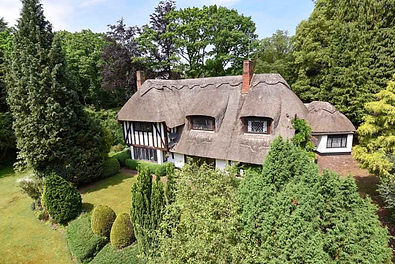
The Corbetts stayed at Burners until sometime in the 1990s. The next owners were John and Anne-Marie Gauld. The current owners moved into Burners in 2017. A recent agent’s photo of the house is shown left (with thanks).
Newbridge Common
Southwards from Burners lies Newbridge Common. Wet, pathless, and full of scrub, this long, thin piece of land must rank as one of Pirbright’s least appealing walking spots. Unsurprisingly, the War Dept snapped it up in the 1880s. We assume that it was returned to Guildford Borough Council in the 1960s. On the western side of Newbridge Common is a 14-acre patch of meadow land. We have written about this in the Stanford - West section.
East side
We will now consider the East side of the Aldershot Road as far south as the Stanford area. There are just 3 (large) houses in this section. They lie just south of Burners Heath, and are somewhat hidden behind trees. They probably escape much notice – they are not particularly easy to look at from a car travelling past, and there are few pedestrians along that stretch of road. We discuss each of the 3 houses moving from north to south. We then write a little about the footpath leading due south to the Ash Road.
To start with, we have shown right the relevant section of the 1807 map, coloured to show the owners of the various properties as follows:
-
Red: George Tate. We have written about George Tate and how he came to own these properties in the Fords Farm section.
-
Green: John Collins. We have written about John Collins and his long family background in the Newmans section.
-
Purple: Samuel Greenfield. We have written about Samuel Greenfield (whom we have referred to as Samuel Greenfield III) in the Bakersgate section.
Almost all of the land in this section was held freehold. Only one field was owned by Henry Halsey (No 477, which was held copyhold by John Collins). The map clearly shows that Mr Tate’s and Mr Collins’s estates had been accumulated piecemeal, resulting in a patchwork of fields. Bakersgate, however, had been the property of the Baker family since at least the 1400s, and was still (in 1807) a homogenous series of connected fields. There is only one dwelling (marked as property 457). This was a small cottage on Bakersgate land. It was not, however, the main Bakersgate farmhouse, and we assume that it was instead for the use of farmworkers.
The track running north to south passed through common land (which would have been fairly open at that time). Today there are far more trees on either side of the road. And 3 houses have been built on the east side: Heatherwood Cottage, Heatherwood and Gorselands. We tell the history of each of these in the sections below.

By 1841, very little had changed. The field boundaries appear to be the same, and the properties had remained within the same families as follows:
-
The red properties were now owned by The Rev John Fitzmore-Halsey and rented out to Stephen Stonard. The Rev Fitzmore-Halsey was a relative by marriage of George Tate, and had inherited George’s property on the latter’s death. This property had included Fords Farm. The Rev Fitzmore-Halsey lived in Hertfordshire, and so had rented Fords Farm as well as the red fields on the map above to Stephen Stonard.
-
The green properties had been inherited by William Collins, the son of John Collins.
-
The purple properties were owned by Samuel Greenfield IV, who had inherited them on the death of his father in 1836.
We will now look at the 3 properties which exist today. Their boundaries don’t match the fields in the map above, but broadly correlate as follows:
-
Heatherwood Cottage (fields 238 and 239, coloured red)
-
Heatherwood (parts of fields 456 and 457, coloured green)
-
Gorselands (field 456, coloured purple)
Heatherwood Cottage
We believe that Heatherwood Cottage was built in 1916 by the then owners of Heatherwood, Archibald and Millicent Stables. We have described how this came about, and shown maps of its location in the Heatherwood section below. We have also shown 2 drawings of the proposed cottage (left). The accommodation consisted of, on the ground floor, a living room, parlour, scullery and WC, and upstairs, 2 bedrooms (one of which measured just 7 feet by 12½ feet). It looks very much as though the cottage was used to provide accommodation for people working for the family that was living at Heatherwood.


The cottage remained part of the Heatherwood property until 1937, at which point the Eagars sold Heatherwood to the Puxleys, but kept a large part of the property (including Heatherwood Cottage) to themselves. In 1951, the Puxleys sold the property back to the owners of Heatherwood at that time, Evan and Joan Jones. They proceeded to develop the cottage into a larger house and rent it out for a while.
We have set out some of the details of these transactions below, but first we will write about the early occupants of Heatherwood Cottage.

The first occupants we can find in the records are Richard and Amy Summers, who were living there in 1921. Richard was born in Winchester in 1878, the son of a Huntsman to Hounds (whose job was to look after the hounds and control them during the hunt by blowing his horn). He was working as a Farm bailiff for the then owners of Heatherwood. Amy (nee Baynham) was born in 1881 in Peckham, the daughter of a chemist.
We have shown left a photo of Heatherwood Cottage from c1920. If you travel along this stretch of road today (coming from Pirbright), with its dense vegetation on both sides, you may well be astonished by this photo. The openness of the land in the photo on both sides of the road and views of the North Downs in the distance are breathtaking.
Richard and Amy married in 1909 at Walton-on-Thames, at which time Richard was an ironmonger, living in Blackheath. In 1911 he was a domestic butler in Leicestershire, while Amy (who by then had a child) lived with her parents.
By 1921 the family had been reunited, and Richard was Farm bailiff, working for Thomas Sedgwick (who was living at Heatherwood – refer section below). The Summers family moved to Farnborough (Hampshire) sometime in the early 1920s. We have shown a later photo of Richard and Amy, right.

In 1925 Arthur and Emily Drury were living at Heatherwood Cottage. Arthur was born at Castle Hedingham, Essex in 1868. Emily (nee Wallington) was born in 1874 in Chorley Wood. Their fathers were both agricultural labourers. They married in Paddington in 1899, at which time Arthur was a coachman (ie a chauffeur). They moved around Surrey and Sussex over the next few years: From 1907 to 1912 they lived at Esher, from 1918 to 1922 at Beare Green, and in 1925 (for 1 year only, it seems) at Pirbright. Arthur was still a chauffeur. The 1920s were tough times economically, but it may suggest that Arthur had some difficulty holding down a permanent job. By 1939 he had become a manservant and the couple lived in Pinner. They had no children.
One small mystery is that a William and Alice Drury were, some years later, living at Heatherwood with the Travises. They may have been carers for the elderly Travis couple, but we cannot trace them, and can’t find a link to Arthur and Emily Drury.
In 1929 Daniel Jones and Eveline Graves were living at Heatherwood Cottage. In 1930 John and Martha Tunnell moved in. John Ernest (“Jack”) Tunnell was born in 1899 at Valley End, an area a little north of Cobham, near the M3 today. His father was a railway platelayer. Martha (nee Norwood) was born 1896 in Maida Vale, daughter of Arthur Norwood, whose job was to wash “Motor cabs”.

John and Martha married in Paddington in 1929. At the time, John was a builder. Immediately after marrying, they moved to Pirbright and soon had 2 children. In the baptism register, John described himself first as a bricklayer (1930) and then as a poultry farmer (1933). So it seemed that he worked in a number of roles for the Eagars. The Tunnells moved to Lightwater in 1939 (by then, John was a General labourer - heavy worker). John died there in 1959. We have shown a press announcement of his death, left. Martha died in Brighton in 1982.
After the Tunnells moved out of Heatherwood Cottage in 1939, Walter and Primrose Allison took their place. Walter was born in 1909 in Hertford, the son of a general labourer. Primrose (nee Horne) was born in Woking in 1902, and was adopted by Mary Annie Gunner, a widow who lived in the centre of Chobham. Mary was 52 years older than Primrose, which must have made life rather tricky at times.
Walter and Primrose married at Brentford in 1935, and initially lived in Hounslow. They moved to Pirbright in 1937, and lived at Oak Cottage (now Heath Oaks), before moving to Heatherwood Cottage in 1939. In the 1939 register, Walter described himself as a “General labourer – heavy work”.
Walter died 1947, aged only 37, leaving Primrose with a young daughter, Sylvia. Primrose stayed at Heatherwood Cottage until c1951, when she moved to Godalming, and then Guildford. She died at Guildford in 1971.
This takes us up to the time when, in 1951, the Eagars sold this property to Evan and Joan Jones, who were still living in Heatherwood, thus reuniting the property to its original size. Evan and Joan proceeded to rent out Heatherwood Cottage. The final division of land between the 2 houses is shown on the plan, right.

In 1953, Raymond and Betty Sanders moved in as tenants of Heatherwood Cottage. We think that Raymond was born in Huntingdon in 1929. Betty was born in 1931, also in Huntingdon, the daughter of a builder’s general labourer. They married in Surrey in 1950. After moving into Heatherwood Cottage in 1953, they had 2 children. Raymond gave his occupation as “Private gardener”.
In 1963 the house was broken into and a gold watch and a cigarette lighter taken. It was one of 3 break-ins that day (the others were in Blackhorse Road and Chobham). The culprit was a 15 year-old boy, who lived at Box Cottage, on a bicycle. The Sanders family stayed at Heatherwood Cottage until 1966, when they moved to Cobham.

The next tenants from the late 1960s were Ernest and Muriel Rowsell. We think that Ernest was born in Yeovil in 1920 and Muriel (nee Snelling) in Bristol in 1922. They married in Chard in 1957. We think that they left Heatherwood Cottage in the early 1970s, and that Ernest died in Guildford in 2009.
The next tenants from the early 1970s were Cyril and Lorimer Jacobs. They went on to live at No 4, Rapley’s Field, and we have written about them in the Rapley’s Field section. In 1972, there was another break-in at Heatherwood Cottage (this time a window was smashed). Some money and account books were stolen. We have shown, left, a photo of Heatherwood Cottage from around this time.
All this time, the cottage had been owned by Evan and Joan Jones, who lived at next-door Heatherwood. However in 1985, Joan Jones put the properties up for sale separately (as described in the Heatherwood section below). But both properties were actually bought by one couple, who proceeded to:
-
In 1986, renovate and extend Heatherwood Cottage.
-
Move into Heatherwood Cottage and live there.
-
Sell Heatherwood to the current owners.
Heatherwood (prev Abbadon Place)
Heatherwood was built in the early 1870s by a group of 3 people: Frederick Wyndham Payne, Charles Baker and John Watkins Johnston. Frederick Payne was a Wine merchant from Battersea, and John Johnston was a London solicitor. It therefore looks as though these were 3 investors who had bought the land off the executors of William Collins in the 1840s and decided to develop it.
The new house was called Abbadon Place. This is a curious name, as “Abbadon” is used to describe an angel of the abyss and a place of destruction. Not very cheerful. The first occupants were Henry and Mary Ann Greenfield and their family from 1872. The Greenfields owned Bakersgate, where we have told their story in more detail. In the Bakersgate section, we have described how Henry got into serious financial difficulties from the mid-1870s, but managed to extract himself from them successfully.
In 1880 Henry purchased Abbadon Place (with the help of a mortgage from one of his father’s friends, George Holt). This seems strange for someone who was formally in “Liquidation by arrangement”. But it may have been a way of alleviating his financial problems (ie by eliminating the rental payments on Abbadon Place and calling in some favours from friends), but we do not know the details.

After Henry’s death in 1895, Abbadon Place and Bakersgate were put up for sale, as shown by the press ad, left. Abbadon Place was actually in the name of one of the Greenfield daughters, Ellen. She married a James Skipper (a farmer, who was 24 years her senior) the following year and they moved to a farm at Bisley. After James’s death in 1911, Ellen returned to Pirbright, living at Ivy Cottage on Dawney Hill.
The purchaser of Abbadon Place in 1895 was Lord Pirbright, who was living at Henley Park, and was buying up a lot of properties in Pirbright at the time, later building “model cottages” on some of them. We have written about him here. He put the house in the name of his wife, Lady Pirbright, and they changed the name of the house to more pastoral-sounding Heatherwood.
We presume that their intentions were to let out Heatherwood. But we can’t find many records of any residents in the house. In 1898, a Mr H Robinson from Heatherwood wrote a letter to the Surrey Advertiser, requesting that an extra train from Woking to Waterloo be inserted into the morning timetable. Good luck with trying that one today, Mr Robinson! In the 1901 census, Henry and Sarah Mason were caretakers of the house. Henry was born in Kent in 1844 and Sarah in Bethnal Green. And in 1902 a Mrs Moule was living at the house.
Lord Pirbright died in 1903, and the following year, Lady Pirbright leased the house for 28 years to Archibald and Millicent Stables. The property was 3½ acres in size, and the rental was £44 pa (today equivalent to £4,500).
Archibald Dunbar Stables was born in Cawdor, Nairn, Scotland in 1863, the son of a Factor on an estate (ie an Estate Manager). Archibald became a Tea planter. He married in 1900, but his wife died (in Bengal) just 2 years later. Archibald remarried the following year (1903) to Millicent Page, and within a year the couple had moved into Heatherwood. Millicent had been born in Preston in 1862, the daughter of a retired Army Major, who had become the Managing Director of Marconi's Wireless Telegraph Company and the London Electric Omnibus Company. (The former was a highly successful company, but the latter had financial issues and closed in 1910.) During WW1, Archibald served as a Lieutenant in the Labour Corps (in his fifties).
Archibald clearly liked the house as, 2 years later, in 1906, he purchased it for £950 (today £98,000). A plan of the property at that time is shown, right. This plan is quite tricky to map to today’s property, as many of the boundaries have changed (as we will see further down). Archibald and Millicent immediately extended the house, using John Faggetter, the well-known Pirbright builder.
Note the presence of “Chesters Field” to the north-east of the property in the plan right. This field had been owned by George Tate in 1807. It was not included in the 1906 purchase, but must have been acquired by the Stables family between 1906 and 1916, as in 1916 they built a small “cottage” on the western edge of Chesters Field, Heatherwood Cottage (see above & below).

We have included (left) an extract from the building plan, showing the position of the cottage (coloured red) in relation to that of Heatherwood (coloured blue). But unfortunately the plan is geographically incorrect. The compass symbol suggests that the direction of the road is c30 degrees away from north-south. Whereas in actuality, the road direction is almost exactly north-south (maybe give or take 5 degrees).
So in fixing the position of the new cottage, we must decide which is correct: The compass symbol or the road direction? We have chosen the latter (the road direction), as it is consistent with the current location of Heatherwood Cottage (ie due north of Heatherwood). We have written the history of this cottage from this point in the Heatherwood Cottage section above.

Archibald and Millicent Stables sold Heatherwood in 1919 and retired to Poole. They died there in 1945 and 1950 respectively.
The new owners of Heatherwood in 1919 were Edward and Doris Pitt-Johnson. Edward Collingwood Pitt-Johnson was born in 1879, the son of the incumbent priest at a church in Devonport, named Pitt Johnson. At some stage, Edward changed his surname to the double-barrelled variety for reasons unknown. Edward was educated at Oxford University and became a Clerk in Holy Orders, like his father. In 1911, while a priest on the Isle of Wight, he married Doris Dauncey, who was born in 1892 in Gloucestershire, the daughter of a bank manager.
We are not sure which church he was attached to while he lived in Pirbright, but he was not the incumbent at St Michael’s. As soon as the Pitt-Johnsons moved into Heatherwood in 1919, they extended the property by adding an entrance hall, a porch and an extra bedroom. Was this a wise investment? Well, the job of a priest in the C of E was often an unstable one. Sure enough, within 2 years he had been transferred to a parish in Sussex. The Pitt-Johnsons had started a farm of sorts on the Heatherwood property, as evidenced by this advert (right from August 1920) for a closing-down sale. Edward had found the time to be the Hon Secretary of the Guildford & District Beekeepers Association.
After his transfer to Sussex, there followed a spell in Canada, then Abinger, then finally Hove, where Edward died in 1939. Doris lived until the age of 90, and died in Weston-super-Mare in 1982.
As a curiosity, Edward has a rather esoteric claim to fame. He was one of a group of 6 friends who camped in a field in Wantage one summer’s day in 1901. As the plaque (pictured left, with thanks) shows, this camping event marked the first meeting of The Association of Cycle Campers, which later morphed into The Camping and Caravanning Club, which today has 730,000 members. Edward can therefore claim to be one of the founder members of this esteemed club. In fact he was the Secretary of the original Association that camped in that Wantage field all those years ago. For that, he must surely be added to the (metaphorical) Pirbright Roll of Honour (albeit nowhere near the top of the list).


The next owners of Heatherwood from 1921 were a Thomas and Kathleen Sedgwick. Thomas was born in Kendal in 1881, the son of a “Bovril Traveller”, which presumably means he was a sales rep for that highly-regarded company. Kathleen was Thomas’s second wife. The 1921 census records that his first wife, Florence (nee Golding in Greenwich in 1888), whom he married in 1908, had died young, although we cannot find any references to this in the records. Thomas had married Kathleen (nee Parker) in Kendal in 1919. When at Heatherwood, they were living with 2 children (one from each marriage).
In 1921, Thomas was a “Newspaper representative on the publishing side” for The Times, than based at Printing House Square. The Sedgwicks revitalised the farm which the Pitt-Johnsons had started a few years earlier, as in 1921 a Farm Bailiff (Richard Summers) was living at Heatherwood Cottage – refer section above.
For whatever reason, the Sedgwicks decided to sell Heatherwood after only 18 months. They had bought it for £3,450 and sold it for only £3,000. That sounds like bad business, but it was a period of deflation (c14% over 2 years), and adjusting for this, it meant that the Sedgwicks sold the house for roughly what they had paid for it. However if they had an outstanding mortgage on the property, they could have been in some trouble.
We have shown an ad for the auction, right. Note that the property is now advertised as being 8 acres in size (because it includes Chesters Field). Later ads for the auction included Heatherwood Cottage in the lot, and increased the size of the combined property to 11 acres. The house also had central heating – a rarity in 1922.
The purchasers of the 11-acre property in 1922 were Harry and Emmeline Travis. Harry was born in Woolwich in 1859, the son of a Master artificer (ie a highly-skilled Navy craftsman). Emmeline (nee Hamlyn) was born in Bickleigh, Devon in 1859, the daughter of a farmer of 65 acres. They were married in 1882, and had 2 children. Harry became a Civil engineer in the War Dept and the family lived in Blackheath.


The move to Pirbright looks as though it was at the time of Harry’s retirement. They were accompanied by one of their children, Edward, his wife (Muriel) and their 2 children. The Travises were early adopters of the telephone, having the rather tidy number of Brookwood 50. The directory entry was in Edward’s name, not Harry’s. 5 years later, in 1927, both Harry and Emmeline died and were buried in St Michael’s Churchyard.
Edward and Muriel Travis stayed at Heatherwood for a couple more years, but decided (for reasons unknown) that they preferred to live in a new house in a slightly different location. And so Burners (on the west side of the Aldershot Road – refer above) was built in 1929, and Edward, Muriel and their 2 daughters moved into it the same year. Edward (or Sir Edward, as he later became) had a highly distinguished career (becoming the Head of GCHQ). We have told his story in the Burners section above.
In 1929, Heatherwood (still an 11-acre property) was sold to Waldegrave (“Waldo”) McGillyCuddy and Emily Isobel Eagar. Waldegrave Eagar was born in 1884 in Redruth, the son of an Irish priest. We wonder what he thought of his rather unusual given names.... (We should point out that Magillicuddy was the name of an Irish clan.) In his youth he had been a choir scholar at St Paul’s Cathedral. In 1903 he was awarded an exhibition to study at Exeter College, Oxford, where he read theology. Emily (nee Heald) was born in Cheshire in 1881, the daughter of a “Railway secretary”, which presumably meant a secretary at a Railway Company.
They married at Hersham in 1916. The marriage certificate shows Waldo as an “Assistant Director” (it was of the Borstal and Central Associations) at the time. By 1921, he was an Inspector of Housing for the Ministry of Health. At this time he was busy helping to found the National Association of Boys’ Clubs (an organisation which still exists today) and later became its Vice-President. He was awarded the CBE, presumably for his services to Boys’ Clubs. Another nomination for the (metaphorical) Pirbright Roll of Honour, we think.
The Eagars set about enlarging Heatherwood as soon as they moved in, adding a new kitchen on the ground floor and a new bedroom and “sleeping porch” on the first floor in 1929.
Waldo died at Eton in 1966. Emily died at Amersham in 1972. We have shown (right) an obituary of Waldo from The Surrey Advertiser (with thanks). And we recommend a read of the excellent description of Waldo’s achievements at https://infed.org/mobi/waldo-mcgillicuddy-eagar-and-the-making-of-boys/
The Eagars sold Heatherwood in 1937, and the property was bought by William and Margaret Puxley for £3,325 (£192,000 today), with the help of a mortgage. However this included only the original (pre-1916) 4½ acres of Heatherwood (red on the plan, right), and excluded the 7 acres of Chesters Field (green on the plan, left, containing Heatherwood Cottage), which the Eagars carefully kept for themselves, as they had other plans. These are spelt out in the Heatherwood Cottage section above.
William Lavallin Puxley was born in Goring (Oxfordshire) in 1898, the son of Herbert Hardress Lavallin Puxley, a wealthy farmer from Cork. The name Lavallin comes from Brittany. The name Hardress originates in Kent apparently.

The Eagars sold Heatherwood in 1937, and the property was bought by William and Margaret Puxley for £3,325 (£192,000 today), with the help of a mortgage. However this included only the original (pre-1916) 4½ acres of Heatherwood (red on the plan, left), and excluded the 7 acres of Chesters Field (green on the plan, left, containing Heatherwood Cottage), which the Eagars carefully kept for themselves, as they had other plans. These are spelt out in the Heatherwood Cottage section above.
William Lavallin Puxley was born in Goring (Oxfordshire) in 1898, the son of Herbert Hardress Lavallin Puxley, a wealthy farmer from Cork. The name Lavallin comes from Brittany. The name Hardress originates in Kent apparently.

Margaret Jessie Burgess was born in 1903 in Philadelphia, the daughter of a Canadian banker. They were married in Goring in 1927. William gave his profession as “Gentleman”. Soon afterwards, William left the Royal Navy and became a London stockbroker, with his office in Throgmorton Street. The couple appear to have changed their surname to “Lavallin Puxley” for unknown reasons, moved to Knaphill and had 4 children. They moved to Heatherwood in 1937.
In WW2, William served as Commander of the destroyer HMS Montgomery between 1941 and 1943. He was then loaned to the Royal Canadian Navy and in 1944 was awarded an MBE: "For good services in action with destroyer force." Later, after WW2, William wrote a couple of books on dogs, Collies and Sheep-dogs, and Samoyeds. For that lot, surely he is a further nominee for the (metaphorical) Pirbright Roll of Honour.
Between 1942 and 1946, Robert and Barbara Kidd also lived at Heatherwood. Robert was born in Norfolk in 1906, the son of a bricklayer. Barbara (nee Wye) was born in Knaphill in 1911, the daughter of a labourer. They married in Bisley in 1932, when Robert was a chauffeur, but by 1939 they were both domestic servants, living at Fleet. Before that (from 1937 to 1939) they had lived at No 3, Chapel Road. After they left Heatherwood, they lived at The Bungalow, Langley House in 1948, then, in 1949, in The House by the Green on the Bagshot Road. So it seems that they moved frequently, seeking employment in large houses where there was accommodation for them.
From 1953 to 1968 they lived in St John’s, which looks as though it was a permanent address for them. From 1956 to 1964, Robert was President of the Pirbright Social Club and Barbara was active in supporting events, so we presume that they were well-liked in the village. Robert died in East Preston (near Chichester) in 1983. Barbara died at Bognor in 1993.
In 1948, one of the Puxleys’ daughters, Susan, married Amias de Carteret at St Michael’s. Amias was living at Bullswater Lodge and nearby Stable Cottage, where we have told his story. We have shown, right, a picture of the happy couple from The Tatler (with thanks).
However in 1970, Susan (now named Susan Lavallin de Carteret) was named in a divorce case between Ian Silver (of Woodwinds, today Wood House) and his wife. The grounds for the divorce were Mr Silver’s adultery with Susan.
Back now to William and Margaret Puxley. After leaving Heatherwood in 1949, they moved to Little London, near Andover. One of their sons, James Puxley, married Alys Jean-Marie Rickword Lane in Pirbright in 1955. They lived in The Birches at Stanford and we tell their story in the Stanford – West section. William died at Andover in 1969. Margaret died in Dorchester in 1990.

The purchasers of Heatherwood (comprising 4½ acres) in 1949 were Evan and Joan Jones, again assisted by a mortgage. Dr Evan Jones MRCS LRCP MB BS Lond MRCP MD FRCP was born in 1907 in Cardiganshire.
To understand the life of Dr Jones, we can do no better than repeat the words of Sir Gordon Wolstenholme and V Luniewska on the Royal College of Physicians website (with thanks):
Evan Jones was brought up in a small Welsh village, speaking Welsh. He was educated at Towyn County School, Wales, and St Thomas’s Hospital, London, graduating MB BS in 1931 and taking the Conjoint diploma in the same year. His academic record was remarkable. He won the William Tite scholarship, the Peacock scholarship, the Mead medal, the Haddon prize, the Toller prize, the Wainwright prize and the Perkins Fellowship - a record which has probably never been equalled. He became a member of the staff at St. Thomas’s at the age of 30, being one of the youngest members of staff every appointed. He took the MRCP in 1933, proceeded to MD in 1937 and was elected a Fellow of the College in 1941. Evan Jones became physician in charge of the department of cardiology in 1942 and hence was one of the youngest cardiologists in the country. He was a superb clinician, inspiring faith in every patient he ever met. His opinion on any form of medical problem was excellent and quite apart from his diagnostic ability he had great humanity. The combination of these two qualities made him a great physician. He wrote little and took very little part in administration, but he loved his work and nothing was ever too much trouble for him. The amount of help he gave to impoverished junior students was not well known because of his modesty.
Eccentric in socially unimportant ways, erratic in timekeeping because he would become so totally absorbed in a clinical problem, unconventional in many spheres, he was loved by all because he never tried to be anything but himself. He had no time for humbug, self-deception, snobbery or intellectual dishonesty. His approach to a problem was always realistic and carried out with detailed thoroughness. He had an enormous practice and his patients were devoted to him. He excelled at clinical work and teaching clinical medicine to postgraduates. Socially he was a sympathetic and charming character, a good listener and a good talker. His gusts of laughter will always be remembered.
For many years golf was his favourite relaxation but though always keen to score well his chief pleasure was in meeting his friends, and exchanging stories of human vagaries on the course. In later years he took to fishing and whenever he had time he would be away with his rods on some loch or river.

There is also a local story that Evan was at one time the official surgeon to King George VI, although we cannot find any evidence to support this. In 1950, Evan had an unfortunate meeting with a tree in Ottershaw, as described in the cutting left.
In 1951, Waldo and Emily Eagar had sold the 7 acres of Chesters Field (including Heatherwood Cottage) to Evan and Joan Jones. So having carefully segregated the field from Heatherwood back in 1937 (when they sold Heatherwood to the Puxleys, but kept Chesters Field for themselves), the Eagars abandoned their plans for the 7-acre field and reunited it with Heatherwood 14 years later. The Joneses were to keep renting Heatherwood Cottage out for the next 34 years.
In 1955 Evan bought a luxury sporting coupe, the Bristol Type 404 with the number plate WRC 404. We are lucky enough to have a photo of the car (below, with thanks to the current owner). The number plate has changed since 1955, but it still looks a wonderful car to us. But in 1959, Evan had another unfortunate experience in his car, as described in a press article of the time (right).

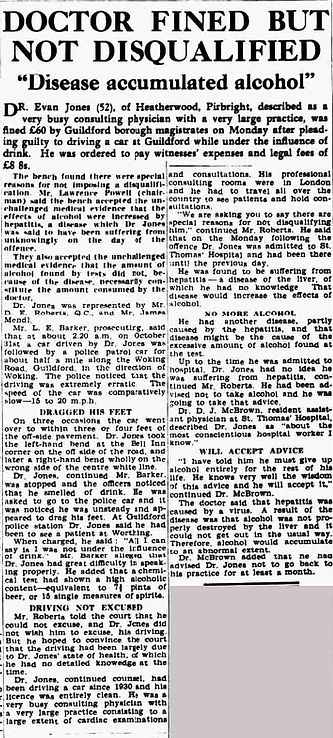
Evan died in 1969 on one of his beloved fishing trips at Ness Castle Fishing Lodge at Scaniport, near Inverness. Joan remained at Heatherwood until 1985, when she put the house up for sale. We have shown photos of Evan and Joan below. A copy of a newspaper ad for the sale is shown, right. As can be seen from the advert, the 2 houses - Heatherwood (8 acres) and Heatherwood Cottage – 3 acres - were for sale separately. And they were indeed bought by 2 separate purchasers.


But both properties were actually bought by one couple, who proceeded to:
-
In 1986, renovate and extend Heatherwood Cottage.
-
Move into Heatherwood Cottage and live there as owners.
-
Sell Heatherwood to the current owners.
Gorselands
Gorselands was built in 1897 for Lord Pirbright. We have shown the plan and a sketch of the house from the building plans. The plan indicates that the house was built on waste ground, and shows Heatherwood (then called Abbadon Place- refer section above) as the only other house nearby. The sketch of the front of the house clearly shows the decoration which can still be seen today (see agent’s photo at the end of this section).


We have written about Lord Pirbright in the Pirbright Cottages section. By 1897, he was well into his programme of buying up land in Pirbright for “affordable housing” as we would call it today. Heatherside, however, was an exception, as it would have been distinctly “unaffordable” for most people. However, as with his affordable housing, he rented Heatherwood out.
The first tenants were Frederick and Mary Jane Stowell. Frederick and Mary Jane (nee Palmer) first met in Kentish Town, where Frederick was boarding in a house rented by Mary Jane’s parents. Frederick started a wine retailing business, which became extremely successful. The business eventually became Stowells of Chelsea, a name very well-known to those above a certain age with a taste for wine.
In 1902, Mary Jane’s family moved to Pirbright to be near Mary Jane and her family. They rented No 16, Pirbright Cottages, where we tell the Stowell story in more detail. In 1911, Frederick and Mary Jane left Gorselands and moved to Hastings. Frederick was partly retired, having handed the business over to his sons. Frederick died in 1924 in Ealing, leaving an estate of £23,000 (today, £1.2 million). Mary Jane died in 1926, also in Ealing.

Lord Pirbright died in 1903, and 6 years later, in 1909, Lady Pirbright sold off some of their properties. One six-lot batch included Gorselands. An ad for the sale is shown left. However, the sale was unsuccessful, and ownership remained with Lady Pirbright.
The next occupants of Gorselands were John and Harriett Bluck. John was born in Small Heath, Birmingham in 1859, the son of a gardener. Harriett (nee Brown) was born in Dudley in 1863, although we can’t be sure who her parents were. John and Harriett married in 1885 in Aston and had 2 daughters.
John started off life as a gardener like his father. By 1901 the Blucks had moved south, and John was one of 2 gardeners at Henley Park, working for the absent owner, Henry Halsey 4. However the tenants at Henley Park were Lord and Lady Pirbright and this doubtless led to John’s next opportunity: By 1911 he had become Estate Steward for Lady Pirbright. One of the perks of this job appears to be accommodation (presumably free) in Gorselands.
After Lady Pirbright’s death in 1916, her 60-odd properties were auctioned off, and John seems to have been the organiser of these sales. He was named as the contact person in the press advertisements.
Gorselands was bequeathed to John in Lady Pirbright’s will. The Blucks continued to live in the house until 1919, when they tried to sell it at auction in (see press ad, right). The house had grounds of nearly 2 acres, but there were no bids reaching the reserve price (£1,550, or £68,000 today) and so the property remained unsold. John and Harriett sold the house later the same year privately (for £1,750), and moved to York Road, Woking. Harriett died in 1922, and John became the administrator of the estate of Sir George Faudel-Phillips, a Baronet who had died in 1922. John died in 1952, aged 92, still living in York Road.


The new owners of Gorselands were 3 siblings: John Locke, Rose Ella and Frances Blanche Lempriere.
The Lempriere family originated in Jersey, and had been Lords of the Manor of Rozel (in North Jersey) for several hundred years. The 3 Lemprieres were children of Harry Reid Lempriere, a solicitor. Harry’s father had served in the Royal Artillery during the Peninsular campaign (1808 -1814) under Sir John Moore, taking part in the notorious retreat to Corunna in January 1809. And Harry’s brother, Arthur Reid Lempriere, became a Major-General. But Harry became a solicitor on the Dorking Road in Epsom and married Ella Locke (hence John’s and Rose’s middle names).
20 years before the 3 siblings were born, the Lempriere family had befriended the young JE Millais (later Sir John Millais), the painter. Left is a drawing by Millais in 1847 of Harry (on the left) with 2 of his younger siblings. Arthur (later Major-General Arthur) is the boy in the middle of the drawing.
All 3 of the Lempriere children were born between 1867 and 1870, and none of them married. Harry and Ella actually had a fourth child, a twin of Frances. He lived in Leatherhead and died, unmarried, in 1922.
John Locke Lempriere was born in Ewell in 1867. He was educated at Haileybury School and became a solicitor in Epsom, like his father (we presume that he worked in his father’s firm). Rose was born in 1868 and was an accomplished watercolourist. We have shown a great example of her work at the foot of this section, and another in the section relating to Appletree Cottage. Frances (“Kit”) was born in 1870. She was disabled and had to use a wheelchair.
The gardens were magnificent, partly down to having 3 gardeners, we suspect. Each of the 3 children had their own separate garden.
The Lemprieres moved into Gorselands in 1919. At that time, the house had 14 acres of land, some of which was woodland. We assume that, as it does today, this comprised the land running down the east side of the Aldershot Road as far as the Ash Road turning. At the end of this Gorselands section, there is a map showing this. In the 1921 census, John described himself as a Retired Solicitor (despite being only 54 years old). Rose and Frances gave their occupation as “Home duties”, and there were 2 servants in the house.
John died in 1947 and Rose in 1950. They were buried in St Michael’s Churchyard. A photo of their gravestone is shown left. We have also shown John’s and Rose’s death notices in the local press.


After Rose Lempriere’s death, Frances moved to Langley Cottage on The Green c1952. Rose Davis, who is mentioned in Rose Lempriere’s death notice, moved to Langley Cottage also. She died in 1967, aged 92. Frances died in 1967, having moved to St Peter’s Convent in Maybury, aged 96. Her ashes were placed in John and Rose Lempriere’s grave. The Lempriere Trust, still in existence, was set up by the family for the poor of the parish.
The new owners of Gorselands in 1952 were Alexander and Edith Middleton. Alexander Allardyce Middleton was born in Dingwall, Scotland, in 1902, the son of a solicitor. Alexander studied at Edinburgh University and became a Civil engineer. One of his first projects was to act as the Assistant Civil Engineer with the Sudan Plantations Syndicate Ltd. The job was located in Sudan, which may have been an exciting proposition then, but would be a pretty dangerous one today.
Edith, nee Cowan, was born in Woolwich in 1914, daughter of Lieutenant Colonel William Cowan MC. In 1939, Edith was a Hospital nurse in Urmston, West Manchester. They married near East Grinstead in 1950 and had 3 children. Edith was a keen horsewoman, often seen riding round the village with daughter Priscilla.
Alexander died in 1988, leaving an estate of £410,000 (equivalent to £1.1 million today). We have shown a copy of a newspaper obituary of Alexander, right.


Edith stayed at Gorselands until c2004. By 2005 Robin and Juliette Apperley had bought Gorselands. They had previously been living in Liphook. The Apperleys moved to Kingfield in Woking c 2010 and the house was sold.
The council report on a subsequent planning application by their successors makes interesting reading: During their stay, 2 buildings were built without planning permission, totalling 350 square metres. One was an indoor swimming pool (which had previously been refused). Because 4 years had elapsed before the council knew about these buildings, no action could be taken. The report also notes that a 100 square metre garage had been built by the Apperleys without permission (although approval was granted retrospectively).
The house was sold again c2021 and purchased by the current owners.
The Gorselands property today includes all the land running down the east side of the Aldershot Road as far as the Ash Road turning – around 14 acres in total. This is shown outlined in red on the current OS map (with thanks) below, and we think has remained unchanged for over 100 years. We have also shown below a recent agent’s photo of the house, with thanks.


South of Gorselands
There isn’t much to see on the eastern side of the road once you have gone past Gorselands. There is a narrow footpath that leads pretty much due south to the Ash Road. At one time it skirted the edge of Bakersgate fields, with fine views across them. But today it is in a sorry state. Very wet in the winter and strewn with rubbish, it only cuts a few yards off the corner.
On the west side of the path is Gorselands property.
The view to the east is mainly of the back of the houses on the Upper Stanford Road.
In mitigation, one can see some promising-looking bluebells in various places of the path at the right time of year. They were put on canvas by Rose Ella Lempriere, who lived in Gorselands (refer section above).