

The Army Training Centre (ATC)
We are very grateful for the assistance provided by the ATC in preparing this section of the website. The officers and staff we met were extremely helpful and went out of their way to show us objects, locations and information which they thought might be of use to us (which they most certainly were). We were struck by the courtesy, professionalism and openness of everyone we met. Our own input into this section has been relatively meagre. The vast majority was kindly supplied by the ATC and their staff, for which we are very grateful. We are also grateful for the information supplied by https://theguardsdepot.co.uk/ and The Guards Museum.
As access to the camp is restricted, most Pirbright residents will never have set foot inside the camp. We will therefore start by showing today’s OS map of the entire camp (with thanks to Ordnance Survey).

To help readers orient themselves, we can give the following guidance:
-
All access to the camp is from the eastern side, along either of Brunswick Road or Billseden Road. Both roads pass through a long stretch of residential housing for Army staff before reaching the camp itself.
-
Entry to the camp is very strictly controlled, as one would expect, and is at the bottom right-hand corner of the area edged in red.
-
The area edged in red is known as the Alexander Camp. It is the main hub for the training of new recruits and lies on the original site of the camp (of which no trace remains today).
-
The area edged in purple is known as the Brunswick Lines (or Brunswick Camp or D Lines). The barracks in the eastern part were originally built during WW1. They were demolished and replaced in 1938. The replacement buildings have now themselves been demolished. Barracks in the western part of the Brunswick Camp were built in 1938 and most still remain (although soon to be redesigned).
-
The area edged in turquoise is known as the Elizabeth Barracks. It was constructed in 1962. At the bottom right-hand corner of the turquoise area is a large empty rectangle. This is the large parade ground, used for rehearsals for special occasions.
-
The 4 main Firing Ranges can be clearly seen in the top left-hand quadrant of the map. They are in the same locations as they were when the camp was opened c1880. These ranges are roughly parallel to (but quite separate from) the NRA Bisley Ranges, which we write about in the NRA Bisley Camp section.
Now, to the history of the camp.
1850 – 1914: The Early Days
The story of what is today called the Army Training Centre, Pirbright begins with the use by the British army of a camp at Chobham in the 1850’s to train its troops. A stone cross just north of the M3 marks the occasion when Queen Victoria reviewed her troops in 1853, just before the Crimean War.
The camp was considered to be very successful in providing a good training ground for the soldiers. Further explorations of the area revealed that the bedrock of virtually all of West Surrey and NE Hampshire comprised the sand and gravels that they’d found at Chobham. Accordingly, the War Department purchased land in Aldershot in 1854 and established a camp there. The next year they purchased land at Ash for firing ranges. Over the following 30 years the department purchased other pieces of vacant land in the area. Camps at Bagshot and North Camp were built. Later, Deepcut, Mytchett, and other bases followed.
In 1871 it was decided to hold the Army’s annual manoeuvres in Berkshire and Surrey for 2 weeks in September that year. The soldiers involved in the manoeuvres were split into 3 divisions for this purpose.

One of the 3 divisions gathered at Aldershot, and used the Surrey Heathland for their exercises. At that time most of the heathlands (including all the land near Pirbright) was common land, generally accessible to everyone for turf and wood collecting, grazing etc. Little of the land was owned by the War Dept. So a certain amount of cooperation was required between the military and local landowners.
The manoeuvres were not allowed east of a north-south line drawn through Brookwood station. But they reached Pirbright, as evidenced by the slightly poetic press cutting, left. We can’t tell exactly where the soldiers went, but mention of Cow Moor means that they used the land near the current-day ATC and Bisley Camp.
A few days later one set of forces made camp near Pirbright, although we don’t know exactly where. The ”Battle of Bisley” ensued, with artillery sited where the railway line to Aldershot leaves the main line.
One newspaper gave us some more detailed information (see cuttings, right). The reporter was trying to analyse how troops to the south of the railway (led by Sir Charles Staveley) could attack an enemy to the north of the railway (camped on the Chobham Ridges, to the west of Bisley. We can recognise many of the landmarks today.


It was reported the next day that General Staveley and his staff had marched at the head of their troops from the south through the railway arch, not knowing that Stephenson’s Brigade of Highlanders were hiding on the other side. Staveley and his officers were riddled with “bullets”. The newspaper reported “If ever a man was killed in theory, General Staveley is he.” When Staveley’s soldiers tried to climb over the railway embankment they were met by more volleys of “bullets”. Oh dear.
Another detail of Pirbright was mentioned in the cutting, left. We assume that the “Pirbright Basin” referred to the wider area of water by the railway bridge, opposite Howfield Cottage.
A lot of failings were exposed by the manoeuvres – lack of maps, lack of understanding of orders, etc – but the experience was seen as helpful. So much so, that similar exercises were held the following year and thereafter. They were often held in the summer, rather than the autumn.
We have shown below an extract from the 1873 OS map with today’s (approximate) footprint of the ATC edged in orange. The area of housing related to the ATC is edged in blue, whilst the ranges (the ATC and next-door NRA Bisley ranges) are edged in red. The map shows that the ATC camp was built on what used to be rather featureless heathland, as were the firing ranges. Much of the more recent ATC-related housing was built on agricultural land belonging to Cowshot Manor. This land was sold to the War Dept in the late 1880s by the then Lord of Pirbright Manor, Henry Halsey 4, who had a particular skill in spending large amounts of money on himself. We have written more about the history of this land in the Cowshot Manor section.

In 1875, the War Department (WD) agreed to buy 3,000 acres of Pirbright heathland. Most of this land comprised the Ash ranges to the west. But it also included the land now occupied by the ATC.
In 1877 a meeting of Pirbright inhabitants was held in The White Hart to form a committee of 5 people to agree the level of compensation to be paid to those Pirbright people who would lose their rights over the commonland. The 5 people selected included 3 whose names are familiar to us: Charles Peyto Shrubb of Merrist Wood, Henry Greenfield of Bakersgate, and John Cherryman of Causeway Farm. Given that real money was at stake, these gentlemen were presumably well-regarded locally and thought to be good negotiators. Edward Joseph Halsey (representing the Halsey family, who owned the land) was also appointed.
The amount finally agreed was £14,000 (worth today £1.3 million – a very tidy sum for “all persons entitled to commonable or other rights”). Unfortunately, we do not know who these persons were, nor how the amount was divvied up between them. Nor do we know how and when they were paid, or how much of it they spent in the alehouses of Pirbright that first evening.
We don’t know exactly when the first camp was pitched at Pirbright in its current location. We assume that it was between 1877 (when the land was purchased) and 1880 (by which time the firing ranges had already been built). An interesting question is why, out of all the land purchased, this particular site in Pirbright was chosen for a camp. We don’t know for sure, but we can think of some good reasons:
-
Proximity to a main line railway station
-
Proximity to the Basingstoke Canal (for importing materials and coal)
-
A suitable location for firing ranges, with no danger of stray shots causing any injury or damage (a musket ball could travel 1,200 yards at the time)
-
Except for a couple of farms, a good distance away from civilian housing.
Probably from its inception, the camp was allocated by the War Dept to The Brigade of Guards. We have written a little about the Brigade of Guards below. But that raises the question as to what was a “Guard”? We’ll start by looking briefly at “The Guards” - who were they, and why they were formed?
The first 3 Guards units (regiments) were formed during the English Civil War of 1642-1651.
-
The Coldstream Guards were formed under Cromwell in 1650.
-
The Grenadier Guards were formed under the exiled King Charles II in 1656.
-
The Scots Guards can trace their origins back to 1642 when they were formed in response to the Irish Rebellion of 1641.
The Coldstream and Grenadier Guards were originally formed to protect their respective leaders (Cromwell and King Charles II). The Grenadier Guards backed the right horse during the Civil War and were thus retained. The Coldstream Guards managed to switch their loyalty from Cromwell to King Charles II in time to survive. The 2 regiments were maintained to serve as the monarch's permanent, professional bodyguard and to defend the state in both domestic and foreign conflicts.
The history of the Scots Guards is a little more complex. They did not change their loyalty quickly enough and were disbanded. They reformed in 1656 and became the 3rd Regiment of Foot Guards. Because of this history, the Grenadier Guards are regarded as the senior of the Guards Units, even though they are not the oldest.
Life in the Guards units in days gone by was tough. We have shown, right, an excerpt from the Punishment Book from 1798-99. Trigger warning: Do not read it if you are of a squeamish nature.

Much later, two further Guards units were formed:
-
The Irish Guards were formed in 1900 by order of Queen Victoria to commemorate the Irishmen who fought in the Second Boer War for the British Empire.
-
The Welsh Guards were formed in 1915 to include Wales in the body of Foot Guards. Within 6 months they were on the front line in WW1.
Thus, there are today 5 Guards Units. Together with 2 Household Cavalry regiments they form the 7 regiments of the Household Division of the British Army.
There has always been a sense of rivalry between the Guards units. Sometimes (as we relate below in 1901 and 1906) this spilt over too far. But there has always been a great sense of camaraderie amongst The Guards, as evidence by the Guards’ Clubs, and frequent alumni events.
In more recent times, the Guards units have come to be regarded as elite, highly-trained infantry units. They wear distinctive uniforms and perform front-line and ceremonial duties. They are perhaps best known for the Changing of The Guard and Trooping the Colour ceremonies. Watching a Guards’ parade is a sight to take the breath away. And which foreign visitors to London can resist taking a photo of a Guard wearing a bearskin cap?
Prior to WW2 the common view of The Guards used to be that they were professional, but privileged and elitist. Witness the old joke: “You can always tell a Guards Officer. But you can’t tell him much.” But that all changed after WW2. Guards Officers now show much more concern for the welfare of their men and their families. The feeling of privilege has long since gone. The Officers’ mess may contain silver salvers, but officers now serve themselves, cafeteria-style.
We have shown a few early mementoes from Guards history below, some from The Guards Museum in London, and others from All Saints Church in the ATC, Pirbright. Our thanks to the Museum and to the ATC for use of these. Top to bottom and left to right:
-
Regimental colour of the Scots Guards, 1790, presented to All Saints Church by descendants of Quartermaster James Lees of the Third Guards (1779 – 1804).
-
Regimental colours of the Grenadier Guards and Scots Guards (1906 – 1922)
-
Plaque placed by the Guards Parachute Association. It was formed in 1975 from the 1st (Guards) Independent Parachute Company, which had been formed at Pirbright in 1948. Operations took place in 21 different countries. The farewell parade at Pirbright was in 1975.
-
Regimental flag of the 1st Battalion Scots Guards 1815 – 1830.


The home of The Guards regiments from 1877 was Caterham Barracks, which had been built as a “Guards Depot” for the Foot Guards. During the Battle of Britain in the autumn of 1940, the camp suffered severe bomb attacks in 2 air raids in 1940. At the time the barracks was crowded with new recruits. Sadly, 25 recruits to the Coldstream and Welsh Guards were killed, many only teenagers. Many of the recruits killed at Caterham were buried at Brookwood Military Cemetery (Plot 5, shown below). They are referred to as “The Caterham Boys”

To many, a mention of “The Guards” will conjure up images of marching bands. Music has indeed been a feature of the The Guards since the early days. We don’t want to offend anyone, but we suspect that 2 of the most well-known UK military bands are:
-
The Band of the Coldstream Guards was formed in 1685. They made one of the first recordings on a wax cylinder in 1889. In 1968 nthey recorded the closing theme for the BBC TV series Dad’s Army (“Who do you think you are kidding Mr Hitler”).
-
The Band of the Grenadier Guards was also formed in 1685. Handel wrote a piece of music (the slow march from Scipio) for the band in the mid-1720s. They were the first British military band to tour the USA after the creation of the USA (in 1876, for their centenary). An Act of Parliament had to be passed to authorise it.
We have shown a copy of the first photo ever taken of the Welsh Guard drums and flutes, going into action in WW1. We have also shown an earlier drawing of some bandsmen from the Grenadier Guards. We can’t work out why one of them is carrying an axe. Both items are displayed in the Guards Museum, whom we thank.


Bands of all the Guards regiments are involved in the annual Trooping the Colour to mark the King’s birthday (and have been since the first ceremony in 1748). As we will see a little later, in the early 1900s, rehearsals for the ceremony were carried out at the camp. We have shown a modern-day photo of the Trooping the Colour ceremony below.

The Guards bands are also involved in major events such as Royal coronations and funerals. During WW1 and WW2 most bands units were temporarily disbanded, with many musicians serving in medical roles.
We’ll now move on to look at “The Brigade of Guards”. In the later 1800s (when Pirbright Camp originated), the structures of the British Army were quite complex, and, over the years, changes had often occurred. For example, flogging was abolished in 1871. 1881 was a year of significant reforms in The Army, and so we will start there.
From the 1880s an Army Brigade would typically have consisted of between 3,000 – 5,000 men, commanded by a Brigadier. A Brigade would be subdivided into, usually, 3 or 4 Battalions, each comprising around 500 - 1,000 men.
The Brigade of Guards was an administrative unit which had been formed in 1856. By 1881 it comprised 7 Battalions and presumably comprised approximately 5,000 men. The 7 Battalions were:
-
3 Battalions of Grenadier Guards
-
2 Battalions of Coldstream Guards
-
2 Battalions of Scots Guards
A 3rd Battalion of Coldstream Guards was formed in 1897. The 1st Battalion of Irish Guards was formed in 1900, and the 2nd Battalion of Irish Guards in 1915. The Welsh Guards were formed in 1915, largely from Welshmen serving in the Grenadier Guards. A 3rd Battalion of Irish Guards was formed in 1941.
Various Battalions of the Guards were involved in the 2nd Boer War (1897-1900), as well of course in both World Wars. During peacetime, the Guards were involved in peacekeeping duties during strikes at home, and in policing overseas colonies, when trouble loomed.
In 1968 the Brigade of Guards was subsumed into the new Household Division.
During the troubles in Northern Ireland in the 1970s, all the Guards’ regiments (except The Irish Guards) served there.
The image of a guardsman standing to attention with shiny boots, red uniform and a bearskin cap must surely rank as one of the symbols of Britishness and has done so for many years. But many changes have occurred in recent years. Today, for example, that guardsman could be male or female [yes, at the time of writing, females in The Guards are known as guardsmen], and could have just about any ethnic background, including Asian (Bangladeshi, Indian, Pakistani), Black (African, Caribbean), and Chinese backgrounds.
We have shown below a magnificent drawing of the Brigade of Guards in South Africa c1900 (with thanks to the Guards Museum).

We will now revert to the history of Pirbright Camp at the point where the camp had just opened and been assigned to The Brigade of Guards.
By 1880, 4 ranges and butts had been prepared (in the same positions they are in today). In 1881 the 2nd Battalion, Coldstream Guards came to Pirbright Camp for musketry practice and Company training (which was an innovation at the time).
The 3,000-acre land purchase by the War Dept no doubt made it easier to use the land to the west of Pirbright for the annual manoeuvres. Newspapers reported these manoeuvres in a surprising amount of detail. A lot of the action was now based on the Ash Ranges (which formed a major part of the War Dept’s purchase). Newspaper reports frequently mentioned skirmishes on Fox Hills. Troops sometimes gathered at Rails Farm in preparation for an advance to Fox Hills.
The first newspaper reference to “Pirbright Camp” is an 1882 report of an argument between 2 taxi drivers (presumably the taxis were horse-drawn) at Brookwood Station about a fare to “the Camp at Pirbright”. The following year a nastier incident was reported (shown left). The incident followed an altercation in a Frimley pub between 3 soldiers and the pub landlord. The soldiers were charged with murder. At the Surrey Assizes Court the following month, 2 of the soldiers were acquitted, but the 3rd was found guilty of manslaughter and sentenced to 15 years in penal servitude.
Still in 1882, we can see reports of military training activity starting at the camp (see cutting, right for an example from 1882).


The cutting mentions that the camp accommodation was under canvas. This was a reference to several large, circular tents which were pitched in lines, with a number of men sleeping in each. As a result, the camp was used only during the April to September months, with a skeleton staff housed in more permanent accommodation on site. This remained the case for at least the next 10 years, and quite possibly longer. At this time the camp was used mainly for firing practice, using the 4 ranges (aligned south to north) a little to the north-west of the camp (where they are today).
The North Canteen was built in 1883, and shortly afterwards an Officers' Mess of corrugated iron was erected and furnished at the expense of the officers of the Brigade of Guards. There is no record of the date of the erection of the south Canteen, now called "C" Lines, N.A.A.F.I., nor of the Church of England Institute, now called the "B" Lines, N.A.A.F.I., but it is probable that it was about this time.
In 1886 the water supply which had been a difficulty in previous years, was solved by the digging of three wells along the main road. Previously water had had to be taken from the canal and boiled before use.
Local inhabitants remembered going to Cowshot in those days to see the Guards doing Field Days in drill order (white jackets), and occasionally in the autumn to listen to the band, when line battalions came for musketry.
Also in 1886 the avenue of chestnut trees along the main road was planted. The five "Egyptian" huts at the eastern end of camp brought from Cove (in Farnborough) and set up. According to one story these huts were designed for the Crimean War and used in Russia, later being taken to Egypt in 1882 and to Suakin in 1885. But it seems more probable that they were made for the Suakin Campaign but never actually sent out of this country. At any rate they were the only War Department buildings on the site and were used for accommodation for the musketry staff or for small parties arriving in camp late in the season.
During 1886-1896 camp stores and the stables for the officers' chargers were built, together with the Commanding Officer's Hut, which was situated at the west end of the present Officer's Mess garden. The Commanding Officer's Hut, consisting of four rooms, was thatched with heather and stood on the south side of the road; the marks of its foundations can still be seen in the grass of the rose garden.
We have shown, right a press cutting from September 1887, which gives us some insights into how the camp was being used: Nearly 500 men had been staying at the camp (under canvas), before having the pleasure of a route march from Pirbright to Windsor – 34 miles, which would take them around 8-9 hours. A nice way to spend a Tuesday in September. The next visitors, another Guards regiment, would do musket training (firing musket balls on the 4 ranges), and then the camp would be wound up for the winter. Earlier in the year, troops at the camp had helped local villagers extinguish heathland fires. The same year there is a record of one of the camp staff (George Hamer) attending Pirbright School. We think that George was born in 1854 near Maidstone and joined the Scots Guards. He served in Bermuda, Malta and Lagos before being discharged in 1896.

In 1889 the National Rifle Association (NRA) purchased a large piece of land next to Pirbright Camp (to the north-east) and transferred their annual meetings from Wimbledon Common to the ranges at Bisley. The area became known simply as Bisley Camp (even though today it lies in Pirbright), and we have written its history in the Bisley Camp section. The Prince of Wales opened the new ranges on 12th July of the following year (1890). The NRA was a private organisation with no link to the War Dept. Thus, at the time the Pirbright and Bisley camps were separate properties with little or no interaction between them (which is still largely true today).
The NRA also built a railway (sometimes referred to as a tramway) from Brookwood Station to the new Bisley Camp. In 1916 (see below) the line would be extended to Pirbright Camp and beyond. We have written more about the railway in the Bisley Camp section.
In 1890 the Aldershot Road Act was passed, the preface of which reads: "Whereas various open lands in or near Aldershot, within the Parishes of Ash and Normandy, Pirbright, Chobham and Bisley in the county of Surrey, and whereas such open lands are crossed by divers tracks, some of which are, and others of which are not, public rights of way; and whereas by reason of the increased range of rifles now used by Her Majesty's forces, it is expedient to make further provision for the safety of the public…….. and to construct new road in substitution for these tracks”.
There were three of these new roads and they ran as follows:
-
from the Gordon Boys' Home to Heather Side Corner on the top of the Chobham ridges, and on towards Frimley (Red Road, presumably named as such because it was marked red on the map attached to the Act);
-
from Deepcut Bridge along the south of the main railway line to Stoney Castle Camp, meeting the old road at Furze Hill Pond (Gapemouth Road);
-
from Mytchett Gate over Tunnel Hill to Stoney Castle and Cook's Green (Mytchett Place Road).
Also in 1890, issues of ill-discipline amongst troops at Pirbright began to surface. We referred above to the 1883 manslaughter incident in a Frimley pub. We have shown, right, 2 cuttings describing 3 separate incidents in the same week of September 1890. Although the articles refer to “Bisley”, the fact that the protagonists were Guards tells us that they were from Pirbright Camp. A week later the Surrey Advertiser published a vitriolic editorial entitled “Military Terrorism”, denouncing the conduct of some of the Guards in Pirbright in the evenings. Edward Halsey wrote a letter along the same lines (although much toned-down) the following week. The Financial Secretary to the War Office spoke the following month at the Guildford Corporation banquet. He regretted the incidents, while referring to them as “boyish freaks”. He praised the overall conduct of the 10,000 young men stationed at Aldershot for their good discipline.
From our perusal of newspapers over the next several years, there were relatively few reports of misdemeanours by soldiers at the camp. The odd burglary or act of drunkenness occurred, and there would regrettably be the occasional assault on a village inhabitant, usually a young lady. The military authorities had to deal with some acts of desertion, and the odd fight at the camp, but it doesn’t appear to us to have been anything more than one might expect in the circumstances.
We are very fortunate that William Shuard (sometimes Sheward), who joined the Coldstream Guards in 1891, recorded his memoirs of these times. William was born in Hartlebury, near Kidderminster, in 1870. He joined the Coldstream Guards in March 1891 and served in South Africa in the 2nd Boer War in 1899. He was discharged in 1903, when his character and conduct were recorded as “exemplary”. He married, had 4 children, and worked as a porter at Queen’s Gate, Kensington. We think that he died in Edgeware in 1939. His memories of Pirbright Camp are shown in full below.
“In the early days at Pirbright the tents were pitched on the heather and sand, and a large marquee was used for the bread, beer and cheese canteen, without a coffee bar. With regard to the firing, I can remember the old-pattern iron targets, which became obsolete in 1893 or 1894; they were by no means an easy task from the markers' point of view. When not in use they were laid flat upon the ground and it usually took two men to rear them up. They would then be whitewashed and the bull painted black, complete with rings for inners and outers.
The method of drying the targets was to gather sufficient heather to make a fire at the back of them. A turf hut was built in the centre of the range and above it was raised a dummy target for marking purposes, similar to the real targets, only a trifle smaller in size, and made of canvas.
The methods of firing were: 200 yards standing, 300 or 400 yards kneeling, and 800 yards lying down. During the firing at these various distances the drummer would sound his bugle to give warning either to commence or cease fire.
If a company happened to be firing on a long range other drummers were borrowed from another company, as a strong wind blowing from the butts prevented the markers from hearing. Telephones, of course, were non-existent in those days.
After volley-firing at every distance the 'Cease Fire' order would be blown by the drummers, the markers would come out from the hut, check the targets and take the flag and signal. Lowering the flag once to the right would mean ten points, and to the left one each time. A man at the firing point would signal the same back, the marker checking his movements and, if correct, would sweep his flag along the ground.
During the first two years of my service, black powder was used, and if in volley firing there happened to be no wind, the smoke would hang about in a cloud for some time. At short ranges one could always tell if the target was hit, because of the 'ping" as the bullet struck the target.
A personal incident that occurred during my recruit firing was when a newly joined officer told the squad that there would be no prizes, but if any man could beat him, he would give him one. As it happened nobody beat him, but I was next, only a few points behind. To my surprise I was called from the ranks and given a gold ten-shilling coin. With a smart about turn and a smarter click of the heels I rejoined the ranks a comparatively wealthy man in those days of small pay. The officer is now a General.
The water supply to the camp was drawn from a well near the officers' kitchen, and at four o'clock the drummer would sound for the Picquet, who would fetch two barrels and fill them at the well and take one to the cookhouse and the other to the Sergeants' Mess. The Sergeants' Mess was on the left going into camp, opposite the Guard Tent, and the cookhouse straight over on the canal bank. If the barrels ran dry before the next day there was always a sweet and beautiful supply running by, where daily hundreds of men bathed two locks above, but not below. I am not going to say that any of the nine cooks took any from the canal in case any man should write and say he did not, but cooks were not noticed going to the well.
At the time there were eight companies to every battalion, and men from the ranks cooked for the drummers.
As mentioned before, the cookhouse backed on to the canal and was an open shed. I think there were nine trenches in front, about a foot deep, sloping up the bank with holes a few inches apart for the pots. At the top end of this cooking installation was the chimney, made of turf, and at the bottom end was a deeper trench to allow the cook to stand in so as to push sticks well under the camp kettles, to feed the fire. Now one good word for the good old days: we used to get better dinners at Pirbright than in any barracks, and I have heard other men pass the same remark."
Later in 1891 a guardsman was accidentally killed, as described in the press cutting, right. Later the same year it was reported that there were 770 men in the camp at one time.
In 1892, the first buildings were built, usually made of wood. The camp was being used by Foot Guards attached to Aldershot. Nearly 1,400 men were now in the camp at a time, doing musketry courses at the ranges near the camp and field manoeuvres at Bisley, Pirbright and Fox Hills.
The camp by now had settled into a regular pattern of musketry training in the summer months, interrupted by the annual manoeuvres. The camp was still closed during from October onwards but opened in early May for the Guards to live under canvas. Buildings were gradually being added to the camp.
In 1893 a Brigade Sergeants' Mess was built and in 1894 the Camp Quartermaster Sergeant's House.
Also in 1894 Captain BFS Baden-Powell (brother of Lord Baden Powell, who founded the Scouts movement) of the Scots Guards, succeeded in raising a man 36 feet off the ground at Pirbright Camp by a huge kite. It was the first well-authenticated occasion in which a man had been raised by a kite. Baden Powell’s work was later used for military reconnaissance and (by Marconi) wireless telegraphy. He later became president of the Royal Aeronautical Society.


In 1895, night firing on the Pirbright Ranges was announced. We have shown (left) a cutting from the Aldershot Military Gazette (with thanks) in May, showing a cheerful view of evening life at the camp.
We have also shown a cutting, right, from the same journal 2 weeks later, showing another type of evening life.

In 1896 a rather odd shooting incident occurred at the camp, as described in the cutting, left.
The following year, 1897, saw the departure of a Battalion of the Grenadier Guards for service in Gibraltar. It sounds from the press report (right) that they received a good send-off.


From 1898, the quartermaster of the camp, Henry Elwick, was living at one of the few permanent dwellings at the camp with his wife Gertrude and their 4 sons. Henry was born in 1858 in Lincoln and had joined the Coldstream Guards in 1883. In 1887 he had married Gertrude (nee Cubis) in Pimlico. They had 5 children.
We have shown the OS map from around this time (the exact date isn’t known, but it was between 1888 and 1913) below. Based on the sequence on the 1901 census and some guesswork, we have marked a possible location of Henry’s house with a red ring. Henry died in 1905 and was buried in St Michael’s Churchyard, Pirbright. He was the great-grandfather of one of the Pirbright Historian Group who produced this history website.

In 1900, although not directly connected with the camp, it’s worth noting that HRH Princess Christian of Schleswig-Holstein (who was a daughter of Queen Victoria) set up a scheme to build and endow cottage homes for wounded and disabled soldiers and sailors returning from the Boer War. One of the objectives was to keep service veterans out of workhouses. Lord Pirbright donated the site in Bisley. The Princess Christian Homes opened in 1902 but closed in 1999. The site was redeveloped and now operates as the Princess Christian Care Centre.
The same year, a press cutting in the Aldershot Military Gazette reported that “Throughout the present season the general conduct at the Camp has been altogether satisfactory”. But unfortunately, almost exactly a year after the press cutting about good conduct above, in 1901 an unpleasant brawl took place between 2 Guards regiments. The details are explained in the press cutting, right.
In 1902 the musketry training started slightly earlier than in previous years, in early March. In late September, the annual athletic sports day of the Irish Guards was held at the camp. The Aldershot Military Gazette reported that “When the weather is fine, nothing can be more picturesque than Pirbright Common, with its ranges of delightful hills and valleys”. A nice compliment to the village, but a slight exaggeration, possibly.
Later in the year Captain Lord Charles Henry Settrington (1870 – 1935) took over the command of troops at the camp, having previously served in the Irish Guards. He became the Earl of March and then the 8th Duke of Richmond. The plume he made in 1900 when appointed to a commission in the newly-formed Irish Guards is shown, left (with thanks to The Guards Museum). His eldest son, Charles, was killed in North Russia in 1919, during Allied forces fighting following the Russian Revolution.


Some rebuilding of the camp took place in 1902. An example was set by the assistant adjutants: They spent more time in camp than other officers, and built themselves "musketoon" huts, which were called Belmont Beeches, Coldstream Cottage, Thistle Thatch and Shamrock Chateau. These have now disappeared but in their place there was a small wooden hut near the road which was usually occupied by one of the Quartermasters. This was left by the contractors who built on that part of the camp during WW2.
Company training in 1903, the first year after the Boer War, was still carried out in white jackets, and it was not until this year that the first complete issue of Service Dress was made to the Brigade at home.
In 1905 tenders were requested for building a Brigade Sergeants’ Mess, presumably to replace the structure built in 1893. A Baptist Soldiers’ Institute was opened later in the year. The Institute was furnished with books and magazines, and some soldiers instituted a daily prayer meeting.
In July 1906 it was announced that some army battalions would be disbanded and that Pirbright Camp was to be closed. We have shown, below right, a newspaper cutting from August 1906 showing one of the threatened battalions at the camp. The 3rd Battalion of the Scots Guards was indeed disbanded in 1906 (though reformed during WW2). However, Pirbright camp itself was not closed.
There were some newspaper reports of incidents between battalions of some Guards and the Scots Guards. The cutting (below left) from June 1906 indicates that at times the feud became serious. The reference to scratching had, apparently, something to do with kilts, but rather mystifies us.


In 1908 there were newspaper reports (example, left) of the experimental use of searchlights on the ranges. It was also reported that several battalions would move by route march from Aldershot to Salisbury Plain during the summer months. 3 battalions stationed at Pirbright would do the same, although this meant an additional 5 miles. There was an overnight stop at Overton Camp (near Basingstoke). That sounds like 2 days of not a lot of fun for a lot of soldiers to us.
In 1909 a newspaper reported that “A first class cricket season will be in full swing before the commencement of May”, suggesting that the cricket ground was getting good usage. One newspaper reported a match between Pirbright Camp CC and Ash United CC.
In May 1910 2 battalions of the Coldstream Guards were abruptly summoned from Pirbright Camp to assist in the lying-in-state and funeral parade for the late King Edward VII.
Later that year Prince Alexander of Battenberg of the Grenadier Guards (1886-1960) was one of the trainees at the camp. The prince was a grandson of Queen Victoria and had been born at Windsor Castle. He served in WW1, reaching the rank of Captain, and later (during WW2) joined the RAF. After WW1 he changed his name to Sir Alexander Mountbatten. He died in 1960, at which point he was the last surviving grandson of Queen Victoria. He was the great-uncle to the late Prince Philip, Duke of Edinburgh.
We have shown below a wonderful postcard of part of the camp, taken c1910. The tents were the sleeping quarters for the soldiers. There is today a pair of old sentry boxes at the small parade ground (which we have shown and written about at the end of this section). One of these could be the sentry box pictured here. If so, it has been moved 100 metres or so in the intervening 110-odd years.
We have shown, right, a rather odd cutting from the Daily Mirror of 1910.
We have shown below a postcard from 1910, showing the Camp Hospital, together with a patient in the back of the wagon. Note the hi-tech ambulance. The text of the postcard is shown underneath it.


In 1911 and 1912, troops at the camp were put on standby to travel to London during the London Dock Strikes. Their role would have been to help maintain order and unload essential provisions. Night firing of ball ammunition by machine gun started on the ranges.
At this time Pirbright Camp was used by the Guards as a practice ground for the annual Trooping the Colour ceremony. We have shown 2 photos below of practice sessions from 1912 below.
In 1901 a presentation of shamrocks to the Irish Guards on St Patrick’s Day started a tradition that still continues today. Usually, the shamrocks were presented by a senior female member of the Royal Family. Queen Alexandra began the custom, and the Queen Mother, Princess Anne, and the Princess of Wales have continued the tradition.
In 1950, King George VI presented them to mark the 50th anniversary, and Prince William did so in 2016. More recently the ceremony has taken place in Aldershot.


During the years up to 1914, except for the buildings already mentioned, the camp was a camp in every sense of the word. Different battalions of foot guards arrived at Pirbright, usually from London, and lived under canvas in marquees each holding twenty-five men, within the belt of trees that now enclose "C" Lines. They slept and ate in their tents. Cooking was open shed and it was a camp life.
The men spent varying numbers of weeks here, primarily involved in field training and musketry training (which included night firing). The officers camped in lines now occupied by the "C" Line officers' huts and the tennis courts. Special events included the annual manoeuvres, various music concerts, sports days and athletics competitions for specific battalions, and regular cricket matches. Whenever there was insufficient camping space, soldiers would camp at the Stoney Castle camping ground.
The materials for any permanent buildings would likely have been brought in via the nearby canal. It is no coincidence that North Camp, Aldershot, Mytchett, Pirbright and Deepcut were all sited near the Basingstoke Canal.
We have shown below 2 extracts from the 1913 OS map (the exact survey date isn’t known, but it was between 1888 and 1913) showing the camp, labelled for the use of the Brigade of Guards. The left-hand extract shows the wider area including the firing ranges to the north-west of the camp. There is also a dotted line (marked Field Firing Range”) demarcating the danger area.
The right-hand extract shows just the camp itself. There are very few buildings marked, but this is not a surprise, as the visitors to the camp stayed under canvas. The 4 “musketoon” huts built in 1902 are probably those buildings just south-east of the Cricket Ground. It may seem odd to us today that there was a cricket ground at the camp. However, the camp was only used in the summer months (when it was too hot for football?) and perhaps cricket was more popular game in 1913 than it is today.


In 1913, the Annual Camp for First Aid Nursing Yeomanry (FANY - an all-female unit set up to treat and transport wounded soldiers on the battlefield) was held at Pirbright. It lasted two whole weeks and saw the Brigade of Guards taking the volunteer corps under their wing, beginning a connection which continues to this day. We have shown (below) 2 photos taken during 1914-1918. One shows 3 lines of FANY tents at Pirbright, the other shows the nurses training at the camp.


1914 – 1939: WW1 and after
On 4 August 1914, war on Germany was declared. Until 1914, details of the various troop movements within the UK had been publicised in the newspapers, which was very helpful for historians, but seems surprising to us today, given the need for strict secrecy over military matters. From the onset of WW1 in 1914, this supply of information to the newspapers dried up abruptly.
The Brigade of Guards left Pirbright Camp, and the role of the camp was initially changed to transform a large number of raw volunteers into front-line soldiers through rigorous instruction and preparation. Modern aerial technology has revealed extensive, unrecorded remains of WWI practice trenches on the commons around Pirbright. These appear as zigzag earthworks that are still visible as subtle banks and ditches on the ground today.
The camp was then occupied by various units, including the Household Battalion, an infantry battalion formed from the Household Cavalry in 1916, and later by the reserve battalion of the Guards Machine Gun Regiment. In 1917 it was used as an officers’ training school for the Tank Corps. From 1917 it was shared with the Women's Army Auxiliary Corps (WAAC).
A camp was opened in 1914 at nearby Bullswater Common for troops from Durham and Northumberland prior to their transport to France. We have written more about this camp in the Bullswater Common section. There doesn’t seem to have been much crossover between the camps, as they were established for different corps of soldiers. As far as we know, the Bullswater Camp was closed in 1915 because conditions there were insanitary.
In 1914 the Senior Medical Officer at the camp was a Dr Herdman Porter, from Faversham. The quartermaster of the 1st Grenadier Guards at the Camp was Lieutenant Sidney Heath, who was later awarded the Military Cross. Lieutenant Heath was one of the NCOs on duty at the funeral of Edward VII.
In 1915 a survey of the Camp was conducted as part of the nationwide Domesday survey. The accompanying map (shown below) shows the layout of camp. There were 14 buildings, all coloured grey, none of which were documented in detail (presumably for wartime security reasons). Just outside the camp itself were 3 other buildings, each numbered in red, which were documented in some detail as follows:
-
No 229 - The Wesleyan Soldiers Home (well-built corrugated building with 5 bedrooms)
-
No 26 - The C of E Soldiers and Sailors Institute (corrugated with 10 cubicles, no bedrooms).
-
No 9 - A small corrugated hut used by the Baptist group
It will not surprise the reader to learn that none of these buildings survive today.We have shown postcards of the Wesleyan and C of E buildings from around this time below.


The base OS map used was produced between 1888 and 1913 and was probably way out-of-date as far as buildings were concerned.In reality there were far more military buildings on the site at this time.At this time, the railway branch line from Brookwood only extended as far as Bisley Camp (ie it had not yet been extended to reach as far as the Pirbright Camp).
A notable event at the Camp in 1915 was a visit and inspection of the newly-formed 1st Battalion of the Welsh Guards by King George V, Queen Mary and Princess Mary (who was the aunt of the late Queen Elizabeth II).
On a completely different note, one newspaper printed in 1915 the view of one old-timer about the newer recruits. We have shown it (right) without comment.

Several structural improvements were made to the camp during WW1 including:
-
Laying a 7-inch water main to the Camp
-
Road improvements: German POWs built the road north of the canal from Bisley Railway Bridge to Deepcut, hence its name – Brunswick Road (named after the German city of Braunschweig).
-
A great deal of building work. The most significant was the building of new accommodation, named C, A and B Lines. The Roman Catholic Church and other huts around the camp office were also built.
-
Railway connection to Bisley Camp (see paragraph below).
In 1916 work started to extend the railway from Bisley Camp to Pirbright Camp, and thence to Deepcut and Blackdown Camps. The work was started by the War Dept, and staffed by Canadian Overseas Railway Construction Corps (who were basically lumberjacks). They were billeted in Lord Pirbright’s Hall and the Old Schoolroom (now the Old House, Little Green). Recently, one lady told the story of how, at the age of 4, in spite of being forbidden, she went into the school room and was discovered dandled on a Canadian knee. The construction works also involved German POW working parties.
It was only several months after work had started that the War Department and L&SW Railway agreed to connect the 2 lines. An agreement between the 2 bodies was reached such that that the L&SWR would run the section of the line from Brookwood to Bisley, and that the War Department would run the Bisley to Blackdown section. The line was formally opened by King George V on 26 July 1917. It was then used daily for military traffic.
In September 1916 there was some local excitement when 5 German POWs escaped from their guards while with a working party on construction of the railway extension from Bisley Camp to Deepcut. The POW camp at that time was on Frith Hill, a little to the north-west of Deepcut.
The POWs’ footprints were found near the railway line, heading towards Brookwood Station. A large search party of police, military and some civilians was formed. Railway stations and trains were searched. 3 of the escapees were found after 2 days at Ascot, and the remaining 3 men 2 days later in a wood at Wokingham.
In June 1918 King George V and Princess Mary (his 21-year-old daughter) visited Bisley to view the test of a new type of machine gun at the next-door NRA ranges. (To our modern eyes it might seem a rather strange type of event to take a 21-year-old lady to, but WW1 was still raging.) We have shown a cutting of the event, left. Pirbright gets a mention at the end, as the royal party first visited Pirbright Camp on their way back to Aldershot. We have also shown a picture of King George at Pirbright during his visit. It looks as though it was raining at the time.


In January 1919, 2 months after the end of WW1, it was announced that the railway from Brookwood to Blackdown Camp had been closed due to shortage of staff. The closure was only temporary.
Later in the year, an issue surfaced around the sewage produced by the camp (approx. 18,000 gallons per day). An initial request to divert the sewage into the sewer at the western end of Connaught Road was turned down due to lack of capacity. We don’t know what alternative arrangements were made. The same year a large fire broke out in the Camp, spreading to the Ash Ranges, where hundreds of acres of gorse and thousands of pine trees were destroyed.
There was an unusual visitor to the Camp in November 1919. We have shown a cutting describing what happened, left.
In 1920 the Aldershot and Gazette and Military News published an excellent article on the various support facilities at the camp. The article also tells us a little about the facilities at the Camp itself. It confirms that the camp still closed down at end of September and describes how miserable the camp was in winter. By that time, the camp seems to have reverted to its pre-WW1 role of providing musketry training for Guards’ units, albeit with rifles instead of muskets. We have shown the cutting below, with thanks.

We have shown a less serious cutting, right. We particularly liked the driver’s excuse. Perhaps noise-cancelling headphones were invented earlier than we thought.
We have shown below an extract from the OS map prepared in the early 1920s.


There are several points of interest:
-
The railway running through the camp is easy to spot, as is the station (labelled “HALT”).
-
The building work west of the original camp (immediately south of the station) is also obvious. These are A, B and C lines.
-
Within the rectangle of the original camp, there are several buildings (previously this was the camping area).
-
The cricket square still exists
-
The firing ranges (marked with dotted lines) can be clearly seen, in the same positions as they are today.
-
The track running north-south at the extreme right of the map leads to the house called Coopers Hill, which still existed at that time.
Over the next few years, the camp was usually occupied from April to October by one battalion (around 1,000 men) in each of A and B lines, with details (ie specific, smaller groups) in C lines. The huts in A and B Lines started to show signs of wear and tear, and it was with difficulty that Aldershot Command were prevented from pulling down the whole camp. This would have meant a reversion to life under canvas. However, the small expenditure required for repairs was eventually authorised, and during the next 10 years considerable improvements were made. These included building a large number of garages for officers’ cars near the Brigade Mess.
For some years until 1925, Lieutenant-Colonel Harold Alexander (1891 – 1969) had been in command of the 1st Battalion, Irish Guards at the camp. When he relinquished his command in October 1925, he sent a farewell message to the officers, warrant officers, non-commissioned officers and men of the regiment thanking him for their loyalty to him and urging them to uphold the high traditions of the regiment.
Harold served in both world wars and oversaw the final stages of the Allied evacuation from Dunkirk in 1940. He commanded the 15th Army Group for the capture of Sicily and served again in Italy before being promoted to field marshal and being made Supreme Allied Commander in the Mediterranean in late 1944. He was known for being a calm leader and a skilled diplomat, who managed complex Allied coalitions. He was regarded as Winston Churchill’s favourite and most trusted commander on the battlefield. Right is a photo of the great man, we presume during WW2.
In 1946, after being created Viscount Alexander of Tunis, he was appointed as Governor General of Canada by King George VI, on the recommendation of the Prime Minister of Canada. In 1952, he was elevated in the British peerage, becoming Earl Alexander of Tunis. He later served as the British Minister of Defence in the Cabinet of Winston Churchill. There is a delightful photo of him with Churchill, Montgomery and Alan Brooke in the Imperial War Museum (which we can also see on his Wikipedia page).
After his death in 1969, the newly-built barracks in Pirbright were named The Alexander Barracks in his honour. We have shown a photo of the plaque in the camp commemorating the opening, as well as a statue of Earl Alexander outside the Wellington Barracks in Birdcage Walk, London. We have also shown a photo of The Banner of the Most Distinguished Order of St Michael and St George, which belonged to the earl, and was lent to The Guards Depot a Pirbright by his wife, Countess Alexander of Tunis in 1970 and still hangs in All Saints Church in the camp.

In 1926 the Prince of Wales (later King Edward VIII) set a splendid example by visiting the camp as Colonel-in-Chief of the Welsh Guards, wearing service kit and taking part in the ordinary field training of the regiment. He stayed overnight in the Commanding Officer’s quarters and led the troops on a long march over the Chobham Ridges (mind you, he rode on horseback). A report of his visit is shown in the cutting, left.
In 1927 we think that the railway from Bisley to Blackdown was decommissioned. The RE office in North Aldershot sought offers for nearly 4 miles of heavy rail and a locomotive shed.
It seems that more building work took place at the camp. An advert selling 11 used timber huts (60ft by 15 ft) at the camp was placed in March. The following year, ads were placed for the sale of furniture from the camp.
In November, there was excitement at Tunnel Hill, when 3 officers were returning to the camp late one afternoon. We have shown a newspaper report of the incident, right, so that the reader can savour the excitement for themselves.


c1926 Edward and Elizabeth Finneron moved into the United Board (“UB”) Soldiers Home at the Camp. The United Board Soldiers’ Home (often called the name United Board Institute) was a welfare, recreation, and spiritual centre run for the benefit of army personnel.
The "United Board (UB)" itself was a joint committee formed by nonconformist Christian denominations - specifically the Baptist and United Reformed (Congregational) Churches - working in tandem with Methodist groups to provide off-duty services, a "listening ear", and an alternative to local pubs for servicemen. It provided soldiers with a safe place to socialise, read, write letters home, and find refreshments.
We can’t be sure whereabouts this building was in the camp. Given that the Baptist Church was one of the founder members of the UB, it seems possible that the small Baptist corrugated hut that had existed in 1913 (No 9 on the 1913 survey map, shown above) had been converted into the UB Home. Possibly, but we think it more likely that the Wesleyan Soldiers Home (No 229 on the 1913 map and pictured above), which was considerably larger, was the forerunner of the UB Institute. It is also possible that a completely new building was constructed. But we think it unlikely that the third building on site - C of E Institute - was involved, for denominational reasons.Back now to Edward and Elizabeth Finneron. Edward was born at Wolverhampton in 1895, the son of a brickburner. Elizabeth (nee Garnett) was born at Ash Vale in 1894, the daughter of a coffee van proprietor, who became a “camp hawker”. This was a term used to describe a travelling street vendor who lived in a temporary camp rather than a permanent bricks-and-mortar home.
In 1913 Edward joined the RAMC (Royal Army Medical Corps) in Wolverhampton and served overseas during WW1. In 1915 Edward and Elizabeth married at Hartley Wintney. At that time Edward was a private in the RAMC, but later that year he transferred to the Grenadier Guards, reaching the rank of Sergeant.
He was formally discharged from the army in 1919 due to his wounds. The Finnerons, who had 3 children by then, moved to Wolverhampton (where Edward had been born back in 1895). In 1921 Edward gave his occupation as Cycle and Motor repairer (self-employed, based at their home).
However, he soon rejoined in the Grenadier Guards, though we are not sure in what capacity. The family moved to Pirbright in 1926. Their 3 children attended Pirbright School, and we can see from the school admittance records of that year that the family were living at the United Board Soldiers’ Home, where we assume that Edward worked. They had a 4th child in 1930, and in the early 1930s Edward played cricket for Pirbright CC.
From 1930, he regularly (usually weekly) placed small ads in the local newspapers for books, The ads were generally non-specific, but we have shown one from 1938 (right) which asks for specific subject matters. He gave his address simply as “Pirbight Camp, Woking” with a phone number of Brookwood 45 (soon changed into Brookwood 2145). The fact that he had a telephone at that time suggests that he took his bookselling business seriously.

By 1934 Edward had set up a bookshop at 33b, North St, Guildford. The shop was demolished long ago but was near where the Post Office used to be (prior to its current development). We don’t know how long the bookshop continued – we haven’t found any reference to it after 1936.
In 1937, Edward was amongst the congregation at Thomas Thorp's funeral in Guildford. Thomas Thorp had been a well-known second-hand bookseller in Guildford (at the top of the High Street). His shop lasted into the early 2000s (run by his family) and was much loved by local residents (including the author) who loved to explore the vast array of old books there. We assume that Edward and Thomas knew each other (being in the same trade). Maybe they worked together at some stage?
In 1938 Edward gave evidence at a Woking court case of suspected stealing in the UB Institute restaurant. He was restaurant manager at the time. The 1939 register records Edward and Elizabeth as being manager and manageress of the UB Institute.
During WW2, Edward purchased a painting that was a portrait of a young Percy Shelley. Or so he was told. Rupert (later Sir Rupert) Hart-Davis, the publisher and editor (who was stationed at Pirbright at the time) recommended that he take it to Edmund Blunden at the Times Literary Supplement (Blunden was a Shelley scholar). We understand the verdict on the portrait was “no”. But it was the beginning of a decades-long friendship between Edward and Edmund. So, it seems that Edward was well-connected in the bibliophile world.
The Finnerons stayed at the camp until 1948, at which point they moved to West Hill Cottage (right by the Brookwood traffic lights). After 1948, Edward’s address in advertisements was given as 77b, Chertsey Rd, Woking, suggesting that his shop was now located there. At that time it would have been part of a bustling commercial row of small local shops and trades.
Elizabeth died in 1976 and Edward in 1980, still living at West Hill.

The newspapers of 1928 through to 1939 report the occasional cricket match at the camp, indicating that the cricket square was still being put to good use.
A 1931 edition of The Queen (a society magazine) carried an interesting article (left) about the First Aid Nursing Yeomanry Ambulance Car Corps (known as FANY). FANY had held their summer camps at Pirbright since 1913, as we have written above. We have also shown some photos of these camps earlier in this section.
A newspaper report (below) from July 1931 tells us that 2 future kings (King Edward VIII and King George V1) visited Pirbright, albeit to watch a rather unpleasant exercise.

Newspaper reports from 1932 tell us that summer exercises were once again held, this time as a reaction to the rise in power of the Nazi party in Germany. The exercises took place in the Ash Ranges. One such exercise reminded some observers of the Gallipoli landings, with Tunnel Hill likened to Achi Baba (the main Turkish defensive position).
In 1933 a battalion of Scots Guards, marching along Connaught Road in Brookwood, were scattered when a car drove towards them. They would not have known that the driver, Edward Travis, would later become Head of what is today known as GCHQ and meet Winston Churchill and General Eisenhower in his house a mile away. We have provided more detail on Edward Travis and shown a press cutting of the incident in the Aldershot Road section.
The same year there was a disturbing series of attacks on young women in the area, including the wife of a sergeant in the Coldstream Guards at the camp. Some newspapers named him as Jack the Ripper. The attacks seem to stop at the end of the year.
In 1934, there was another round of army manoeuvres in the area. Pirbright Camp was set up as a defence area, fortified by sandbags and wire. But an hour before dawn one fine August day, local residents were woken by a loud booming of artillery. It was intended as a preparatory barrage, but resulted in a response from the defending Mercian Regiment. The noise, presumably at around 5am was deafening, and then followed by the whines of aeroplanes and the bark of anti-aircraft fire. A bit of a surprise for the local people in their beds, but at least it was during the week, and not on a Sunday morning.
500 men from the Scots Guards had to do a different sort of fighting – against a large forest fire which swept across 2 miles of heathland. It had been a hot summer that year.
Later that year, in November, the emaciated body of Joseph Parlett was found by a private in the Coldstream Guards in a dugout at the camp. He died a few hours later. He was 60 years old and did occasional farmwork in return for food and shelter. Previously he had lost many jobs through drink. No belongings were found with him except for his clothes and a halfpenny (equivalent to 15p today). Joseph had lived at Rails Cottage where we have written more about Joseph and his family.
There were some Local Council reorganisations discussed towards the end of the year, and a suggestion was made to transfer both the Pirbright Camp and the NRA Bisley camp from Pirbright parish into Bisley parish. The suggestion predictably received opposition and appears to have sunk without trace (92 years later both camps remain in Pirbright parish).
In 1935 there was a dramatic incident (see cutting, right) involving a bus near the camp. Fortunately, injuries were minimal. We have shown a wonderful cutting from 1935, below. We don’t think any additional comment from us is necessary.


The future King George VI (then the Duke of York) visited Pirbright to inspect battalions of The Scots Guards. One of the guardsmen in the Scots Guards was charged with desertion later that year. He gave as an excuse that he was employed in the Officers’ Mess to wash up the dishes, which he didn’t like. Nice try.
Another heathland fire - a particularly bad one - occurred in 1936, in May. The wall of flame was 3 miles long as it advanced eastwards across the Chobham Ranges. The flames were 50 feet high. Pirbright Camp avoided being engulfed by a few hundred yards, while flames reached within 100 yards of the next-door NRA Bisley Camp. Soldiers dug trenches 3 feet across and to beat the fire out. The red glow could be seen as far away as Godalming.
In 1937 the War Dept was engaging in a rearmament phase. As part of this, they released press announcements of their latest weaponry. A cutting illustrating this (from May 1937) is shown below. If the reader was unsure what a howitzer was, here is a good picture of one. Other new weaponry included a Bren light automatic gun and an anti-tank rifle, capable of throwing up to 8 half-inch projectiles a minute.

On a domestic note, a new cook house was built in C Lines with a more modern dining hall.
In 1938 a significant amount of building work took place. Several older buildings were demolished and replaced, while new buildings were built at the western end of the camp. For the first time, a gas main was laid to the camp. We don’t know for sure whether or not all this work was in preparation for a likely war, but as events turned out, it was a wise move to make.
1939 – 1960: WW2 and after
1939 was of course the start of WW2. Unlike during WW1, we think that the camp remained as a Guards’ camp throughout the war. Earlier in 1939, there seems to have been some sort of PR campaign, with several different types of photographs shown in various newspapers. We have shown 4 examples below, as well as an extract from an article encouraging women to join up. Though we don’t think that today’s generations would see it as very “encouraging”.


Until 1939 the camp staff had been found from personnel attached from regiments of the Brigade, with a Camp Quartermaster Sergeant. But on 2 December 1939 a War Establishment was issued, announcing a Camp Adjutant, Camp Quartermaster, 3 sergeants and some clerks as the staff of the “Pirbright Garrison”.
The training battalions of the Coldstream and Scots Guards mobilised at Pirbright but found the Guards Brigade in possession. For 10 days there was overcrowding such as the camp had never seen. But eventually all settled down to their respective Lines. After the departure of the Guards Brigade, the Coldstream Guards occupied B and C Lines, and the Scots Guards A Lines.
In 1940 the old railway line from Brookwood to Bisley and then to Pirbright was requisitioned and put back into service. It was to last only 10 years.
During WW2 there was a news blackout of domestic military matters, and so our knowledge is sparse. The camp was hit by 2 bombs, one of which landed near the canal. Later during the war, a V1 bomb exploded west of the camp, near the canal. The impact was further west than the westernmost point of today’s camp, so well off target. It was near to where the canal and the railway are closest together.
In 1957 a newspaper spilt the beans on Pirbright Camp’s role in determining the future of Rudolf Hess back in 1941. At the time, Hess was Deputy Führer and No 3 in the official German hierarchy, after Hitler and Göring. The story is shown below, and a gripping read it is too.

We have found a superb photo (below) of Sergeants of the Coldstream Guards at Pirbright in 1944. Note the name of the photographer in the bottom left-hand corner. This was Derrig Gwyer Gibbs, who lived at Roughways in Whites Lane. The photo on the right shows a squad of Coldstream Guards at the camp in 1945, kindly posted on our facebook page by a grandson of the soldier, George Jackson, seated 3rd from the left in the front row (next to the officer in the centre).


In 1945, a few months after VE Day, a bad traffic accident occurred at Wanborough involving Coldstream guardsmen. We have shown a press cutting of the event, right

We have shown below an aerial photo of the camp taken between 1944 and 1950.


Comparing this photograph with the OS map from the 1920s (shown above) is a bit tricky. Some things haven’t changed, but others have. In particular there are significantly more buildings in and around the camp. More specifically:
-
The buildings south of the word CAMP are oriented roughly north-south. Buildings in this area were shown on the 1920s map. They had been built during WW1 but were oriented east-west. The earlier ones had been demolished and replaced in 1938.
-
Further west is another large expanse of buildings, again oriented north-south (approx) and built in 1938 across the path of the old railway between the camp and Deepcut Camp. These buildings are part of the Brunswick Camp, and many still exist today.
-
New buildings exist within the rectangular are of the original camp, and also closer to the canal. Again, we think that these date from 1938.
-
The cricket square still exists. A new oval running track has been created north-west of it.
-
The 4 shooting ranges are very easy to spot. The horizontal lines that seem to be lit up are shooting positions (probably 100, 200, 300 and 400 yards) to give soldiers practice with different weapons at different distances. The soldiers would usually have been lying on the ground to shoot, which gives those areas a white appearance on the photograph.
-
The path of the railway line can be traced (sort of). It may or may not have been operational at the time of the photo.
After WWII had finished, the Daily Mirror published an article about the Brigade of Guards at the camp. A little bit tongue-in-cheek perhaps, but we have shown it, left (with thanks).
The camp was still putting out a cricket team although we don’t know whether the old cricket pitch was still in use. As can be seen in the aerial photo above, there was a running track a little further to the north-west, and we think that this doubled up as a football pitch. There are newspaper reports of football matches being played at the camp from 1948. The running track still exists today.
In 1950, the old railway line to the camp (which had reopened in 1940) was closed for the last time. 2 years later, the Bisley branch was closed, and that was the end of the entire branch line. The track was taken up in 1954. We have written more about the railway in the section dealing with the NRA Bisley Camp. However, we have shown a modern-day photo of the old railway embankment between the Railway arch and the NRA camp, right. It’s a very pleasant stroll along it.
In 1951 the Evening News printed a rather questionable article (shown below, left).
In 1953 the camp was heavily involved in the preparations for the Coronation. Initially 3 Guards Battalions, a detachment of the Life Guards and the Royal Canadian Horse Artillery used the camp to practise their routines for the procession. A little later 2,000+ selected Commonwealth troops arrived from a multitude of Commonwealth countries. The London Evening News decided to whet the public’s appetites for the ceremony by printing the picture shown below, right.


Final rehearsals for the event were held on the main parade ground at the camp. Witnessing them must have been a very colourful (and noisy) experience. The Duke of Edinburgh visited the various Commonwealth troops in their different sections of the camp before their departure to London a few days before the Coronation itself. The duke had flown to the camp from the lawns of Buckingham Palace, which was the first ever time that a helicopter had landed and taken off from the Palace grounds. After the Coronation the Commonwealth troops stayed at Pirbright for a further 6 weeks before returning to their homelands.
In 1958 the Duke of Edinburgh paid another visit to the camp as Colonel of the Welsh Guards (see cutting, below left) and had an opportunity to demonstrate his sense of humour. We found another photo from the same visit (left, bottom). The soldier on the right seems to be enjoying his lunch! We have also shown a more formal article from The Sphere (below right) with thanks.


In 1959 a real hero to many people, Field Marshal Montgomery, appeared at the camp to distribute leeks at the “traditional” St David’s Day parade (which was 900 men strong). He was standing in for Prince Philip who was unavailable at the time. We have shown (right) a cutting from the Daily Mirror which marks the occasion. Shame about the caption.
The Duke of Gloucester visited the camp 3 months later to watch Scots Guards during training.
At the end of 1959, the newspapers were reporting the goings-on of a criminal nicknamed by the press as “Irish Mick”. This “scar-nosed attacker of women” evaded the police for some time before being arrested at the camp after a nationwide search and a phone call to the police by a Guards’ Commanding Officer. It turns out that “Irish” Mick was in fact a Welshman: 18-year-old Welsh Guardsman Michael Dowdall. He confessed to one murder, and to drinking a lot. He blamed his house-breaking and assaults as being “because my army mates think I’m queer and I’ve tried to show them they’re wrong”. He was sentenced to life imprisonment for manslaughter.

1960 – 1993: The Guards Depot
In April 1960, the Caterham Guards Depot closed. The Caterham Depot had been built as a 3-storey barracks in 1877 and had seen thousands of Guards recruits trained on their way to various regiments. It had been designed as a "new era" for soldier welfare in the 1870s, intended to improve upon crowded, disease-ridden barracks with better-designed, cleaner living quarters.
However, by 1960 it was no longer “new era”, and, with the ending of National Service, changes were necessary. Caterham’s operations were transferred to Pirbright Camp, which became the new Guards Depot. Cited advantages of the “new” Pirbright Depot (most of which had been built in 1938) were central heating and baths, which tells us something about the conditions at Caterham.
We have shown a PR shot of Irish Guards from the time of the transfer, left.
As for the Caterham Barracks, they were used by various regiments until 1995, but then closed finally. They were demolished in 1998 and residential houses built. Many of the new roads were given Guards-related names (eg Coldstream Road, Grenadier Place, Sergeant’s Place). A stone from the Caterham Barracks was installed at Pirbright (shown below).


And so Pirbright Camp now changed its focus to serve as the initial training depot for the Grenadier, Coldstream, Scots, Irish, and Welsh Guards.
The training involved intense, roughly 20-week adult training cycles, which included drill, weapon training, physical training and Battle Camps, notably at Thetford in Norfolk. Given the presence of the well-known bands in the various regiments, music also played a role in the training activities.
The new Guards Depot was sometimes referred to as the "University of Pirbright", but more commonly known more simply as "the Guards Depot". It was infamous for its strict discipline and high standards.
We have shown, right a photo of the entry sign to the camp, which will surely be familiar to many of the older guards recruits.
Recruitment was a year-round continuous process, and at any time there were between 800 and 1,000 recruits in training. Recruits were offered 10 weeks leave (with pay) and 3 railway passes a year. They could sign up for periods up to 21 years.
The induction process was described as: “Registration, Medical, Quartermaster’s Store, Soft-shoulder chat with the padre, pep talk from the Company Commander”. Once trained, Guards could become involved in many different roles. Some of these had deep historical roots, eg picket duty at The Bank of England and Guard duty at the Tower of London.
Left is a recruitment poster for the Welsh Guards from 1961. Note the minimum term of 4 years and the minimum height requirement in the bottom left corner!


In 1962 the War Dept gained approval to build 163 houses for its staff at the camp, and quickly applied for permission to build a further 240 houses. Caterham Close was built during the 1960s, adding 30 houses closer to Pirbright village. 3 years later this increase in residents caused problems in local school capacity, with Brookwood Primary County School oversubscribed. A whopping 75% of the children at the school were from the camp. We have written about the Army housing in different sections of this site.
There was also a great deal of building work in the camp itself during the 1960s and 1970s. Many of the buildings remain today and are not particularly attractive to the eye. The buildings were built using black bricks, so are easily recognisable (although some have been painted white to brighten the look). We have shown an early photo of some of these buildings below. We have also shown a photo of the new 3-man rooms, which were considered a big improvement on the previous shared barracks.


In June 1962 the Daily Express printed an amusing story about a Coldstream Guardsman, aged 19, who failed to apply for a leave pass on his wedding day (in Sheffield). He had told no one about his marriage plans and said that he wasn’t sure how to apply for a leave pass. He told the newspaper “I’m still keen on marrying Miss Ward. As soon as we can fix a date, I should like to have leave for the wedding”. He spent his aborted wedding day on ordinary duties at the camp until teatime. In the evening he went to the cinema “to be out of the way”. And, since you ask, yes, Jonathan did marry Miss Ward (later the same month).
The occasional soldier going AWOL happened from time to time. But in 1963, no less than 25 Scots Guards left the camp without permission. 10 of the men returned voluntarily and another 15 were picked up in London. They complained that they had been “treated like children and not like trained soldiers”.
5 of the men elected to be tried summarily by their Commanding Officer and were given up to 8 days restriction of privileges (ie being confined to barracks, reports to the guardroom and fatigues, regarded by some as a light punishment). The other 20 elected to be tried by Court Martial but then changed their minds and opted for a summary trial by their Commanding Officer instead. 7 of the 20 were given up to 14 days detention in the guardroom; the other 13 were given restriction of privileges for between 5 and 12 days.
The affair was even discussed in Parliament. One MP wrote to the War Minster, a certain John Profumo, asking whether the 20 men had been subject to any coercion.
In 1968 a not dissimilar situation happened when 41 junior guardsmen absented themselves from the camp. The soldiers, all aged about 17 were said to earn about £7 per week (equivalent to £108 per week today). After a search for the boys was launched, they were found marching in formation back to the camp. We don’t know what happened to them.
In 1969 Princess Anne carried out her first official engagement on her own by presenting leeks to Welsh Guardsmen on St David’s Day at the camp. A press article about the event is shown, below top. The overcrowding at Brookwood School was resolved by transferring children from the camp to Pirbright School.
In 1971 a further planning application for staff housing was made, this time for 62 houses at Dawney Hill. Unsurprisingly there were strong objections, and we don’t think that the houses were ever built. However, building work continued in the camp itself throughout the 1970s.
In 1973 the St Patrick’s Day presentation of shamrocks to the Irish Guards was made by HRH The Queen Mother. The regimental mascot, an Irish wolfhound called Fionn, received his shamrock after the officers. Below, left is a picture of HRH with Fionn and others. In July the Minister of Defence, Lord Carrington, attended the passing-out parade of Junior Guardsmen, as described in the cutting below, right. The headline reminds us of how difficult those times were.

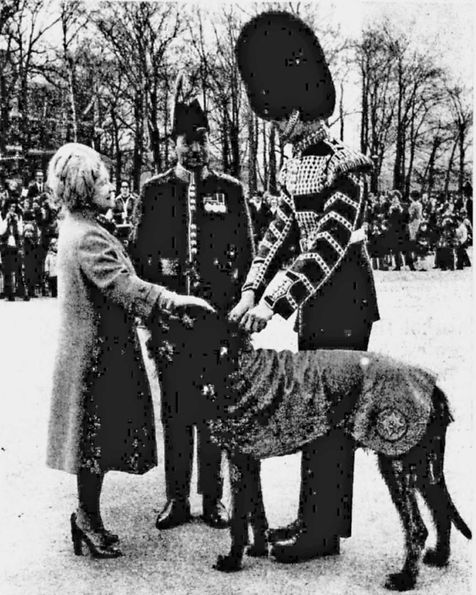

On 5 October 1974 the Provisional IRA targeted 2 pubs in Guildford, specifically because they were popular with British Army personnel stationed at nearby bases. 2 bombs were planted. 4 soldiers and 1 civilian died and 65 people were injured. 2 of the dead were from Pirbright Camp: Guardsman William Forsyth (18) and Guardsman John Hunter (17). Both were recent recruits of the Scots Guards. [The author and his wife had a drink at a Guildford pub that evening. There but for the grace of God…]
We have shown below a photo of the Guards Depot instructors from 1975. And a terrifying group they look too. We have also shown a squad photo from 1977 - impressive.


In 1982 the 1st Battalion Welsh Guards, who were based in Pirbright, fought in the Falklands War. They were a key part of the 5th Infantry Brigade, but tragically they suffered heavy losses during the bombing of the RFA Sir Galahad on 8 June, when 32 Welsh Guards were killed.
Many of the Guards who had been trained at the camp in previous years also fought in the Falklands War, notably the 2nd Battalion, Scots Guards, who had been based in London at the time. This battalion famously captured Mount Tumbledown during 13-14 June, suffering 8 fatalities and 43 wounded. The 1st Battalion Welsh Guards also took part in that battle, suffering 1 fatality.
In 1983 Prince Charles attended the St David’s Day parade at the camp. He was sporting 2 black eyes and a cut nose from a fall from his horse during a hunt a few days earlier.
2 shooting accidents on the nearby ranges resulted in civilian fatalities. In April a lady was shot and died while walking near Chair Hill. In June an 8-year-old schoolgirl at Frimley was struck in the leg by a bullet. The 2 incidents happened on different parts of the ranges, 4 miles apart. The press photo below (which shows members of the jury at the inquest) shows a security warning at the Chair Hill area at the time. Death by misadventure was the verdict of the jury inquest. Security has been significantly beefed up since then with strong fencing. We are not aware of any recent accidents to the public.

The same year the MoD sold off several small pieces of land in Pirbright which they had purchased back in 1877. The land concerned was the various parts of Bullswater Common and nearby areas. Most of these pieces remain undeveloped today and are superb heathland walking areas. Several of the original granite boundary markers can still be seen in situ. We have shown an example of one such marker, right.


We have shown a 1984 photo, left, of the Bayonet Assault Course at the camp.
It looks almost as terrifying as the group of instructors we showed above.
The excellent website, https://theguardsdepot.co.uk/ has more pictures and videos of the camp, including exercises and parades.
Below is a picture of a group of WAACs (Women's Army Auxiliary Corps), complete with mascot from 1988. We have also shown 3 excerpts from the punishment book around this time. Poor conduct was regarded as a serious issue, and usually resulted in extra duties as a punishment. On the left we have shown a brochure for the camp from (at a guess) the 1970s.


1993 – date: The Army Training Centre
In 1993 the Guards Depot at Pirbright closed and Guards training was transferred to Catterick. Pirbright Camp then reopened as the Army Training Centre (ATC). Its primary role since 2002 has been to train all new recruits into the British Army. Currently the induction training lasts 13 weeks.
Over recent years, things had changed in the Army, and it seems that the Army wanted the public to know this. We have shown, below left, a newspaper article from 1996 about a training event at the camp for students. The following year, in 1997, 20 Sikh teenagers spent a week at the camp learning skills such as night navigation, surviving in the field and first aid. We have also shown, below right, an article about an MP visiting the camp from 1998. The same year Prince Charles (now King Charles) toured the camp and specifically met new ethnic minority recruits


In 2005 Kelly Holmes used the camp’s notorious (see section below) assault course during her 'On Camp with Kelly' initiative, which was aimed at junior female middle-distance runners, with a view to helping them to bridge the gap between junior and senior athletics.
As a further sign of the Army’s modernisation, in 2016 Channel 4 were allowed to make a 3-part documentary entitled British Army Girls, showing female recruits at Pirbright. At the time of writing, it was still available and is a good watch! Seeing raw recruits transform into a well-drilled outfit at their passing-out parade is a joy to behold. We have shown below 4 stills from the programmes (with thanks to Channel 4) in the hope that it might encourage some readers to watch the programmes.


The camp has also recently been used as a holding point for soldiers if there is reason to believe emergency conditions may be imminent in London. A recent example is their involvement in the funeral of HRH Queen Elizabeth II.
The Army Training Centre today
There are several reminders of the camp’s past around the camp, although some of these will disappear as room is created for more modern facilities. They are inaccessible to members of the public without security clearance, but we have listed a few below:
The Officer’s Mess. Unsurprisingly, this is a most impressive building, smartly decorated and comfortably furnished within, and backing onto a fine lawn. We have told the story above how this lawn was the site of discussions over the future of Rudolf Hess after his arrival in Britain in 1941.
Within the Officers’ Mess the framed Brigade of Guards Star (shown below) has a very interesting background, as told by the brass plate and narrative, which we have shown separately. The fact that the inscription originally referred to the 3 regiments of the Foot Guards means that it must predate 1900 (the year in which The Irish Guards were formed to become the 4th Guards Regiment). Our apologies for the reflections from the glass frame. There is also a fine fireplace in the mess (shown below).
Unfortunately, the building is scheduled for demolition, which seems a great shame.


The Cinema. The Camp Cinema was built as part of the 1938 extensions forming The Brunswick Camp. It is an impressive building at the western end of the camp. It gave hours of pleasure to the Guards over the years but is currently due to be demolished. We have shown a picture of the cinema in its current sad state, right.
The Railway. We have written about the railway that leads from Brookwood Station and the Bisley NRA camp above. We have written more about it in the Bisley NRA Camp section. It was finally removed from the camp in 1953. The only remnant still to be seen is the old platform, still in good condition, pictured left.

The Guard House. The guard house in a camp was where security and access to the camp was controlled. It also served as a place of detention for miscreants. The old (1938?) Guard House still exists in the camp, although it is now an administration and storage area.
We are lucky to have had the chance to inspect some of the cells in the Pirbright guard house (without finding ourselves being locked in), and they are not a pretty sight. Right is a photo of the outside of the building. Note the bars around the cell windows. Below left is a photo of the inside of a cell (the cell is smaller than it looks in the photo). For good measure we have also shown a photo of the cell door from the outside. Not nice.
Detainees were allowed out for an hour in the morning and an hour in the afternoon for exercise in the yard. Another Guard House on the site had broken glass (recently removed) along the outside walls to discourage any thought of escape.


The large Parade Ground. The largest parade ground in the camp is near the south-west corner. It was built in the 1950s as part of the Elizabeth Barracks and is certainly large! As we have written above it is the still used for practices and rehearsals of some important ceremonies.
The smaller Parade Ground. There is an older, smaller parade ground at the centre of the camp near the Alexander Barracks. We think that it dates back to at least the 1920s. The square used to have sentry boxes along the south side (in pairs) so that guards could practice for guarding Buckingham Palace. Only 1 pair of sentry boxes remains today (pictured below). Each is coloured blue but is in poor repair.

The Assault Course. Towards the western end of the camp is a glade containing the camp’s assault course. In former times, soldiers were formed into teams of 8. As one account puts it: Each was dressed in battle kit and carried a pack weighing between 30 and 35 pounds. To ensure that the weight was correct, the NCOs kindly poured sand into the ammunition pouches. Each man carried a rifle and one poor *** was lumbered with the machine gun, weighing 27 pounds. The official time for the course was 15 minutes per person. The sergeant would make helpful comments like (to a recruit swinging over a trough of filthy water): “Smith, keep your ****** mouth shut or you’ll drink the ****** water.”
Prior to 1993, a Guardsman recruit’s final test was to:
-
First, run 3 miles cross-country with full equipment (35lb pack and a 10lb rifle) in 34 minutes,
-
take a 2-minute break,
-
then tackle the assault course in 22 minutes,
-
take a 2-minute break,
-
then perform an accurate battle-shooting test on one the ranges.
The assault course was recognised as one of the world’s toughest. The author took a quick look at it, then moved quickly on to somewhere else. The assault course is now rarely used, in view of its difficulty. We have shown 3 enticing photos of the course below.


The Brunswick Camp. The Brunswick Camp, rebuilt in 1938, sits at the heart of the camp and holds many memories for many senior Guardsmen. It is set for redesign and renovation over the next few years.
We have shown left an extract from a 1959 plan of the Brunswick Map (referred to as D Lines). The main block of 54 huts is arranged in the original “spiderweb” design, whereby 6 huts are each connected to a central hut. There are 9 central huts, labelled A to J. Some of these central huts remain today, but only a few are still connected to the outer huts of a web.
The cinema which we wrote about above (labelled as “Theatre”) is at the top of the plan and is due for demolition. The tennis courts next to the cinema no longer exist.
We have shown below a photo of one of the huts, together with a view of several of the huts from another angle. We have also shown a photo of the Guards office opposite.


All Saints Church. The camp church lies near the entrance to the camp and is a delight to visit. It has a sense of calmness that is not easy to find in an army camp. Built c1960, it is decorated with some wonderful Guards memorabilia from years gone by. It regularly attracts congregations of 200+ trainee soldiers at Sunday services.
We have shown below photos of:
-
A wooden cross for Major General MB Beckwith-Smith DSO, MC, who joined the Welsh Guards form the Coldstream Guards in 1930. He was taken prisoner at the fall of Singapore and subsequently died in a Japanese PoW camp in 1942. This wooden cross was carved by his fellow PoWs in his memory. It was given to his Regiment by his widow, to be kept permanently in All Saints Church.
-
A wooden cross carved in honour of the 28 officers and 700+ other ranks of the Grenadier Guards who were killed during the battles of the Somme. The village of Saillisel had been completely churned into the ground during the battles, and from the largest mound (once the village church) some suitable timber was found to make this cross. It was erected 20 yards in front of the trench from which the Battalion launched their attack on Lesboeufs in 1916. The ground was recaptured by the Germans in 1918, but, after their retreat later that year, it was found that they had carefully cared for the cross and even repainted it. In 1923, a permanent cross was erected, while the original was erected at Caterham Barracks. A later inspection discovered that the wood was at least 1,000 years old.
Coincidentally, the author worked with an indirect relative of the Commanding Officer who ordered the cross to be made, Lieutenant-Colonel Claude Raul Champion de Crespigny. Claude was born in Wiltshire in 1878, the 5th child of Sir Claude Champion de Crespigny, the fourth Champion de Crespigny baronet. He was educated at Wellington College and joined the Grenadier Guards. In 1908 he was appointed Commander of the troops at Pirbright Camp.
In 1913 he married Violet Sykes in the magnificent Guards Chapel on Birdcage Walk (next to where The Guards Museum is today). He reached the dizzy heights of Brigadier-General. But in 1926 they divorced. Violet had requested a divorce for some time, but Claude had refused to provide any evidence to support the divorce. In the end she wrote a letter to him saying: “I therefore send you the enclosed bill of St Mildred’s Hotel, Westgate-on-sea, from which you will see that I have been staying there recently with a lady. This will no doubt enable you to procure the evidence necessary to take the steps which your position renders desirable.” Claude became the 5th baronet after the death of his father in 1935. He had no children and died in 1941.
-
A “Colour” presented by the future King George VI to the Grenadier Guards in 1919. After the move of the Guards Depot from Caterham to Pirbright in 1960, the Colour came with it.
-
A stone tablet listing Officers killed in 3 battles of the Nine Years’ War (1688 – 1697) in what is now Belgium. It is one of 5 similar tablets on the walls of the church, listing casualties in various battles up to 1855.


The Firing Ranges. The firing ranges at the camp have now been in use for nearly 150 years. The 4 main ranges are in exactly the same positions in which they started back c1880. 1 or 2 shorter ranges have been added over the years. The ranges (and the accompanying Ammunition Centre) are not actually owned by the ATC itself, but by the MoD. Their booking and operation has been outsourced to a 3rd party organisation. The ranges can be booked and used by any part of the MoD (or by an external group) as well, of course, as by the ATC.
The road to Deepcut. At the very western end of the camp are the old Brunswick Road (which led to Deepcut Camp) and a track leading to Deepcut Village. Unsurprisingly both are secured. One of the roads and Deepcut itself was used in the film Kingsman: The Secret Service.
Change is still underway at the camp. For example, part of the old Brunswick Camp area is now set aside for recruits who need care or special attention. And at the time of writing (2026), there was a great deal of renovation and building work being planned or being carried out. This is expected to continue over the next 5 years or so. Much of the renovation work involves refitting existing huts to meet the needs of today’s recruits. For example, huts that housed up to 28 men in the post-WW2 years are being redesigned for 12 people.
In 2024 a Pirbright Military Heritage Trail was constructed around the danger area to the north of the camp. Starting at the railway arch, the trail goes north along Queens Road to Bisley, continues further north to Lightwater, then goes west to the Heatherside residential estate, south to Deepcut and east along the canal back to the railway arch. 13 information boards have been installed along the route. What a wonderful initiative! The author confesses that he has not yet walked this route, although hopes to do so at some point in the future.
We finish this section with a collection of 4 photos of the camp during the years of the Guards Depot. They were provided by Ivan Smith, who also provided 6 of our earlier photos (with thanks to Ivan).


